
Ibrahim of Ifriqya had in 876 erected …
Years: 878 - 878
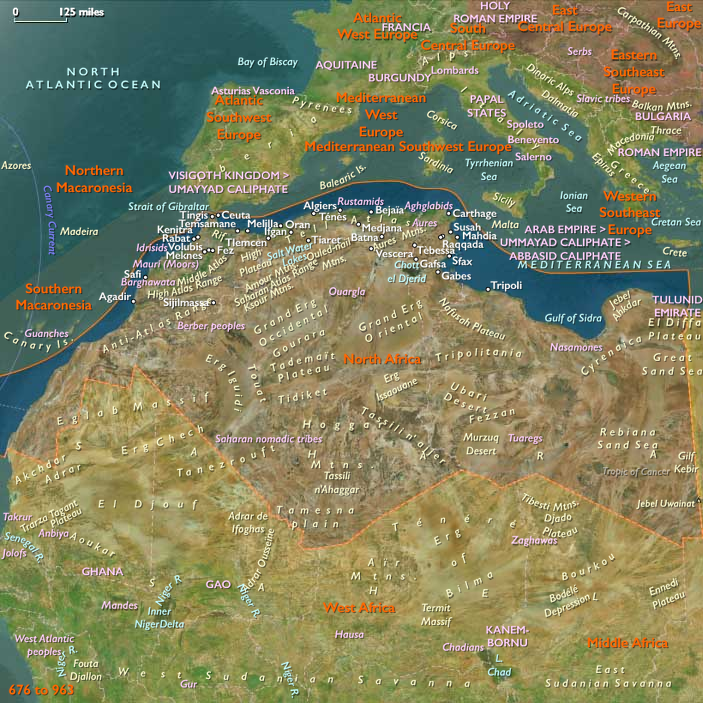
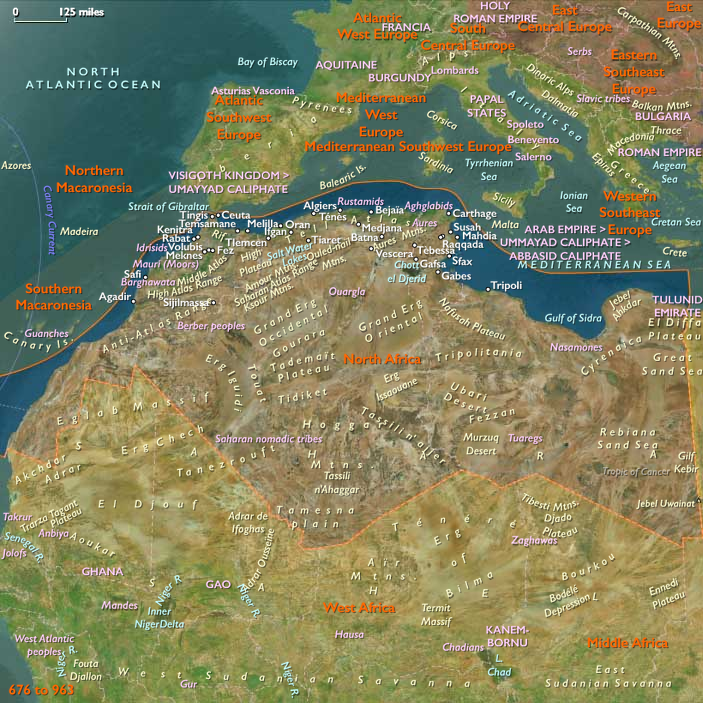
Ibrahim of Ifriqya had in 876 erected a new palace-city, Raqqada ("the Somnolent") just a few miles southwest of Kairouan.
It replaced the nearby palace-city of al-Abbasiya used by previous Aghlabid emirs.
Raqqada was built on a grandiose scale.
According to al-Bakri, its walls were ten kilometers long and encompassed a land area as large as Kairouan itself.
Its skyline is marked by a great tower, called the Abu al-Feth ("Father of Victory").
It has multiple palaces and barracks, influenced primarily by Umayyad designs, with vast gardens, pools and hydraulic systems.
The city is divided into two roughly equal-sized districts, one dedicated to the emir alone, the other a densely packed quarter for his noble retinue, which also contains the facilities for regular urban life—a congregational mosque, souks, public baths, etc.
The separation emphasizes the royal majesty of the Aghlabid Emir and his independence from the aristocracy. (According to al-Bakri, the Fatimid leader, Abdullah al Mahdi, upon entering the conquered city in 909, was astonished at the Aghlabid constructions, and singled out the waterworks of Tunis and the palaces of Raqqada as two things in the Maghreb which had no parallel back in the East.)
At the beginning of his rule, Ibrahim II had been well-regarded as a just and enlightened ruler, but this eventually gives way to a more tyrannical and gruesome reputation.
A centralizing ruler, Ibrahim mistrusts the old Arab high aristocracy of Ifriqiya, which had often been a thorn in the side of prior Aghlabid emirs.
He holds open court in Raqqada every week, after Friday prayers, when the common poor people of Ifriqiya are invited to present petitions directly to the emir.
Identifying himself with the people, Ibrahim treats any report of mistreatment of a commoner by a noble as a case of lese-majesty, and hands out severe penalties to the offender, even members of his own family.
An absolutist monarch by disposition, ascetic without distractions, Ibrahim seems to have kept counsel with himself, largely immune from the influence of courtiers and bureaucrats.
Only a few names appear near the top—his learned and martial son, Abu al-Abbas Abdallah, his chamberlain (hajib) Muhammad ibn Korhob and his successor Hassan ibn Nakib, and two ruthless slave-generals known as Ma'imun and Rashid.
Above everybody is his mother, whom the chronicles deferentially refer to merely as the Sayyida ("Supreme Lady") and characterize as the only person whose opinion Ibrahim respected or who had any influence upon him (although he was not above embarrassing her—in a public case over a six hundred dinar debt she owed two merchants, he judged against her and forced her to pay up).
Ibrahim seeks to undermine the semiautonomous Arab regiments (junds) which are the basis of the aristocracy's power, by supplanting them with loyal black African slave-soldiers ("Abid" or "Sudan") at the core of the Ifriqiyan army.
At the inauguration of Raqqada in 878, Ibrahim has the palace guard of his predecessor massacred at the tower of Abu al-Feth in order to make way for his own new Sudanese guard.
Ibrahim expands the Sudanese regiments (later supplemented by white European Slavs or Saqaliba) to as much as ten thousand, much to the chagrin of the Arab jund commanders.
The Arab nobility resents not only being eclipsed, but also the hefty taxes and requisitions imposed by Ibrahim to maintain such a large standing army.
Locations
People
Groups
- Arab people
- Islam
- Ifriqiya, Aghlabid Emirate of
- Abbasid Caliphate (Samarra)
- Roman Empire, Eastern: Macedonian dynasty
Topics
Commodoties
Subjects
- Commerce
- Architecture
- Engineering
- Labor and Service
- Conflict
- Mayhem
- Faith
- Government
- Custom and Law
- Technology
Regions
Subregions
Related Events
Showing 1 events out of 1 total
Years: 878 - 878
Locations
People
Groups
- Arab people
- Islam
- Ifriqiya, Aghlabid Emirate of
- Abbasid Caliphate (Samarra)
- Roman Empire, Eastern: Macedonian dynasty
Topics
Commodoties
Subjects
- Commerce
- Architecture
- Engineering
- Labor and Service
- Conflict
- Mayhem
- Faith
- Government
- Custom and Law
- Technology
Regions
Subregions