
Ibn Fadlan also records his encounters with …
Years: 922 - 922
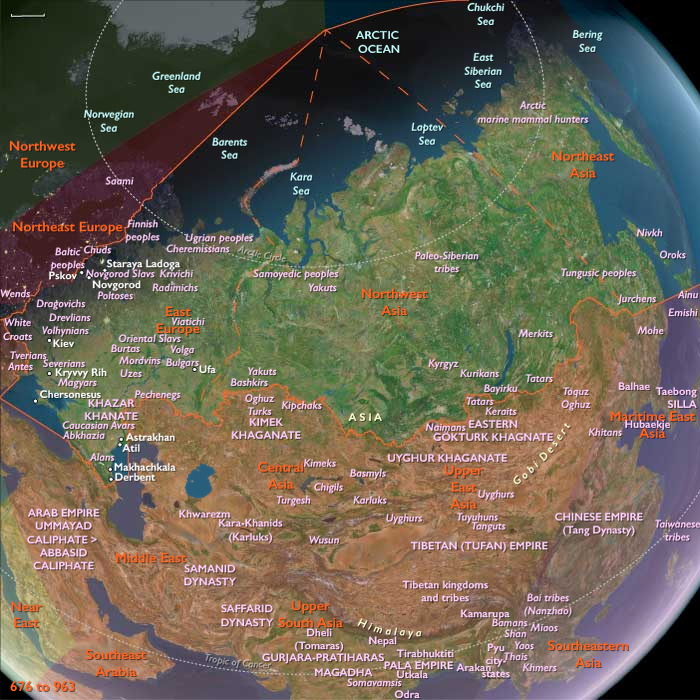
Ibn Fadlan also records his encounters with the Oghuz on the east coast of the Caspian, the Pechenegs on the Ural River, and the Bashkirs in what is now central Russia.
All told, the delegation covers some four thousand kilometers kilometers (twenty-five hundred miles).
When the embassy arrives to the Volga Bulgars’ capital on May 12, 922 ,Ibn Fadlan reads aloud a letter from the Caliph to the Bulgar Khan, and presents him with gifts from the caliphate.
The meeting with the Bulgar ruler, “a man of striking appearance and dignity, stout and broad, who sounded as though he were speaking from inside a large barrel,” left Ibn Fadlan “frightened and distressed,” since he was blamed for not bringing with him the promised money from the caliph to build a fortress as defense against enemies of the Bulgars.
A substantial portion of Ibn Fadlan's account is dedicated to the description of a people he calls the Rūs or Rūsiyyah.
Most scholars identify them with the Rus' or Varangians, which would make Ibn Fadlan's account one of the earliest portrayals of Vikings.
The Rūs appear as traders who set up shop on the river banks nearby the Bolğar camp.
They are described as having bodies tall as (date) palm-trees, with blond hair and ruddy skin.
They are tattooed from "fingernails to neck" with dark blue or dark green "tree patterns" and other "figures" and that all men are armed with an ax, sword and long knife.
Ibn Fadlan describes the Rus as "perfect physical specimens" and the hygiene of the Rūsiyyah as disgusting (while also noting with some astonishment that they comb their hair every day) and considers them vulgar and unsophisticated.
In that, his account contrasts with that of the Persian traveler Ibn Rustah, whose impressions of the Rus were more favorable.
He also describes in great detail the funeral of one of their chieftains (a ship burial involving human sacrifice).
Some scholars believe that it took place in the modern Balymer complex.
Locations
People
Groups
- Jews
- Christianity, Chalcedonian
- Oghuz Turks
- Islam
- Volga Bulgaria, or Volga-Kama Bulgaria
- Varangians
- Khazar Khaganate
- Pechenegs, or Patzinaks
- Bashkirs
- Rus' people
- Kievan Rus', or Kiev, Great Principality of
- Abbasid Caliphate (Baghdad)
Topics
Commodoties
Subjects
- Commerce
- Symbols
- Writing
- Watercraft
- Labor and Service
- Decorative arts
- Conflict
- Exploration
- Faith
- Government
- Custom and Law
- Technology
Regions
Subregions

Years: 922 - 922
Locations
People
Groups
- Jews
- Christianity, Chalcedonian
- Oghuz Turks
- Islam
- Volga Bulgaria, or Volga-Kama Bulgaria
- Varangians
- Khazar Khaganate
- Pechenegs, or Patzinaks
- Bashkirs
- Rus' people
- Kievan Rus', or Kiev, Great Principality of
- Abbasid Caliphate (Baghdad)
Topics
Commodoties
Subjects
- Commerce
- Symbols
- Writing
- Watercraft
- Labor and Service
- Decorative arts
- Conflict
- Exploration
- Faith
- Government
- Custom and Law
- Technology
Regions
Subregions