The Black Death, beginning in 1347, spreads …
Years: 1336 - 1347
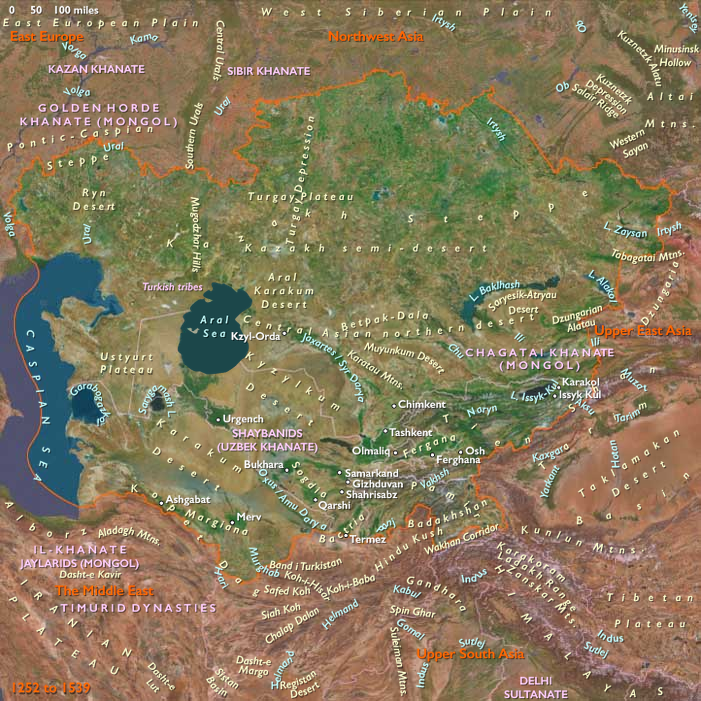
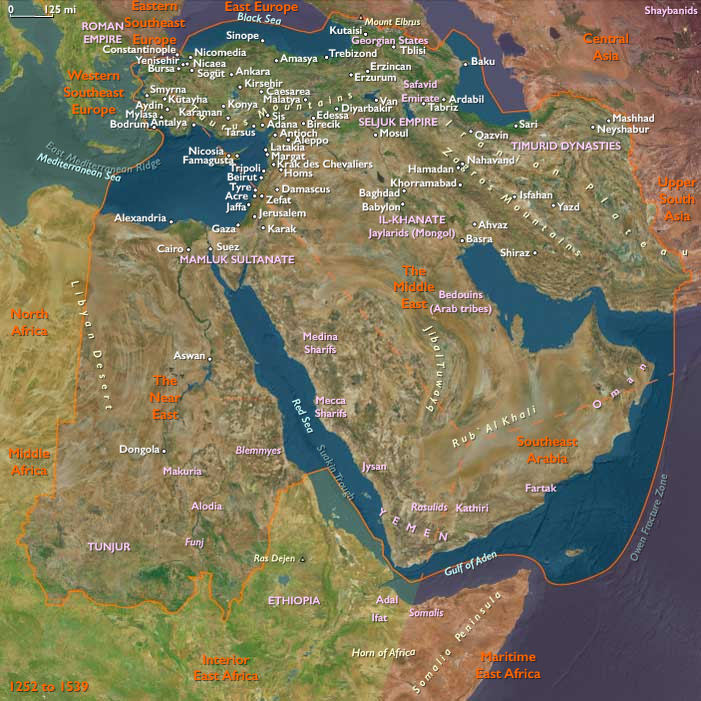
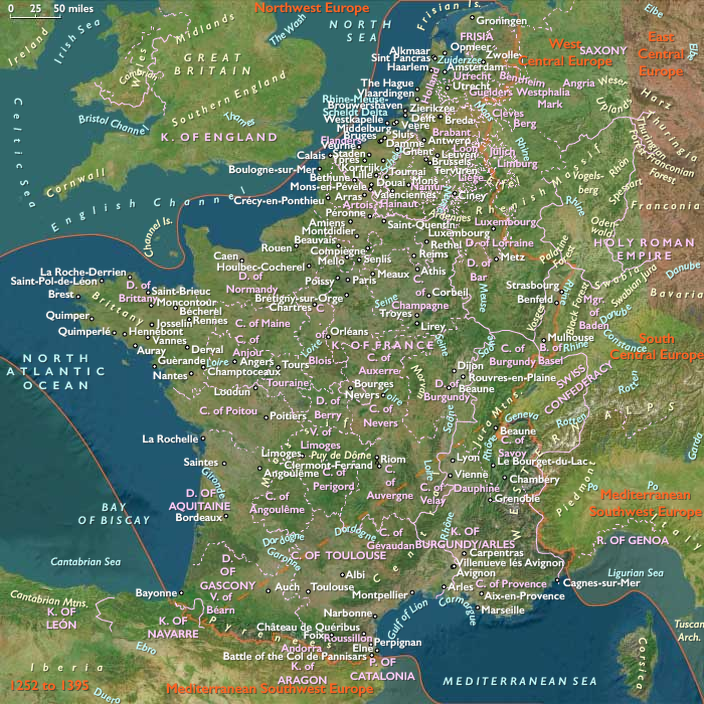
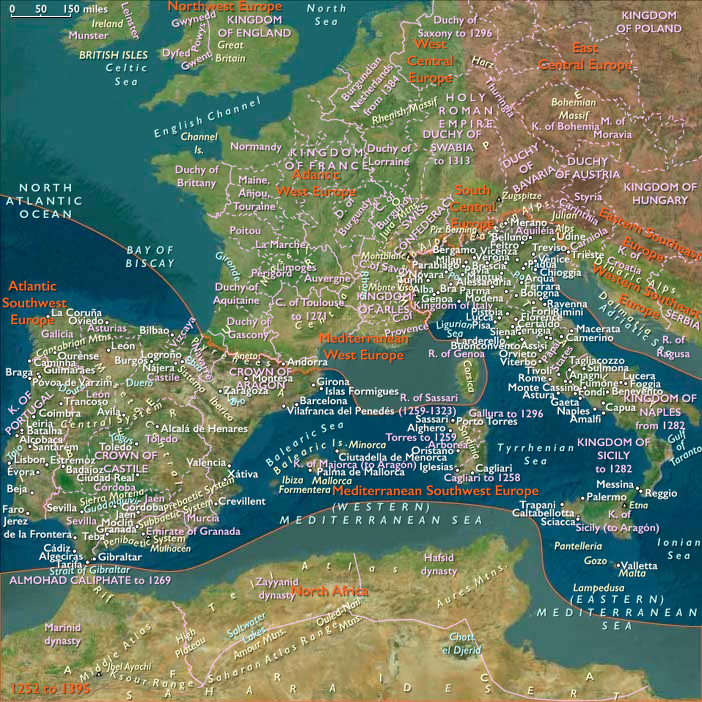
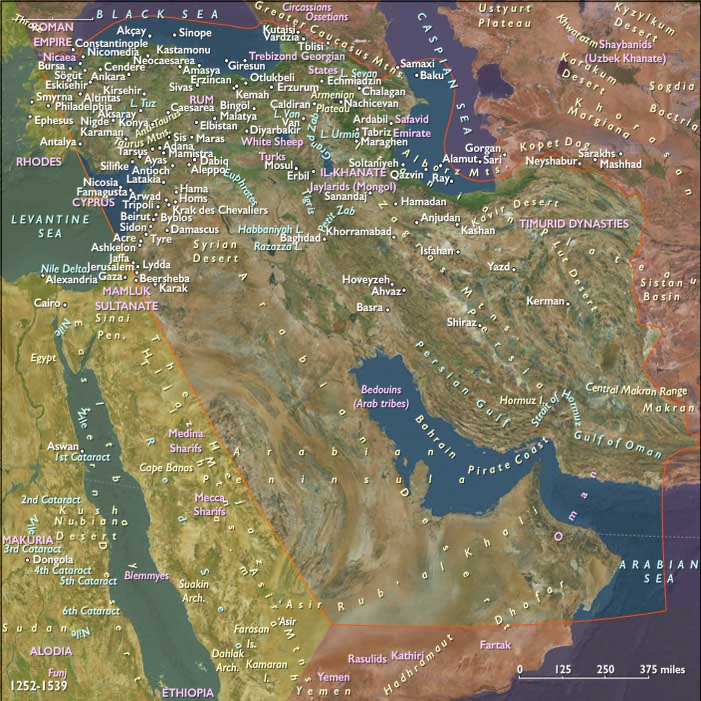
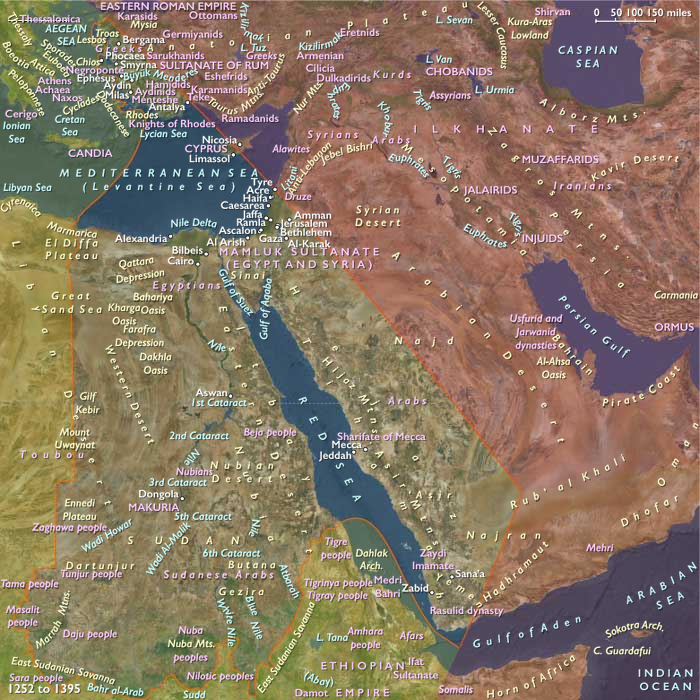
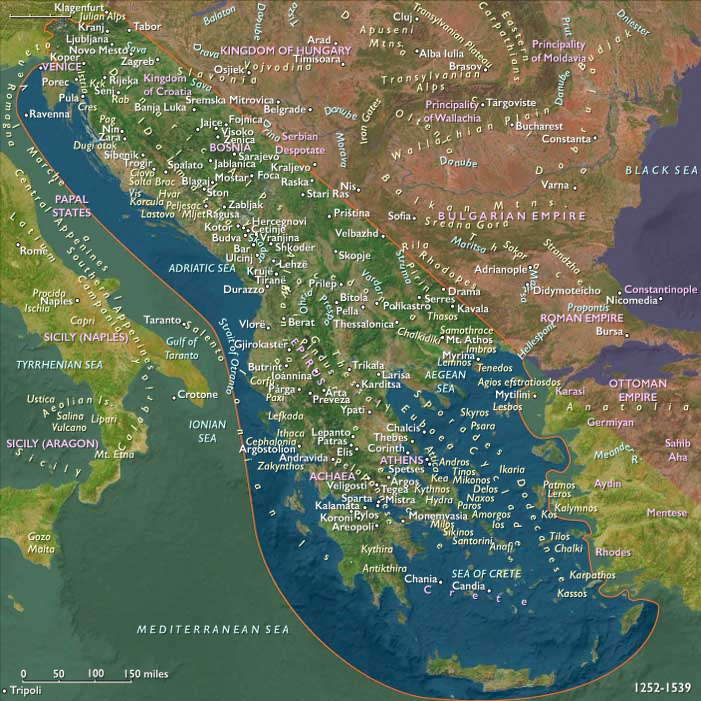
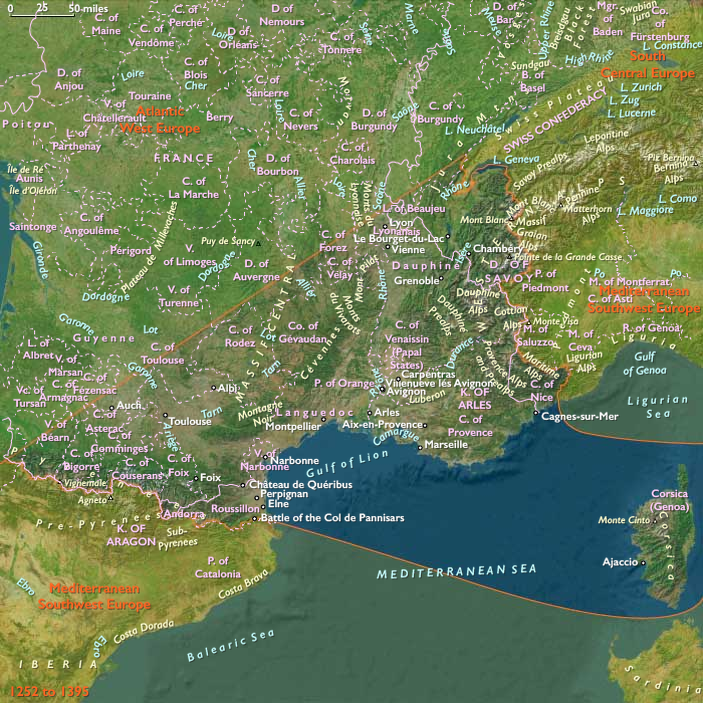
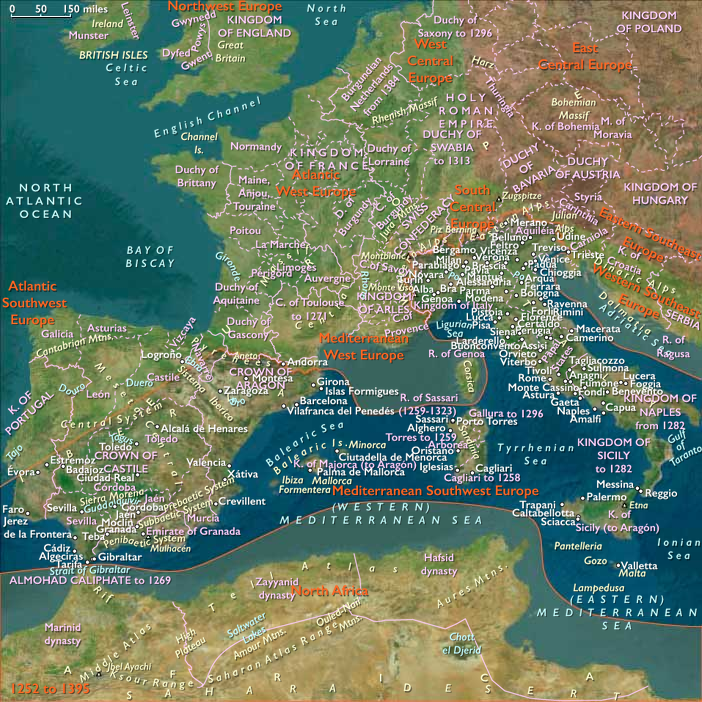
The Black Death, beginning in 1347, spreads rapidly from inner Asia along the major European sea and land trade routes to eastern Thrace, Anatolia, the Near East, and Egypt, as well as to Provence, Sicily, Sardinia, and Corsica.
The plague in 1347 alone kills an estimated twenty-five percent to fifty percent of the populations in these regions.
Topics
Subjects
Regions
Subregions
Related Events
Filter results
Showing 10 events out of 44539 total
Ibn Battuta continues his explorations of the Islamic world, journeying through North Africa, the Near and Middle East, East Africa, Central Asia, India, Southeast Asia, and possibly China.
Go-Daigo endeavors in the swell of victory to restore imperial authority and tenth-century Confucian practices.
This period of reform, known as the Kenmu Restoration (1333-36), aims at strengthening the position of the emperor and reasserting the primacy of the court nobles over the bushi.
The reality, however, is that the forces who had arisen against Kamakura had been set on defeating the Hōjō, not on supporting the emperor.
Ashikaga Takauji finally sides with the Northern Court in a civil war against the Southern Court represented by Go-Daigo. The long War Between the Courts lasts from 1336 to 1392.
Early in the conflict, Go-Daigo is driven from Kyoto, and the Northern Court contender is installed by Ashikaga, who becomes the new shogun.
The ensuing period of Ashikaga rule (1336-1573) is called Muromachi for the district in which its headquarters are in Kyoto after 1378.
What distinguishes the Ashikaga bakufu from that of Kamakura is that, whereas Kamakura had existed in equilibrium with the Kyoto court, Ashikaga takes over the remnants of the imperial government.
Nevertheless, the Ashikaga bakufu is not as strong as the Kamakura had been and is greatly preoccupied by the civil war.
Not until the rule of Ashikaga Yoshimitsu (as third shogun, 1368-94, and chancellor, 1394-1408) does a semblance of order emerge.
The deposed Japanese emperor Go-Daigo, driven from Kyoto, denounces both the shogun and the puppet emperor and establishes a rival imperial Southern Court at Mount Yoshino, inaugurating a period called Nanbokucho ("north and south dynasties").
Buddhist monk Yoshida Kenko writes “Essays in Idleness” around 1340 in the classical Japanese literary style.
Kenkō was probably born in 1283, the son of an administration official.
His original name was Urabe Kaneyoshi.
He had become an officer of guards at the Imperial palace, later retired from public life, changed his name to Yoshida Kenkō, and became a Buddhist monk and hermit.
The reasons for this are unknown, but it has been conjectured that either his unhappy love for the daughter of the prefect of Iga Province or his mourning over the death of Emperor Go-Daigo caused his transformation.
He also writes poetry and enters some poetry contests at the imperial court (his participation in 1335 and 1344 is documented), but Kenkō's enduring fame is based on Tsurezuregusa, his collection of two hundred and forty-three short essays, published posthumously.
Traditionally translated as "Essays in Idleness," a more accurate translation would be "Notes from Leisure Hours" or "Leisure Hour Notes."
Themes of the essays include the beauty of nature, the transience of life, traditions, friendship, and other abstract concepts.
The work is written in the zuihitsu ("follow-the-brush") style, a type of stream-of-consciousness writing that allows the writer's brush to skip from one topic to the next, led only by the direction of thoughts.
Some are brief remarks of only a sentence or two; others recount a story over a few pages, often with discursive personal commentary added.
The Tsurezuregusa will become popular in the fifteenth century and from the seventeenth century onward will be considered a classic.
It is part of the modern Japanese high school curriculum, as well in some International Baccalaureate Diploma Program schools.
East Europe (1336–1347 CE): Muscovite Strengthening and Shifts in Mongol Influence
Political and Military Developments
Golden Horde Fragmentation and Local Autonomy
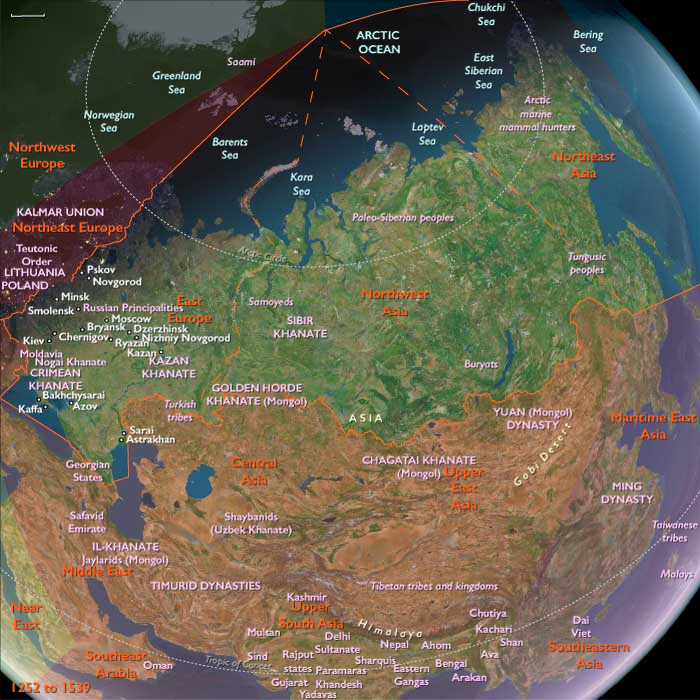
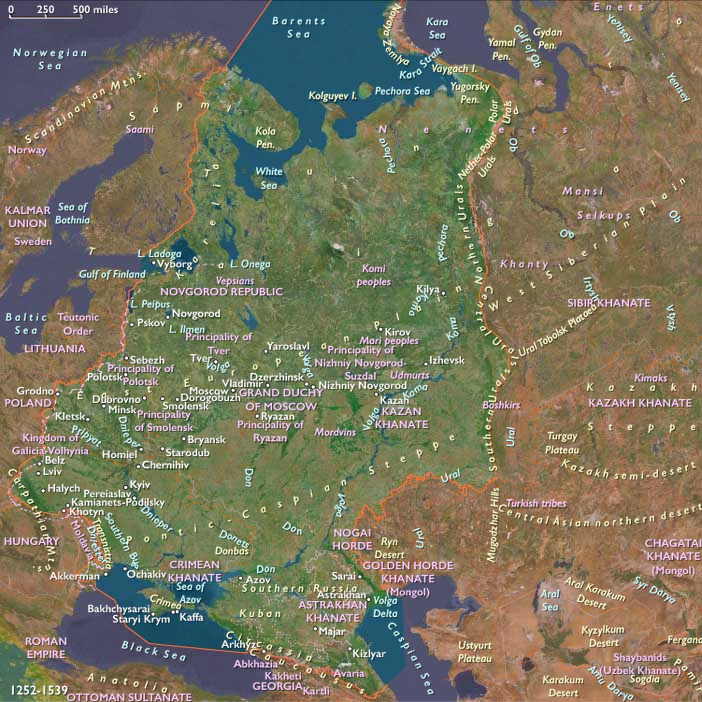
Between 1336 and 1347 CE, increasing fragmentation within the Golden Horde allowed local East European principalities, particularly Moscow, greater political maneuvering and autonomy. Regional dynamics shifted notably as Mongol authority waned incrementally.
Expansion and Centralization of Muscovite Power
Moscow actively expanded its territorial control and centralized political authority, capitalizing on weakening Mongol oversight. This period marked substantial advancements in Muscovite regional influence, governance consolidation, and internal stability.
Diverse Ethnic Engagements
Ethnic communities including the Mari, Mordvins, Udmurts, Komi, and Vepsians continued deepening their integration into Muscovite administration and society, further enriching regional demographic and cultural complexity.
Economic and Technological Developments
Increasing Local Economic Vitality
Although Eurasian trade remained important, regional economies increasingly sought autonomy. Muscovy, Tver, and Novgorod expanded local markets and strengthened internal trade, supporting continued urban and regional economic growth.
Enhanced Military and Technological Capabilities
Muscovite and regional forces refined military tactics, fortification technologies, and siege capabilities, significantly enhancing their defensive and offensive potential. These advancements were crucial as Mongol control weakened.
Cultural and Artistic Developments
Continued Cultural Fusion and Innovation
Artistic traditions flourished through further blending of Mongol, Rus', and local ethnic influences, creating distinct and innovative styles in architecture, ornamentation, and iconography.
Robust Literary and Intellectual Efforts
Chroniclers and intellectuals remained active in documenting historical, religious, and cultural narratives, reinforcing Rus' heritage and intellectual traditions amidst changing political dynamics.
Settlement Patterns and Urban Development
Urban Prosperity and Expansion
Moscow, along with other significant cities, saw continued growth, reflecting enhanced governance, economic prosperity, and demographic stability. Infrastructure improvements supported expanding populations and economic activities.
Further Fortification and Defensive Strategies
Enhanced fortification efforts were implemented, focusing on strategic defense and urban security amidst shifting regional power balances and potential external threats.
Social and Religious Developments
Complex Social Structures and Ethnic Inclusion
Society became increasingly complex, with greater integration and representation of diverse ethnic groups in governance and social hierarchies. Aristocratic and administrative structures adapted to accommodate these diverse communities.
Orthodox Church as Cultural Anchor
The Orthodox Church maintained and strengthened its central societal role, providing continuity, education, and moral guidance during this dynamic period. Its cultural influence persisted as a stabilizing factor.
Long-Term Consequences and Historical Significance
The era from 1336 to 1347 CE marked significant progress in Muscovite centralization and regional autonomy, driven by Mongol fragmentation. The integration of diverse ethnic groups further enriched regional society, laying essential foundations for future state consolidation and cultural identity.
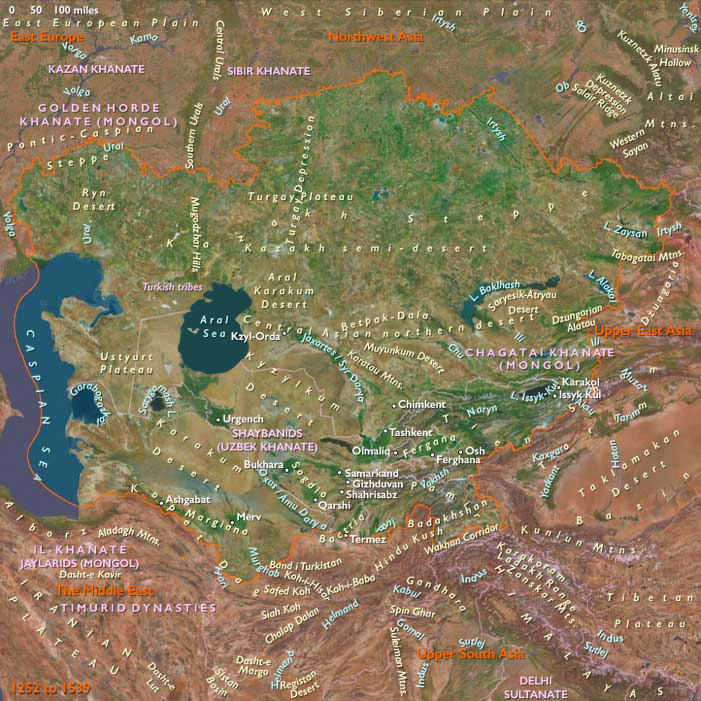
The Golden Horde is largely Turkified and Islamized under Öz Beg Khan, a convert to Islam who reigns from 1313 to 1341.
Under Öz Beg Khan and his successor Janibeg (1342–1357), Islam, which among some of the Turks in Eurasia has deep roots going back into pre-Mongol times, gains general acceptance, though its adherents remain tolerant of other beliefs.
In order to successfully expand Islam, the Mongols build a mosque and other "elaborate places" requiring baths—an important element of Muslim culture.
Sarai attracts merchants from other countries.
The slave trade flourishes due to strengthening ties with the Mamluk Sultanate.
Growth of wealth and increasing demand for products typically produce population growth, and so it is with Sarai.
Housing in the region increases, transforming the capital into the center of a large Muslim Sultanate.
Jani Beg, after putting two of his brothers to death, crowns himself in Saray-Jük.
He is known to have actively interfered in the affairs of Russian principalities and of Lithuania.
The Grand Princes of Moscow, Simeon Gordiy, and his successor Ivan II, will be under constant political and military pressure from Jani Beg.
Northeast Europe (1336–1347 CE): Territorial Shifts, Crusader Authority, and Regional Dynamics
Introduction
Between 1336 and 1347 CE, Northeast Europe experienced pivotal territorial realignments, significant crusader influence, and evolving political dynamics. The defining event of this era was the transfer of the Duchy of Estonia from the direct control of the Kingdom of Denmark to the Teutonic Order, reshaping regional geopolitics and influencing future historical trajectories.
Sale of the Duchy of Estonia (1346)
In 1346, the Kingdom of Denmark, under King Valdemar IV, sold its territory of Danish Estonia—also known as the Duchy of Estonia—to the Teutonic Order. This transaction occurred due to Denmark’s pressing financial difficulties and challenges maintaining distant territories. The sale effectively ended Danish dominion (dominium directum) over northern Estonia, which had been held since 1219, transferring authority to the crusader state known as the Ordensstaat.
This territorial shift reinforced the strategic position of the Teutonic Knights, allowing them greater regional consolidation and control. The Teutonic Order integrated the newly acquired lands into their expansive territorial holdings, administratively aligning Estonia closely with other crusader states around the eastern Baltic.
Teutonic Order’s Consolidation of Power
Following this acquisition, the Teutonic Knights strengthened their governance structures in the region, fortifying key locations such as Reval (Tallinn), further developing urban settlements, and promoting economic growth. These administrative and military enhancements solidified the Order’s authority across the Baltic coast, reaffirming their dominance in the face of regional rivalries.
Stability and Governance in the Livonian Confederation
The Livonian Confederation, administered from the important trading city of Riga, maintained internal stability amidst these broader geopolitical changes. The Confederation continued strategic diplomatic engagement, bolstered defensive fortifications, and nurtured commercial networks that linked the region economically with wider European markets.
Swedish Influence and Consolidation in Finland
Concurrently, Sweden reinforced its governance over southern Finland, strengthening ecclesiastical establishments, fortifications, and administrative oversight. These efforts consolidated Finnish territories politically and culturally within the broader Swedish realm, enhancing Sweden’s regional authority despite shifting dynamics elsewhere.
Economic Development and Urban Prosperity
Urban centers such as Reval (Tallinn), now securely under the Teutonic Order, along with Riga, Visby on Gotland, and Königsberg, experienced considerable economic growth. Expanding maritime trade and strengthened economic ties significantly boosted regional prosperity, enhancing stability despite changing territorial controls.
Ecclesiastical Institutions and Cultural Continuity
Ecclesiastical institutions, particularly the influential Teutonic Order and regional bishoprics, played essential roles in governance, education, and cultural cohesion. Latin Christianity continued to exert considerable influence, guiding social policies, education, and administrative practices, reinforcing regional stability and cultural identity.
Rising Geopolitical Complexity
This territorial shift heightened the region’s geopolitical complexity. The expansion of the Teutonic Order’s territorial control contributed to ongoing diplomatic realignments, fostering intensified interactions and rivalries among neighboring states, including Sweden, Lithuania, and other regional powers.
Legacy of the Era
The era from 1336 to 1347 CE significantly reshaped Northeast Europe, marked chiefly by the critical transfer of the Duchy of Estonia to the Teutonic Order. This event, combined with strengthened Swedish influence in Finland and ongoing economic vitality, fundamentally redefined regional political boundaries and alliances, leaving an enduring impact on Northeast Europe's historical landscape.

Birgittais, today the most celebrated saint of Sweden, is the daughter of the knight Birger Persson of the family of Finsta, governor and lawspeaker of Uppland, and one of the richest landowners of the country, and his wife, a member of the so-called Lawspeaker branch of the Folkunga family.
Through her mother, Ingeborg, Birgittais is related to the era's Swedish kings.
She was born in June 1303; there is no record of the precise date.
She had married, at the age of fourteen in 1316, Ulf Gudmarsson of the family of Ulvåsa, Lord of Närke, to whom she bore eight children, four daughters and four sons.
Six survived infancy, which is rare at this time.
One daughter is now honored as St. Catherine of Sweden.
Bridget becomes known for her works of charity, particularly toward Östergötland's unwed mothers and their children.
When she is in her early thirties, she is summoned to be lady-in-waiting to the new Queen of Sweden, Blanche of Namur.
She and her husband go on pilgrimage in 1341 to Santiago de Compostela.
Ulf dies shortly after their return in 1344 at the Cistercian Alvastra Abbey in Östergötland
After this loss, Birgitta becomes a member of the Third Order of St. Francis and devotes herself wholly to a life of prayer and caring for the poor and the sick.
It is about this time that she develops the idea of establishing the religious community which is to become the Order of the Most Holy Savior, or the Brigittines, whose principal house at Vadstena will later be richly endowed by King Magnus IV of Sweden and his queen.
One distinctive feature of the pre-Reformation houses of the Order is that they are double monasteries, with both men and women forming a joint community, though with separate cloisters.
They are to live in poor convents and to give all surplus income to the poor.
However, they are allowed to have as many books as they please.
The St. George’s Night Uprising denotes a series of unsuccessful rebellions in 1343-1345 by the indigenous Estonian-speaking population in the Duchy of Estonia, the Bishopric of Ösel-Wiek, and the insular territories of the State of the Teutonic Order to rid themselves of the Danish and German rulers and landlords, who had conquered the country in the thirteenth century during the Livonian crusade, and to eradicate the non-indigenous Christian religion.