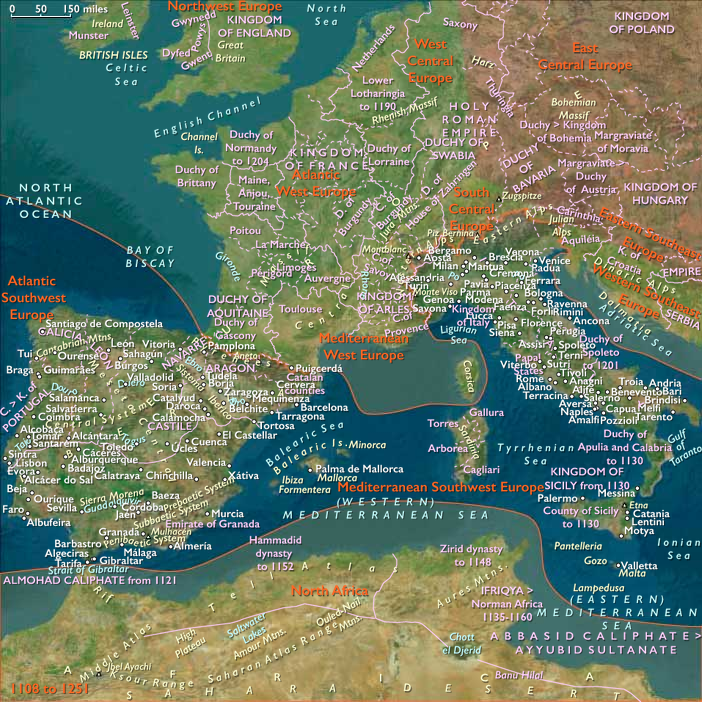
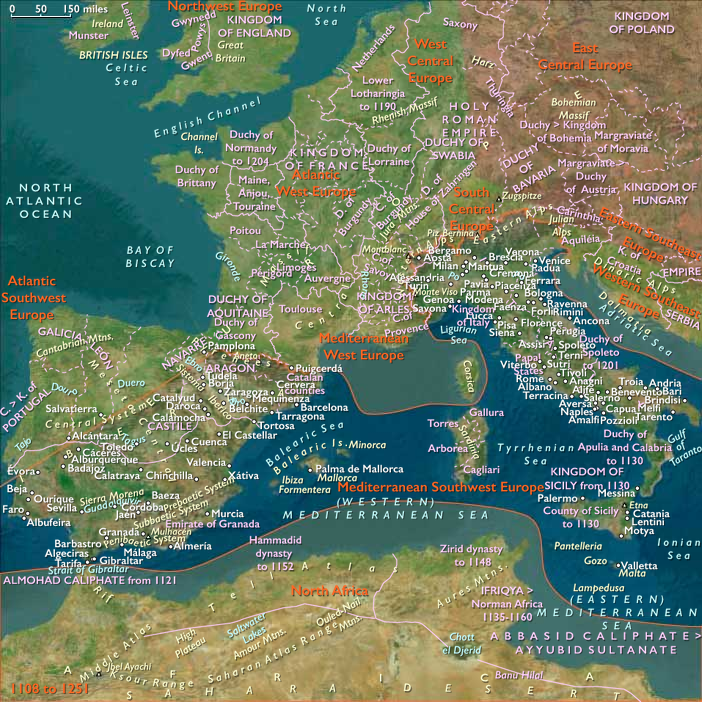
Ibiza, together with the islands of Formentera …
Years: 1110 - 1110
April
Ibiza, together with the islands of Formentera and Menorca, is invaded by King Sigurd Magnusson of Norway in the spring of 1110 on his crusade to Jerusalem.
The king had previously conquered the cities of Sintra, Lisboa and Alcácer do Sal and given them over to Christian rulers, in an effort to weaken the Muslim grip on the Iberian peninsula.
King Sigurd continues to Sicily where he visits is Norman ruler, king Roger II.
Locations
People
Groups
- Muslims, Sunni
- Majorca, Muslim statelet, or taifa, of
- Norway, independent Kingdom of
- Christians, Roman Catholic
- Sicily, County of
- Jerusalem, Latin Kingdom of
Topics
Commodoties
Subjects
Regions
Subregions
Related Events
Filter results
Showing 10 events out of 49530 total
Borivoj II returns from exile with the support of Prince Boleslaw III but is defeated and imprisoned by Vladislav in 1110.
He exiles him into the custody of his ally, Holy Roman Emperor Henry V.
Crusaders under Tancred reoccupy the Muslim stronghold at Qal'at al-His, taking it from its Kurdish garrison in 1110 and making it part of a chain of fortresses protecting approaches to their county of Tripoli.
The fortress, which will become known as the “Krak des Chevaliers”, will in 1144 be given by Raymond II, count of Tripoli, to the Hospitallers, contemporaries of the Knights Templar, who will rebuild it and expand it into the largest Crusader fortress in the Holy Land.
King Edward I of England, who will see the fortress while on the Ninth Crusade in 1272, will use it as an example for his own castles in England and Wales.
Owned today by the Syrian government, it is one of the most important preserved medieval military architectures in the world.
Bertrand, Raymond IV's illegitimate son, claims two-thirds of Tripoli for himself, with the other third falling to the Genoans.
Thus Tripoli becomes a crusader state; the rest of the Mediterranean coast had already fallen to the crusaders or will pass to them within the next few years, with the capture of Sidon in 1111 and Tyre in 1124.
Baldwin had become King of Jerusalem when his brother Godfrey of Bouillon died in 1100.
The County of Edessa had passed to his cousin Baldwin of Bourcq.
He was joined by Joscelin of Courtenay, who became lord of the fortress of Turbessel on the Euphrates, an important outpost against the Seljuq Turks.
The Frankish lords had formed a good rapport with their Armenian subjects, and there were frequent intermarriages; the first three counts had all married Armenians.
Count Baldwin's wife had died in Maraş in 1097, and after he succeeded to Edessa he had married Arda, a granddaughter of the Armenian Roupenid chief Constantine.
Baldwin of Bourcq had married Morphia, a daughter of Gabriel of Melitene, and Joscelin of Courtenay had married a daughter of Constantine.
Baldwin of Bourcq had quickly become involved in the affairs of northern Syria and Asia Minor.
He had helped secure the ransom of Bohemond I of Antioch from the Danishmends in 1103, and, with Antioch, had attacked the Empire in Cilicia in 1104.
Later in 1104, Edessa had been attacked by Mosul, and both Baldwin and Joscelin had been taken prisoner when they were defeated at the Battle of Harran.
Bohemond's cousin Tancred had become regent in Edessa (although Richard of Salerno actually governed the territory), until Baldwin and Joscelin were ransomed in 1108.
Baldwin had had to fight to regain control of the city; Tancred had eventually been defeated, though Baldwin had to ally with some of the local Muslim rulers.
Mawdud ibn Altuntash is an officer of Mehmed I of Great Seljuk, who had sent him to reconquer Mosul from the rebel atabeg Jawali.
After his conquest of the city, Mehmed had entrusted him with several military attempts to push back the Crusaders from the nearby Principality of Antioch and county of Edessa.
The first attempt is launched in 1110; having joined forces with Ilghazi, the emir of Mardin, and of Soqman al Qutbi, emir of Khilat, they begin by besieging Edessa from April of that year, but Baldwin I of Jerusalem intervenes, and forces Mawdud to retreat.
All Edessa’s lands east of the Euphrates are lost to Mawdud of Mosul in 1110.
This is not followed by an assault on Edessa itself, as the Muslim rulers are more concerned with consolidating their own power.

Kilij Arslan, Sultan of Rüm, had conquered Mosul in 1107, but had been defeated in the Battle of the Khabur River by Emir Jawali al-Saqawu for Muhammad I of Great Seljuq, supported by the Artuqids and Radwan of Aleppo, at the Battle of Mosul.
He had drowned in the river while retreating from Mosul.
His son, Malik Shah, kept prisoner in Isfahan, returns to Anatolia in 1100 to assume his father's succession in Konya.
The Investiture Controversy, also known as the lay investiture controversy, the most significant conflict between secular and religious powers in medieval Europe, had begun as a dispute in the eleventh century between Holy Roman Emperor Henry IV and Pope Gregory VII concerning who would control appointments of church officials (investiture).
The controversy, undercutting the Imperial power established by the Salian emperors, would eventually lead to nearly fifty years of civil war in Germany, the triumph of the great dukes and abbots, and the disintegration of the Holy Roman Empire, a condition from which it would not recover until German unification in the nineteenth century.
At the time of Henry IV's death in 1106, Henry I of England and the Gregorian Papacy had also been embroiled in a controversy over investiture, and its solution would provide a model for the eventual solution of the issue in the Empire.
The reign of Henry V, who is also unwilling to give up investiture, coincides with the final phase of the great controversy.
The papal party who had supported Henry in his resistance to his father hoped he would assent to the papal decrees, which had been renewed by Paschal II at the synod of Guastalla in 1106.
The king, however, continued to invest the bishops, but wished the pope to hold a council in Germany to settle the question.
After some hesitation, Paschal preferred France to Germany, and, after holding a council at Troyes, renewed his prohibition of lay investiture.
The matter has rested until 1110, when, negotiations between king and pope having failed, Paschal renews his decrees and Henry invades Italy with a large army.
The strength of his forces helps him to secure general recognition in Lombardy.
Almoravid forces had overrun the Kingdom of Valencia after the death of its leader, El Cid, and by 1100 had managed to cross the Ebro into Barbastro, which brought Aragon into direct contact with them.
The Banu Hud, an Arab dynasty that has ruled the taifa, or statelet, of Zaragoza from 1039, has stubbornly resisted the Almoravids, leading the smaller Muslim taifas in their resistance until their defeat in May 1110.
Banu Hud sultan Abd-al-Malik Imad ad-Dawla, forced to abandon his capital, allies himself with the Christian Aragonese under Alfonso the Battler and from this time, the Muslims of Zaragoza will become military regulars within the Aragonese forces.
The sculptor Wiligelmo da Modena, the founder of the Lombard Romanesque style, executes the richly decorated stonework of the facade of Modena Cathedral, consecrated only six years after its first stone was laid in 1099.
The “Genesis” marble reliefs for the west facade include portraits of prophets and patriarchs, and most of all the Biblical Stories, a masterpiece of Romanesque sculpture.
The scholars have pointed out the splendid achievements in the creation of Adam and Eve, the original sin and the story of Noah.
Wiligelmo imparts to the strongly bovine figures of Adam and Eve the quality of heaviness and earthiness that characterize the sturdy Lombard Romanesque style.
The first sculptor in Italy who begins again to produce large size sculptures, he signs his work.
Henry I’s Response to the French-Angevin Threat and the Strengthening of Norman Rule (c. 1110 CE)
Faced with increasing Capetian and Angevin opposition, Henry I of England responded with a strategic consolidation of power in Normandy. Recognizing the vulnerability of his rule, he expanded his network of loyal supporters and tightened control over the Norman baronage, ensuring that rebellion within the duchy would not threaten his broader ambitions.
Consolidating Norman Authority: Arrests and Redistribution of Lands
Henry I took decisive action against Norman barons he deemed unreliable, employing a combination of:
- Arrests and dispossessions – Barons suspected of disloyalty or collusion with Louis VI were stripped of their lands and power.
- Bribery and land grants – Confiscated estates were redistributed to more dependable nobles, particularly in Maine, where Henry sought to secure the allegiance of key lords in this contested region.
This strategy effectively weakened opposition within Normandy, strengthening Henry’s grip on the duchy while simultaneously undermining the influence of his French and Angevin rivals.
The Pursuit of William Clito
In 1110, Henry attempted to arrest his nephew, William Clito, the son of Duke Robert Curthose and the last legitimate male heir of the Norman ducal line. Henry viewed William as a direct threat to his rule, as Capetian-backed factions sought to use Clito as a figurehead for Norman resistance.
However, William’s mentors—loyalists of his imprisoned father—successfully moved him to Flanders, placing him under the protection of Count Baldwin VII before Henry could secure his capture. From exile, William Clito would remain a persistent challenge to Henry I’s rule, serving as a rallying figure for Norman and Capetian oppositionin the years to come.
Henry’s Assumption of the Ducal Title
By this time (c. 1110 CE), Henry I likely began styling himself as the Duke of Normandy, reinforcing his claim to hereditary control over the duchy. Although he had de facto ruled Normandy since his victory at Tinchebray (1106), his assertion of the ducal title reflected his intensified efforts to secure Normandy against external threats, particularly from Louis VI and Fulk V of Anjou.
This shift in title signified Henry’s full integration of Normandy into the Anglo-Norman realm, further provoking Capetian opposition and setting the stage for renewed Anglo-French conflicts in the following decades.
The Rise of Fulk V of Anjou and the Marriage Alliance with Maine (1109–1110 CE)
Fulk V of Anjou, born between 1089 and 1092, was the son of Count Fulk IV ("Fulk the Surly") and Bertrade de Montfort. His mother’s controversial bigamous marriage to King Philip I of France in 1092 had drawn condemnation from the Church and strained Angevin-Capetian relations. However, despite this family scandal, Fulk V inherited the County of Anjou in 1109 following the death of his father, embarking on a rule that would restore Angevin authority and expand its influence in Western France.
Marriage to Erembourg and the Securing of Maine (1110 CE)
In 1110, Fulk V strengthened his position by marrying Erembourg of Maine, the heiress to the strategically vital County of Maine. This union cemented Angevin control over the region, ensuring that Maine remained firmly aligned with Anjou, rather than falling under Norman or Capetian influence.
The marriage had profound consequences for the balance of power in France:
- It consolidated Angevin power, giving Fulk V a stronger base from which to challenge Henry I of England in the struggle for Normandy.
- It antagonized Henry I, who had long sought to dominate Maine as a buffer between Normandy and Anjou.
- It deepened Angevin ties to France, as Fulk's marital alliance placed him in closer alignment with King Louis VI, who also opposed Henry I.
Fulk’s assertive leadership and strategic alliances would make Anjou a major force in Atlantic West Europe, setting the stage for further conflicts between the Angevins, Normans, and Capetians in the decades to come.
Years: 1110 - 1110
April
Locations
People
Groups
- Muslims, Sunni
- Majorca, Muslim statelet, or taifa, of
- Norway, independent Kingdom of
- Christians, Roman Catholic
- Sicily, County of
- Jerusalem, Latin Kingdom of