
I Modi (The Ways), also …
Years: 1597 - 1597
I Modi (The Ways), also known as The Sixteen Pleasures or under the Latin title De omnibus Veneris Schematibus, is a famous erotic book of the Italian Renaissance in which a series of sexual positions were explicitly depicted in engravings.
While the original edition was apparently completely destroyed by the Catholic Church, fragments of a later edition survive.
This new series of graphic and explicit engravings of sexual positions is produced, probably from copies of the originals, by Agostino Carracci (or, less likely, by Camillo Procaccini) for the reprint of Aretino's poems.
The second edition is accompanied by sonnets written by Pietro Aretino, which described the sexual acts depicted.
Their production is in spite of their artist’s working in a post-Tridentine environment that encourages religious art and restricted secular and public art.
They are best known from the 1798 edition of the work printed in Paris as “L`Aretin d`Augustin Carrache ou Receuil de Postures Erotiques, d`apres les Gravures a l`eau-forte par cet Artiste celebre” (“The ‘Aretino’ of Agostino Carracci, or a survey of erotic poses, after Carracci’s engravings, by this famous artist”—this famous artist was Jacques Joseph Coiny, who lived from 1761 to 1809).
Agostino’s brother Annibale Carracci also has begun work the elaborate fresco of Loves of the Gods for the Palazzo Farnese in Rome (where the Farnese Hercules, which influences them both, is housed).
These images are drawn from Ovid’s Metamorphoses and include nudes, but (in contrast to the sexual engravings) are not explicit, intimating rather than directly depicting the act of lovemaking.
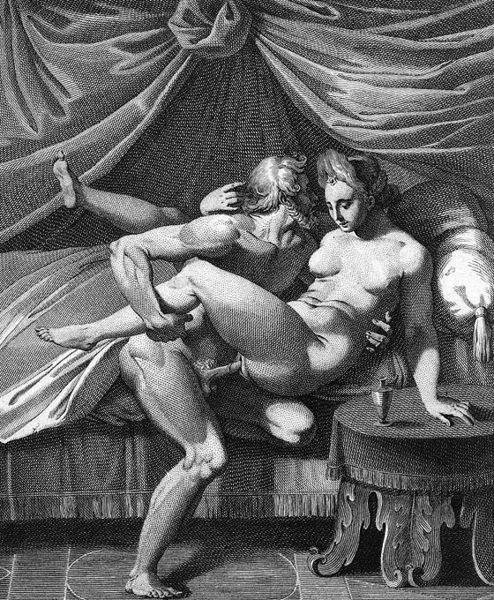
Agostino Carracci: Jupiter and Juno
Locations
People
Groups
- Polytheism (“paganism”)
- Papal States (Republic of St. Peter)
- Christians, Roman Catholic
- Venice, (Most Serene) Republic of
Topics
- Renaissance, Italian
- Protestant Reformation
- Counter-Reformation (also Catholic Reformation or Catholic Revival)
- Western Art: 1588 to 1600
Subjects
Regions
Subregions
Years: 1597 - 1597
Agostino Carracci: Jupiter and Juno
Locations
People
Groups
- Polytheism (“paganism”)
- Papal States (Republic of St. Peter)
- Christians, Roman Catholic
- Venice, (Most Serene) Republic of
Topics
- Renaissance, Italian
- Protestant Reformation
- Counter-Reformation (also Catholic Reformation or Catholic Revival)
- Western Art: 1588 to 1600
Subjects
Regions
Subregions