
Huvishka, the son of Kanishka, is the …
Years: 136 - 147
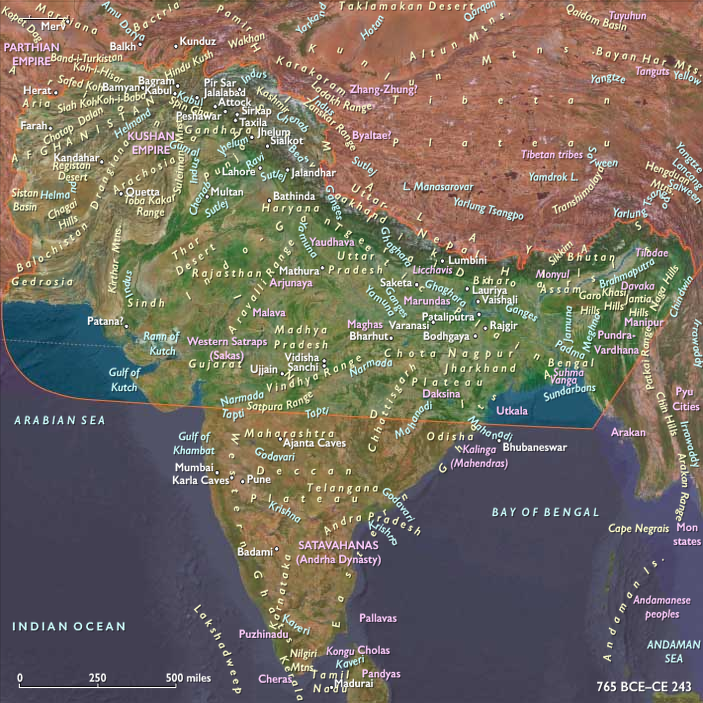
Huvishka, the son of Kanishka, is the first Indian emperor to introduce gold coins.
His reign also is known as the Golden Age of Kushan rule.
The reign of Huvishka corresponds to the first known epigraphic evidence of the Buddha Amitabha, on the bottom part of a second century statue which has been found in Govindo-Nagar, and now at the Mathura Museum.
The statue is dated to "the twenty-eighth year of the reign of Huvishka", and dedicated to "Amitabha Buddha" by a family of merchants.
Compared to his predecessor Kanishka, Huvishka seems to rely less on Iranian deities (which are much less numerous in his coinage), and more on India ones, such as war divinities of Shivaism.
He also incorporates in his coins for the first and unique time in Kushan coinage the Hellenistic-Egyptian Serapis (under the name Σαραπο, "Sarapo", and the Goddess Roma (thought to represent "Roma aeterna"), under the name "Riom" (Greek: ΡΙΟΜ).
Locations
People
Groups
Topics
Commodoties
Subjects
Regions

Subregions
Related Events
Showing 2 events out of 2 total
Years: 136 - 147
Locations
People
Groups
Topics
Commodoties
Subjects
Regions
Subregions