
The Caribs of the Lesser Antilles are …
Years: 1396 - 1539
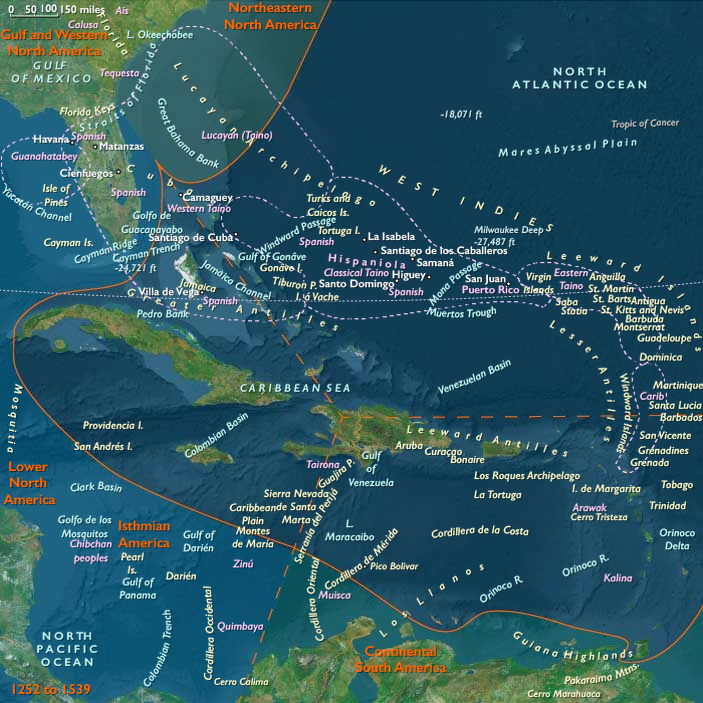
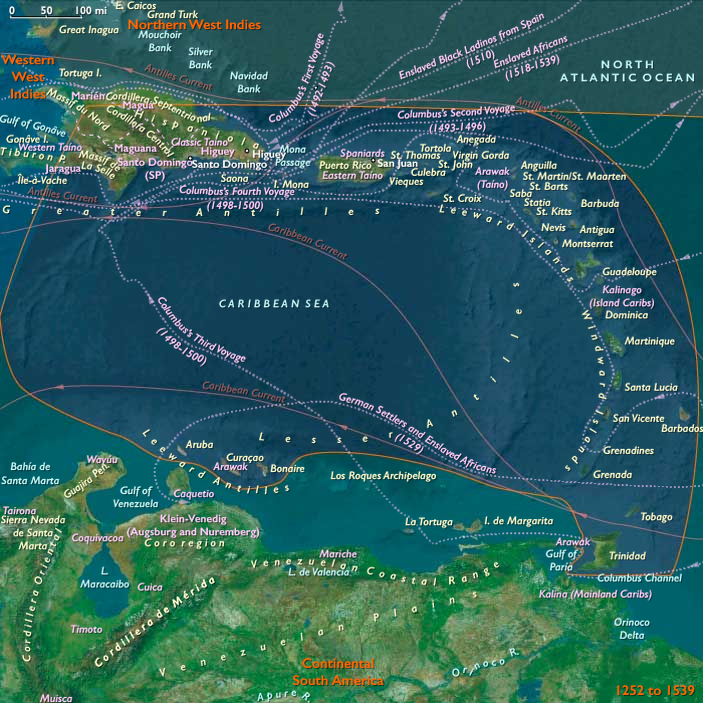
The Caribs of the Lesser Antilles are a highly mobile group; they possess canoes similar to those of the Arawaks, but they employ them for more warlike pursuits.
Their social organization appears to be simpler than that of the Arawaks.
They have no elaborate ceremonial courts like those of the Arawaks, but their small, wooden, frame houses surrounding a central fireplace might have served as ceremonial centers.
Many of their cultural artifacts—especially those recovered in Trinidad—resemble those of the Arawaks.
This might be explained in part by the Carib practice of capturing Arawak women as brides, who then could have socialized the children along Arawak lines.
The social and political organization of Carib society reflects both their military inclination and their mobile status.
Villages are small, often consisting of members of an extended family.
The leader of the village, most often the head of the family, supervises the food-gathering activities, principally fishing, done by the men, and the cultivation activities, done by the women.
In addition, the leader settles internal disputes and leads raids against neighboring groups.
The purpose of these raids is to obtain wives for the younger males of the village.
Warfare is an important activity for Carib males, and before the arrival of the Spanish they have a justified reputation as the most feared warriors of the Caribbean.
Using bows, poisoned arrows, javelins, and clubs, the Caribs attack in long canoes, capturing Arawak women and, according to Arawak informants, ritualistically cooking and eating some of the male captives.
There are, however, no records of Caribs eating humans after the advent of the Europeans, thus casting doubts on the Arawak tales.
People
Groups
- Guanahatabey
- Arawak peoples (Amerind tribe)
- Kalinago (Amerind tribe)
- Spain, Habsburg Kingdom of
- Spaniards (Latins)
Topics
Commodoties
Subjects
Regions
Subregions
Years: 1396 - 1539
People
Groups
- Guanahatabey
- Arawak peoples (Amerind tribe)
- Kalinago (Amerind tribe)
- Spain, Habsburg Kingdom of
- Spaniards (Latins)
Topics
Commodoties
Subjects
Regions
Subregions