Hungarian raiders attack the abbey of St. …
Years: 926 - 926
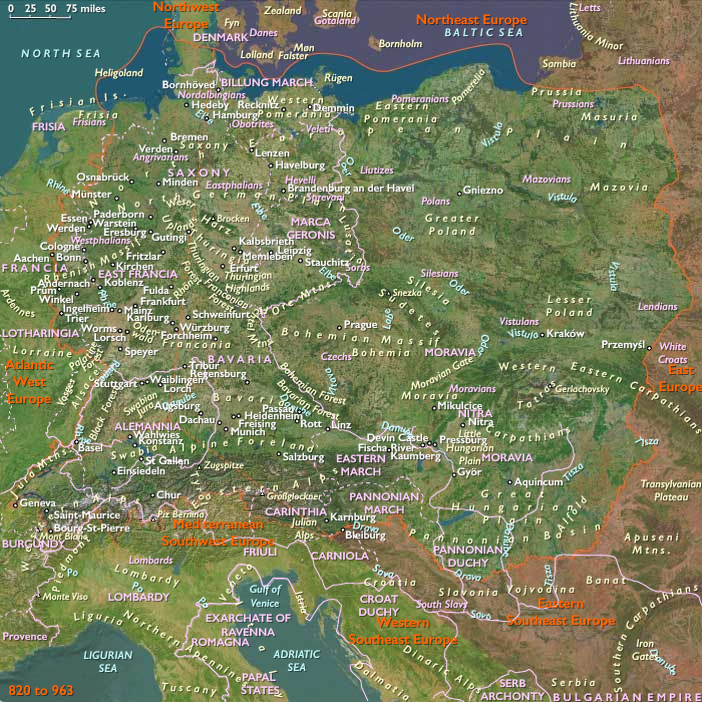
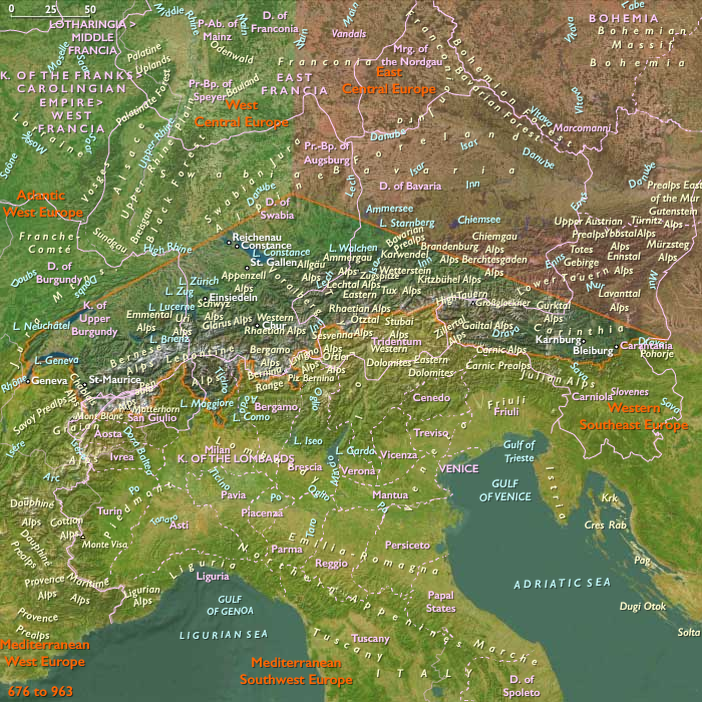
Hungarian raiders attack the abbey of St. Gallen and the surrounding town in 926.
Saint Wiborada, who is to be the first woman formally canonized by the Vatican, reportedly sees a vision of the impending attack and warns the monks and citizens to flee.
While the monks escape with the abbey treasure, Wiborada chooses to stay behind and is killed by the raiders.
Locations
Groups
Topics
Commodoties
Subjects
Regions
Subregions
Related Events
Filter results
Showing 10 events out of 53230 total
Simeon has styled himself “Tsar of the Bulgars and Autocrat of the Greeks” from 925, and the pope recognizes him as such the following year, but his country is near exhaustion.
The Bulgarian kingdom has reached its greatest size under Simeon, who has presided over a golden age of artistic and commercial expansion.
He has encouraged the building of palaces and churches, the spread of monastic communities, and the translation of Greek books into Slavonic.
Preslav has been made into a magnificent capital that observers describe as rivaling Constantinople.
The artisans of its commercial quarter specialize in ceramics, stone, glass, wood, and metals, and Bulgarian tile work in the “Preslav style” surpasses its contemporary rivals and is eagerly imported by Constantinople and Kievan Rus.
Most likely after (or possibly at the time of) Patriarch Nicholas' death in 925, Simeon had raised the status of the Bulgarian Orthodox Church to a patriarchate.
This may be linked to Simeon's diplomatic relations with the Papacy between 924 and 926, during which he has demanded and received Pope John X's recognition of his title as "Emperor of the Romans", truly equal to the emperor in Constantinople, and possibly the confirmation of a patriarchal dignity for the head of the Bulgarian Orthodox Church.
Simeon's troops under Alogobotur invade Croatia in 926, at this time an ally of Constantinople.
The reason might have been that Tomislav had received and protected the Serbs who were expelled by Simeon from Rascia.
In all probability, however, the main reason is that Simeon, if crowned by the Papal Legate, fears an attack from the Emperor Romanos Lekapenos, supported by Tomislav.
Romanos had won the friendship of Tomislav some years previously, handing over Dalmatia to Tomislav and recognizing him as King of Croatia (Pope John X had recognized Tomislav as King of Croatia in 925).
Tomislav had sent his troops to Italy during the summer of 926 to expel Saracens from the city of Sipontus, which belongs to the imperial province of Langobardia.
This event could have been sufficient proof to Simeon that the Croats had taken the side of Constantinople and that they would support the Greek emperor actively in the future.
Therefore, when Simeon sends a great army against the Croats, the Bulgarians are met by Tomislav's army in the mountainous region of Eastern Bosnia.
The Croatian forces under the leadership of their king completely devastate the Bulgarian army.
Key to Tomislav's triumph is likely the choice of terrain on which the battle takes place: Croatian soldiers are probably more skilled in fighting in the mountainous terrain of the Bosnian highlands.
The Croatian victory is so decisive and the battle so big that contemporary sources greatly overestimate Croatia's army at one hundred and sixty thousand men, with a slightly bigger force on the Bulgarian side.
This is the only battle Tsar Simeon ever loses.
Since both rulers maintain good relations with John X, the pope is able to negotiate an end to the war soon afterward without any further border changes.
Tomislav, fearing Bulgarian retribution, accepts to abandon his union with Constantinople and make peace on the basis of the status quo, negotiated by the papal legate Madalbert.

The Roman Empire had conquered Raetia in 15 BCE.
Under emperor Diocletian (late third century CE), the existing settlement of Curia Raetorum had been made the capital of the newly established province of Raetia prima.
Chur In the fourth century had become the seat of the first Christian bishopric north of the Alps.
Despite a legend assigning its foundation to an alleged Briton king, St. Lucius, the first known bishop is one Asinio in 451.
After the invasion of the Ostrogoths, it had been rechristened Theodoricopolis; in the sixth century it had been conquered by the Franks.
The city has suffered several invasions, including one by the Magyars in 925-926, when the cathedral is destroyed.
The Italian nobility, turning against Rudolph in 926, requests that Hugh of Arles, the effective ruler of Provence (or Lower Burgundy), rule them instead.
Rudolph returns to Upper Burgundy to protect himself, assuring Hugh's coronation as King of Italy in the process.
Burchard II had married his daughter Bertha to King Rudolph II of Upper Burgundy in 922 and affirmed the peace of three years prior.
Burchard had then accompanied Rudolph into Italy when he was elected king by opponents of the Emperor Berengar.
When, in 926, Hugh of Arles is elected by his partisans to oppose Rudolph, Burchard attacks Novara, defended by the troops of Lambert, Archbishop of Milan.
Here he is killed, probably on April 29.
His widow, Regelinda (d. 958), remarries to Burchard's successor, Herman I.
Dynastic Struggle for the Throne of León (925 CE)
Following the death of King Fruela II in 925 CE, a succession crisis erupts between the sons of Ordoño II and their cousin, Alfonso Fróilaz, son of Fruela.
- Alfonso Fróilaz, already King of Galicia, claims Asturias and León, asserting his right as the direct heir of Fruela II.
- However, Sancho Ordóñez, Alfonso IV, and Ramiro II, the sons of Ordoño II, dispute his claim, rebelling against their cousin and asserting their own rightful succession as the legitimate heirs of their father.
This internal struggle marks a pivotal moment in the political fragmentation of the Kingdom of León, with rival factions vying for control over the Asturian-Leonese throne.
The Ordóñez Brothers Overthrow Alfonso Fróilaz and Divide the Kingdom (925 CE)
With the support of King Jimeno Garcés of Pamplona, the Ordóñez brothers—Sancho Ordóñez, Alfonso IV, and Ramiro II—successfully defeat and depose their cousin Alfonso Fróilaz. They force him to retreat to the eastern marches of Asturias, stripping him of his claim to León and Galicia.
Following their victory, the brothers divide the kingdom among themselves:
- Alfonso Ordóñez is crowned King of León as Alfonso IV...
- Sancho Ordóñez, the eldest, is acclaimed King of Galicia.
This partition of the Asturian-Leonese realm reflects the ongoing dynastic struggles and regional fragmentation that characterize the early medieval kingdoms of northern Iberia.
The Magyar Invasion of West Francia (926): The Unchecked Devastation
In 926, the Magyars, having already terrorized East Francia and Italy, launch a devastating foray into West Francia, encountering no significant resistance as they pillage deep into the heart of the kingdom, even endangering Reims, one of the most important religious and political centers of West Francia.
Context: The Magyar Threat in Europe
- Since the late 9th century, the Magyars, a nomadic horse-riding people from the Hungarian plains, had become the dominant raiding force in Central and Western Europe.
- Their campaigns into East Francia, Bavaria, and Italy had already weakened the Carolingian successor states, and their raids were becoming increasingly daring.
- Unlike the Vikings, who used ships and riverways, the Magyars specialized in fast-moving cavalry raids, making them even harder to intercept.
The Magyar Raid of 926: A Devastating Attack on West Francia
- The Magyars enter West Francia unopposed, taking advantage of the political instability following the death of Robert I (923) and the contested rule of Rudolph of Burgundy.
- Their forces plunder towns, monasteries, and settlements, moving deep into the kingdom.
- They threaten Reims, a city of great religious and royal significance, as it was the traditional site of Frankish coronations.
- Unlike the Vikings, who often sought land or tribute, the Magyars focused solely on looting, capturing slaves and wealth before retreating.
Why Was There No Opposition?
- West Francia was politically fragmented, with King Rudolph struggling to consolidate power after his contested election in 923.
- The nobility was preoccupied with internal struggles, particularly against Viking incursions and local feudal revolts.
- There was no unified military response, as the feudal structure made it difficult to assemble a coordinated royal army in time to stop the Magyars.
Consequences of the Magyar Raid (926)
-
Exposes the Vulnerability of West Francia
- The fact that the Magyars reached Reims without resistance highlights the weakness of centralized royal authority.
- Feudal lords become even more independent, as they realize they cannot rely on the king for protection.
-
Encourages Future Raids
- Seeing little organized resistance, the Magyars continue raiding into Francia and Burgundy throughout the 930s.
- Their incursions will only be stopped after Otto I of Germany decisively defeats them at the Battle of Lechfeld in 955.
-
Further Weakens Carolingian Legitimacy
- The inability of the king to protect his realm leads to further discontent among the nobility, accelerating the shift toward localized rule.
- This contributes to the ongoing decline of Carolingian influence, paving the way for the eventual rise of Capetian rule in France.
Conclusion: A Sign of West Francia’s Decline
The Magyar raid of 926 demonstrates that West Francia is no longer capable of defending itself from external threats, as internal conflicts and feudal decentralization leave the kingdom vulnerable. Though the Magyars will eventually be stopped in Germany, their unchecked foray into Francia is a clear indicator of the kingdom’s continuing political fragmentation in the early 10th century.
Henry, having captured a Hungarian prince, manages in 926 to arrange a ten-year-truce, though he is forced to pay tribute.