
Humayun's untimely death in 1556 leaves the …
Years: 1540 - 1683
Humayun's untimely death in 1556 leaves the task of further imperial conquest and consolidation to his thirteen-year-old son, Jalal-ud-Din Akbar (r. 1556-1605).
Following a decisive military victory at the Second Battle of Panipat in 1556, the regent Bayram Khan pursues a vigorous policy of expansion on Akbar's behalf.
As soon as Akbar comes of age, he begins to free himself from the influences of overbearing ministers, court factions, and harem intrigues, and demonstrates his own capacity for judgment and leadership.
A "workaholic" who seldom sleeps more than three hours a night, he personally oversees the implementation of his administrative policies, which are to form the backbone of the Mughal Empire for more than two hundred years.
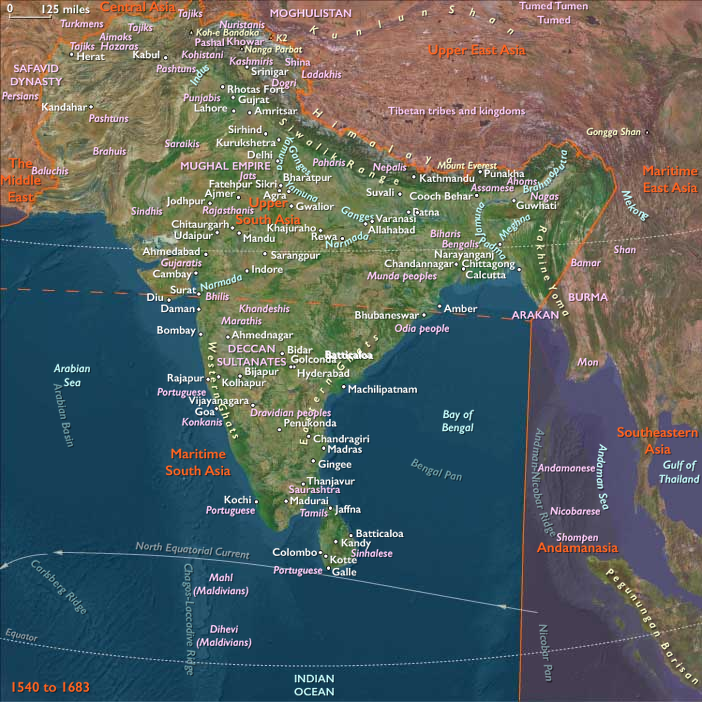
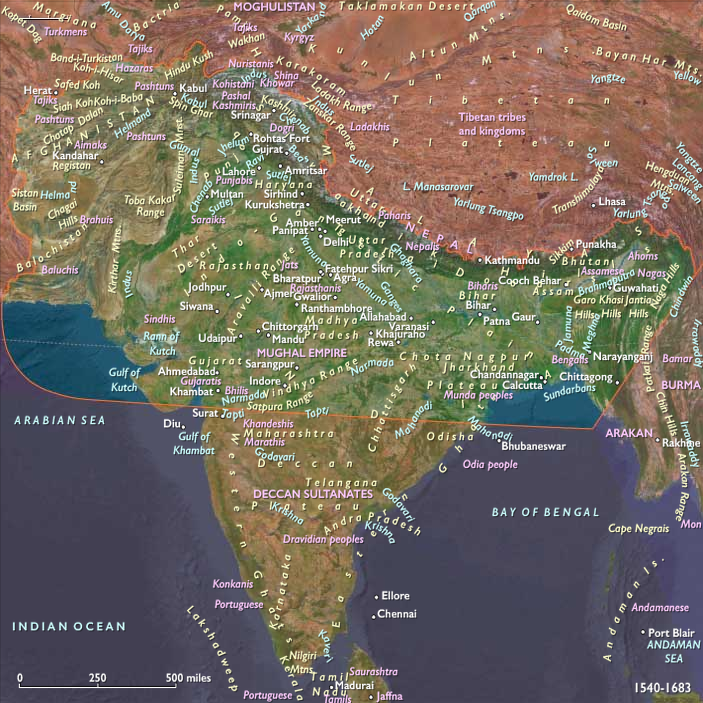
He continues to conquer, annex, and consolidate a far-flung territory bounded by Kabul in the northwest, Kashmir in the north, Bengal in the east, and beyond the Narmada River in the south—an area comparable in size to the Mauryan territory some eighteen hundred years earlier.
Locations
People
Groups
- Hinduism
- Pashtun people (Pushtuns, Pakhtuns, or Pathans)
- Indian people
- Rajputs
- Islam
- Muslims, Sunni
- Delhi, Sultanate of (Lodi, or Afghan, Dynasty)
- Mughal Empire (Agra)
- Sur Empire
- Mughal Empire (Agra)
Topics
Subjects
Regions
Subregions
Years: 1540 - 1683
Locations
People
Groups
- Hinduism
- Pashtun people (Pushtuns, Pakhtuns, or Pathans)
- Indian people
- Rajputs
- Islam
- Muslims, Sunni
- Delhi, Sultanate of (Lodi, or Afghan, Dynasty)
- Mughal Empire (Agra)
- Sur Empire
- Mughal Empire (Agra)
Topics
Subjects
Regions
Subregions