
Hulagu has probably always intended to take …
Years: 1257 - 1257
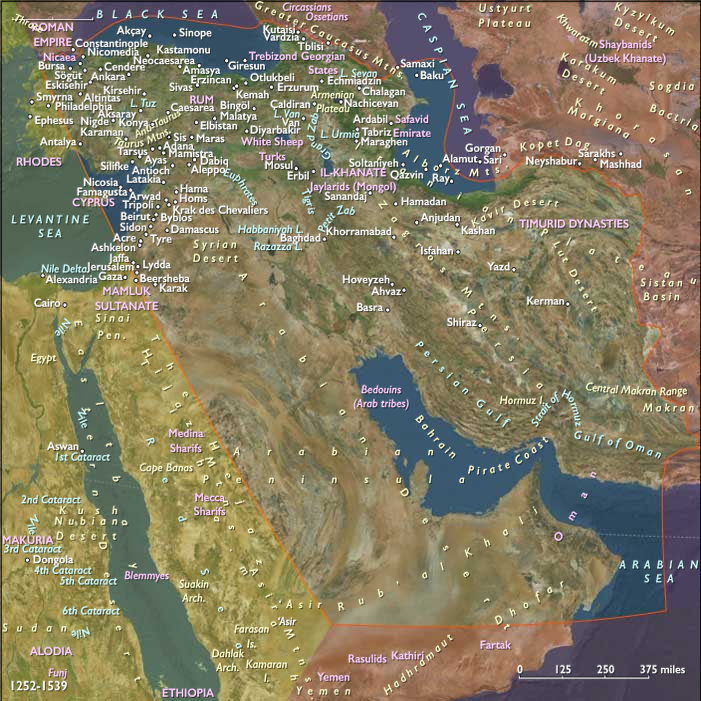
Hulagu has probably always intended to take Baghdad, which the Mongols have been meaning to attack for over ten years, but he uses the caliph's refusal to send troops to him as a pretext for conquest, since his brother the Great Khan has ordered him to be merciful to those who submit.
The Mongol army sets out for Baghdad in November of 1257, led by Hulagu and the Han Chinese commander Guo Kan in vice-command.
The latter had participated in the final drive in the conquest of the Jin Dynasty, including the capture of Kaifeng, and may have served in the European campaign with Subutai a few years following the fall of the Jin Dynasty.
By order of Mongke Khan, one in ten fighting men in the entire empire have been gathered for Hulagu's army, probably the largest ever fielded by the Mongols.
The attacking army also has a large contingent of Christian forces levied from tributary states.
By the time that the Mongols reach Baghdad, their army includes even some Frankish forces from the Principality of Antioch, whose prince, Bohemond VI, had on the advice of his father-in, law, Hethum of Little Armenia, submitted to Mongol overlordship.
The main Christian force seems to have been the Georgians, who are to take a very active role in the destruction to follow.
Also, Ata al-Mulk Juvayni describes Cicilian Armenians, Persians, and Turks as participants in the siege, together with about one thousand Chinese artillery experts.
Rocket technology had first become known to Europeans following their use by the Mongols Genghis Khan and Ögedei Khan when they conquered parts of Russia, Eastern, and Central Europe.
The Mongolians had acquired the Chinese technology by conquest of the northern part of China and also by the subsequent employment of Chinese rocketry experts as mercenaries for the Mongol military.
Reports of the Battle of Sejo in the year 1241 describe the use of rocket-like weapons by the Mongols against the Magyars.
They appear in literature describing the capture of Baghdad in 1258 by the Mongols.
Locations
People
Groups
- Islam
- Abbasid Caliphate (Baghdad)
- Antioch, Principality of
- Mongols
- Armenian Kingdom of Cilicia, or Little Armenia
- Mongol Empire
- Il-khanate
Topics
- Crusades, The
- Mongol Conquests
- Mongol Conquest of the Song Dynasty
- Mongol Invasion of the Abbasid Caliphate
Commodoties
Subjects
Regions

Subregions
Years: 1257 - 1257
Locations
People
Groups
- Islam
- Abbasid Caliphate (Baghdad)
- Antioch, Principality of
- Mongols
- Armenian Kingdom of Cilicia, or Little Armenia
- Mongol Empire
- Il-khanate
Topics
- Crusades, The
- Mongol Conquests
- Mongol Conquest of the Song Dynasty
- Mongol Invasion of the Abbasid Caliphate
Commodoties
Subjects
Regions
Subregions