Hugh, meeting with Rudolph of France and …
Years: 928 - 928
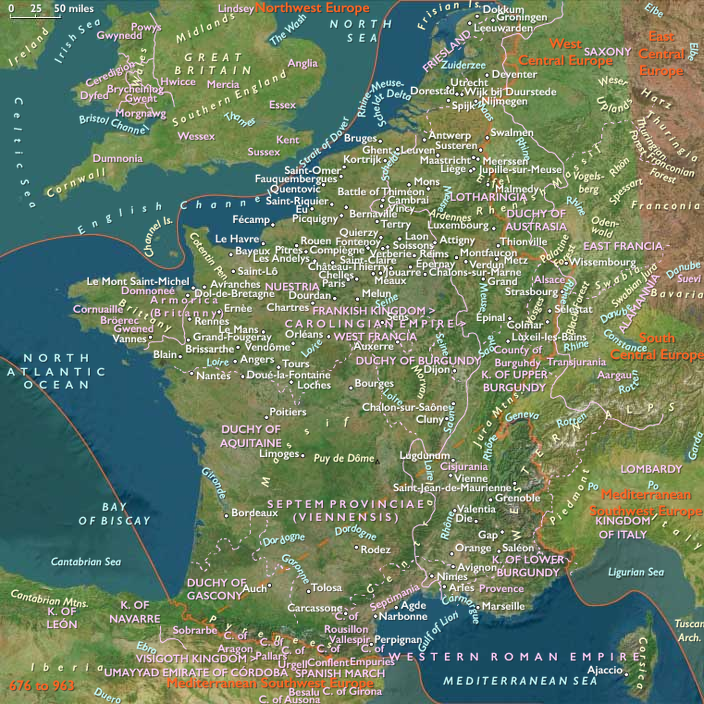
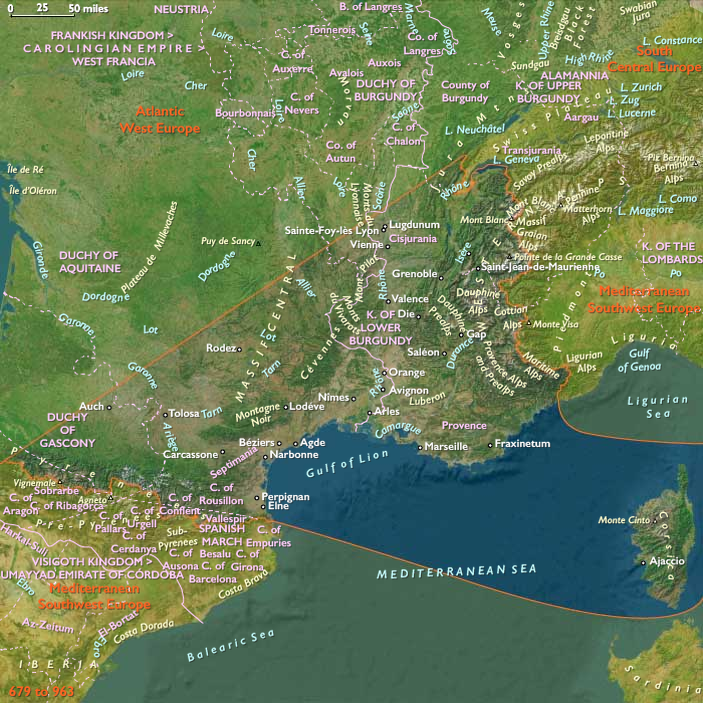
Hugh, meeting with Rudolph of France and Herbert II of Vermandois in Burgundy in September 928, grants Vienne to Herbert's son Odo in opposition to Charles Constantine.
He is still in conflict with Rudolph of Burgundy and hopes to ally with the King of France against the Burgundian monarch.
Locations
People
Groups
- Burgundians
- Italy, Carolingian Kingdom of
- Francia Occidentalis (West Francia, or France), Kingdom of
- Burgundy, Upper, Kingdom of
- Burgundy, Lower, Kingdom of
- Hungary, Principality of
Topics
Commodoties
Subjects
Regions
Subregions
Related Events
Filter results
Showing 10 events out of 53207 total
Wang Kon's army fights ceaselessly with Later Baekje for the next decade, with Silla in retreat.
After a crushing victory over Baekje forces at present-day Andong in 930, Goryeo receives a formal surrender from Silla and proceeds to conquer Later Baekje by 935—amazingly, with troops led by the former Baekje king, Kyonhwon, whose son had treacherously cast him aside.
After this accomplishment, Wang Kon becomes a magnanimous unifier.
Regarding himself as the proper successor to Goguryeo, he embraces survivors of the Goguryeo lineage who are fleeing the dying Balhae state, which had been conquered by Khitan warriors in 926.
He now takes a Silla princess as his wife and treats the Silla aristocracy with unexampled generosity.
Wang Kon establishes a regime embodying the last remnants of the Three Kingdoms and accomplishes a true unification of the peninsula.
East Central Europe (928–939 CE): Saxon Victories over the Magyars, Bohemian Consolidation under Wenceslaus and Boleslaus, and Emerging Polish Tribes
Between 928 and 939 CE, East Central Europe—comprising modern-day Poland, Czechia, Slovakia, Hungary, and eastern portions of Germany and Austria east of 10°E and north of a line from approximately 48.2°N at 10°E to the Austro-Slovenian border near 46.7°N, 15.4°E—entered a crucial phase characterized by successful Saxon resistance to Magyar incursions under Henry the Fowler, political consolidation and conflict in Bohemia under the Přemyslid rulers Wenceslaus I and Boleslaus I, and the early formation of distinct tribal centers in what would later become Poland. These developments significantly reshaped regional dynamics, establishing clearer political entities and cultural identities that profoundly influenced subsequent historical trajectories.
Political and Military Developments
Henry the Fowler’s Saxon Victories over the Magyars
-
In 933 CE, Henry the Fowler (r. 919–936) decisively defeated Magyar forces at the Battle of Riade, significantly curbing Magyar raids and solidifying Saxony’s military strength. His victories fortified East Francia’s eastern frontier, bolstering regional stability and setting a critical precedent for future Saxon dominance.
Přemyslid Consolidation and Internal Struggle in Bohemia
-
Bohemia witnessed critical political consolidation under the Přemyslids. Duke Wenceslaus I (Saint Wenceslaus, d. 935) significantly strengthened centralized authority but was assassinated by his brother, Boleslaus I the Cruel (r. 935–972), who consolidated his power through aggressive political and military strategies, expanding Bohemian territory and asserting independence from external powers.
Emergence of Early Polish Tribal Entities
-
Early tribal centers emerged distinctly in regions of modern-day Poland, notably around the Polans and other Slavic groups. While still fragmented, these early political structures laid essential groundwork for subsequent Polish state formation.
Economic and Technological Developments
Revival of Regional Economic Activity
-
With increased security from Saxon victories, regional trade networks regained stability, enhancing commerce and exchange between Saxony, Bavaria, Bohemia, and emergent Polish centers, notably involving agricultural products, metals, and manufactured goods.
Defensive and Administrative Infrastructure Improvements
-
Henry the Fowler extensively developed fortified towns and frontier defenses, notably in Saxony and Bavaria, significantly improving regional security, facilitating economic activity, and laying the foundations for organized medieval urban life.
Cultural and Artistic Developments
Saxon Cultural Flourishing under Henry
-
Henry the Fowler’s reign fostered significant cultural achievements through ecclesiastical patronage, monastery foundations, and manuscript production, solidifying Saxony’s cultural prominence within East Francia.
Přemyslid Cultural Identity in Bohemia
-
Under Wenceslaus and Boleslaus, Bohemian cultural and ecclesiastical identity strengthened considerably, notably through the promotion of Slavic-Christian traditions and artistic patronage, laying cultural foundations that profoundly shaped Bohemian identity.
Formation of Early Polish Cultural Centers
-
Early Polish tribes began developing distinct cultural identities through local traditions, settlement practices, and artisanal production, establishing cultural groundwork for future Polish states.
Settlement and Urban Development
Saxon Fortified Towns and Military Infrastructure
-
Henry the Fowler’s fortification strategy significantly enhanced urbanization and settlement structures, notably in Saxony and along East Francia’s eastern frontier, laying critical foundations for medieval towns.
Bohemian Urban and Administrative Consolidation
-
Prague and other Bohemian centers experienced significant growth under Přemyslid rule, becoming administrative, religious, and commercial hubs central to the duchy’s expanding influence.
Emergence of Polish Tribal Settlements
-
Early tribal settlements in Poland, particularly among the Polans, saw steady growth, laying the early settlement patterns and political organization crucial to future Polish territorial consolidation.
Social and Religious Developments
Christian Expansion and Ecclesiastical Influence
-
Christianity continued expanding across Saxony, Bohemia, and emerging Polish centers. Ecclesiastical institutions significantly influenced social structures, governance, and cultural integration.
Formation of Dynastic and Aristocratic Hierarchies
-
Saxony under Henry, Bohemia under the Přemyslids, and emerging Polish tribes developed distinct aristocratic hierarchies, reinforcing dynastic leadership structures that profoundly influenced later medieval governance.
Long-Term Consequences and Historical Significance
The era 928–939 CE was decisive for East Central Europe, marking the beginning of Saxon military dominance over the Magyars, solidifying Přemyslid power in Bohemia, and establishing formative political and cultural identities among Polish tribes. These critical developments set enduring political structures, cultural traditions, and demographic patterns, laying essential foundations for subsequent historical developments in medieval East Central Europe.
Admiral-turned-coemperor Romanus I Lecapanus passes and enforces a series of laws to defend the small landowners against the acquisitive instincts of the “powerful,” organizing the theme system as an institution of free, yet taxpaying, soldier-farmers and peasants.
Eastern Southeast Europe (928–939 CE): Social Reforms and Religious Movements
Settlement and Migration Patterns
Stable Demographic Continuity
From 928 to 939 CE, Eastern Southeast Europe maintained demographic stability, continuing the cultural and social integration among Bulgarians, Slavs, and Greeks. The region benefited from ongoing stability despite occasional tensions and shifting dynamics.
Political and Military Developments
Social and Agrarian Reforms under Romanus I Lecapanus
Admiral-turned-coemperor Romanus I Lecapanus enacted and enforced significant reforms aimed at protecting small landowners from the exploitative practices of the aristocratic elite. These reforms reinforced the theme system, transforming it into an institution that supported free, taxpaying soldier-farmers and peasants, which bolstered social stability and military readiness.
Bulgarian Political Stability and Power Dynamics
Bulgaria, having reached a zenith under Tsar Simeon, maintained its regional prominence during this period. However, its dominance was increasingly challenged by internal and external pressures, influencing regional political dynamics.
Economic and Technological Developments
Economic Stability through Social Reforms
The reforms implemented by Romanus I enhanced economic stability by safeguarding the livelihoods of small landowners and peasants. These measures helped sustain agricultural productivity and facilitated continued economic resilience across the region.
Continued Craftsmanship and Trade
The period saw sustained prosperity through ongoing trade, particularly benefiting Preslav's renowned craftsmanship and its continued export of specialized ceramics and tile work. These economic activities supported regional prosperity and maintained trade connections with Constantinople and Kievan Rus.
Cultural and Artistic Developments
Sustained Artistic and Cultural Expression
Cultural and artistic endeavors continued to thrive, particularly in Preslav and other regional centers. The established traditions in ceramics, glass, metalwork, and tile artistry flourished, reinforcing Bulgaria’s cultural identity and influence.
Scholarly and Literary Continuity
Educational and scholarly institutions maintained their roles in manuscript production and classical learning, reinforcing intellectual continuity and contributing significantly to cultural resilience and regional heritage.
Social and Religious Developments
Spread of Paulician and Bogomil Doctrines
Paulician doctrines gained significant traction among Macedonians, Bulgarians, and Greeks, especially among rural peasants. This religious movement contributed significantly to the rise of the Bogomils, whose doctrines first emerged in Bulgaria in the early tenth century.
Bogomil Movement
Named after its founder, the priest Bogomil, the Bogomil movement represented a fusion of dualistic, neo-Manichaean beliefs inherited primarily from the Paulicians, combined with local Slavonic evangelical Christian reform ideals. This movement aimed to reform the Bulgarian Orthodox Church and played a crucial role in shaping regional religious and social dynamics.
Continued Dominance of Orthodox Christianity
Despite these emerging religious movements, Eastern Orthodox Christianity remained the dominant religious institution, significantly influencing societal structures, community cohesion, and cultural identity.
Long-Term Consequences and Historical Significance
The period from 928 to 939 CE was marked by significant social reforms under Romanus I Lecapanus and the rise of influential religious movements such as the Bogomils. These developments had enduring impacts on the region's socioeconomic structures, religious landscape, and cultural identity, shaping Eastern Southeast Europe's historical trajectory in subsequent centuries.

Paulician doctrines are disseminated among the Macedonians, Bulgarians, and Greeks, especially among the peasants, and it seems that they contribute to the development of the doctrines and practices of the Bogomils, who first appear in Bulgaria in the early tenth century.
So called after their founder, the priest Bogomil, the Bogomils represent a fusion of dualistic, neo-Manichaean doctrines imported especially from the Paulicians, and a local Slavonic movement aimed at reforming, in the name of an evangelical Christianity, the recently established Bulgarian Orthodox Church.
Abbasid caliph Muqtadir feels confident enough in 928 to once again confront Abū-Tāhir Al-Jannābī, son of the late Qarmatian rebel leader Abu Said al-Djannabi, and now ruler of the Qarmatian state in Bahrain, calling in his generals Yusaf bin Abi As'saj from Azerbaijan, Munis Khadim, Muzaffar and Harun.
After a heavy fight, all are beaten and driven back to Baghdad.
Abu Tahir destroys Jazirah Province as a final warning to the Abbasids and returned to Al-Hasa.
Abu Tahir thinks that he has identified the Mahdi as a young Persian prisoner by the name of Abu'l-Fadl al-Isfahani, from Isfahan who claims to be the descendant of the Persian kings, brought back to Bahrain from the Qarmatians' raid into Iraq.
Saadia ben Joseph al-Fayyumi, a religious philosopher, Bible exegete, apologist, and liturgical poet serves as head (Gaon) of the Talmudic academy of Sura, and spiritual head of Babylonian Jewry.
Known as Saadia Gaon, he is party to a protracted dispute with Babylonia's Karaite rulers over their opposition to Judaic tradition.
Merkava mysticism, which has as its main concern ecstatic and mystical contemplation of the divine throne, or merkava (seen in a vision by Ezekiel, the prophet; Ezekiel 1), had begun to flourish in Palestine during the first century CE, but from the seventh to the eleventh century its center is in Babylonia.
Strongly influenced by Gnostic beliefs, Merkava mystics probably experience ecstatic visions of the celestial hierarchies and the throne of God.
In Merkava mystical literature, the ascent of the visionary's soul is described as a perilous journey through seven spheres, or “heavenly dwellings”, manned by hostile angels.
The visionary's goal is to behold the divine throne situated on its chariot.
Saadia writes an important commentary on the Sefer Yetzira (Hebrew: Book of Creation), the oldest known Hebrew text on white magic and cosmology; it contends that the cosmos derived from the twenty-two letters of the Hebrew alphabet and from the ten divine numbers (sefirot).
Taken together, they are said to comprise the “thirty-two paths of secret wisdom” by which God created the universe.
The book, falsely attributed to Abraham and thus sometimes called Otiyyot de Avraham Avinu (”Alphabet of Our Father Abraham”), appeared anonymously between the third and sixth century CE, but interpolations were later added.
The Yetzira developed the pivotal concept of the ten sefirot, which profoundly influences subsequent Judaism.
The first group of four represent universal elements (the spirit of God, air, water, and fire), whereas the last group represents the six spatial directions.
The sefirot and the letters of the alphabet are likewise correlated to parts of the human body, thereby making man a microcosm of creation.
The ten-mile-long Veeranam Dam in South India, created by Rajaditya Chola, son of Parantaka I, and built from 907 to 955, represents a climax of earthen dam technology, employing hewn stone to face the steeply sloping sides.
Abū-Tāhir Al-Jannābī leads the Qarmatians’ most notorious attack when he pillages Mecca in 930 and desecrates Islam’s most sacred sites.
Unable to gain entry to the city initially, Abu Tahir calls upon the right of all Muslims to enter the city and gives his oath that he comes in peace.
Once inside the city walls, the Qarmatian army sets about massacring the pilgrims, taunting them with verses of the Koran as they do so.
The bodies of the pilgrims are left to rot in the streets or thrown down the Well of Zamzam.
The Kaaba is looted, with Abu Tahir taking personal possession of the Black Stone and bringing it back to Al-Hasa.
The attack on Mecca symbolizes the Qarmatians’ break with the Islamic world—it is believed to have been aimed to prompt the appearance of the Mahdi, who will bring about the final cycle of the world and end the era of Islam.
Much of Bosnia is taken over after the death of Tomislav in 928 by a Serb princedom that acknowledges the sovereignty of Constantinople.
The first recorded mention of Bosnia is written during this period by the the Greek emperor Constantine VII Porphyrogenitus, whose writings are one of the best sources of information on the Greek empire and neighboring areas.
Describing “Bosona” as a district in “baptized Serbia,” the district he refers to is an area much smaller than modern Bosnia and centered on the Bosna River.
Soon after Constantine writes those words, most of the modern territory of Bosnia reverts to Croatian rule.
Years: 928 - 928
Locations
People
Groups
- Burgundians
- Italy, Carolingian Kingdom of
- Francia Occidentalis (West Francia, or France), Kingdom of
- Burgundy, Upper, Kingdom of
- Burgundy, Lower, Kingdom of
- Hungary, Principality of