The Division of …
Years: 960 - 960
The Division of Hugh the Great’s Lands and Lothair’s Regency (956–960)
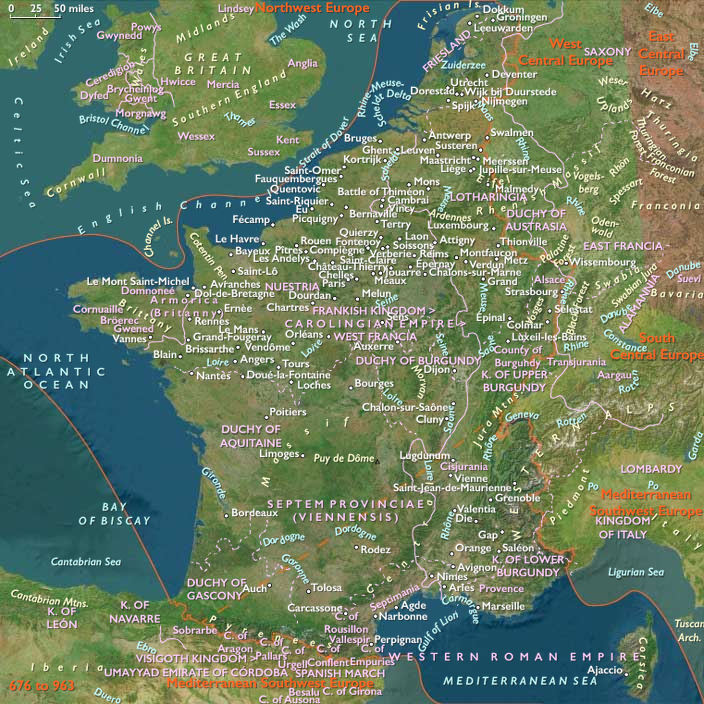
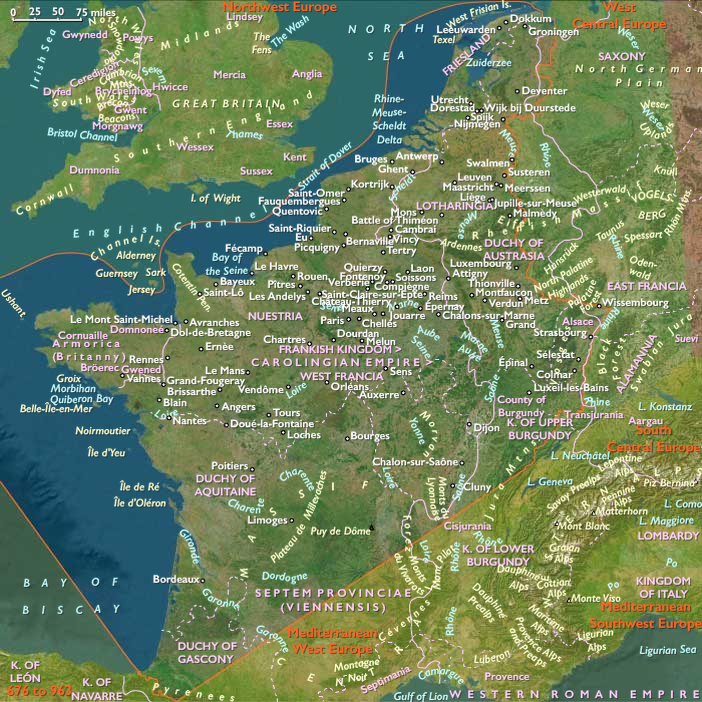
Following the death of Hugh the Great in 956, King Lothair of West Francia is forced to mediate between Hugh’s sons—the powerful Hugh Capet and his younger brothers Otto and Henry—to prevent internal conflict among the most influential noble family in France. This period sees:
- The division of Hugh the Great’s vast territories between his sons.
- Lothair coming under the guardianship of his maternal uncle, Bruno of Cologne, reinforcing Ottonian influence over West Francia.
The Division of Hugh the Great’s Domains (956–960)
To maintain stability and avoid a civil war, Lothair makes the following decisions:
-
Hugh Capet, the eldest son, receives:
- The County of Paris
- The Duchy of the Franks (dux Francorum), the highest noble title in West Francia
- Control over much of Neustria and the Loire Valley
-
Otto of Burgundy (younger brother of Hugh Capet) is invested in 960 as Duke of Burgundy, controlling:
- The Duchy of Burgundy, ensuring its autonomy from Neustria.
-
Henry, the youngest brother, does not receive an immediate duchy but is a key member of the family’s growing influence.
This division ensures that the powerful Robertian family remains dominant, though Hugh Capet emerges as the most powerful of the brothers.
Lothair’s Guardianship Under Bruno of Cologne (956–965)
- With Hugh Capet still consolidating power, Lothair, who had ascended the throne in 954 at age 13, falls under the influence of his maternal uncle, Bruno, Archbishop of Cologne and Duke of Lotharingia.
- Bruno serves as regent, reinforcing Ottonian control over West Francia, as he is also the younger brother of Otto I, Holy Roman Emperor.
- This allows the Holy Roman Empire to maintain a strong presence in Frankish affairs, ensuring Lothair remains politically weak while the Robertians grow stronger.
Consequences of This Power Shift
-
Hugh Capet Establishes the Foundation of the Capetian Dynasty
- Now controlling Paris and Neustria, Hugh Capet emerges as the dominant noble in West Francia, a position he will hold until his eventual rise to the throne in 987.
-
Burgundy Becomes Semi-Independent
- The duchy is now separate from Neustria, meaning West Francia’s royal power is further decentralized.
-
Ottonian Influence Over West Francia
- With Bruno of Cologne as Lothair’s guardian, the Holy Roman Empire has a strong political grip over West Francia.
- This prevents Lothair from acting independently until Bruno’s death in 965.
Conclusion: A Step Toward the Capetian Takeover
While Lothair technically remains king, the division of Hugh the Great’s lands strengthens the Robertians, particularly Hugh Capet, who emerges as the most powerful noble in France. Meanwhile, Ottonian influence over West Francia grows through Bruno of Cologne’s regency, ensuring that Lothair’s rule remains weak and dependent on external forces. This balance of power will eventually lead to the downfall of the Carolingian dynasty and the rise of the Capetians in 987.
Locations
People
- Bruno the Great
- Fulk II
- Henry I, Duke of Burgundy
- Hugh Capet
- Lothair of France
- Otto, Duke of Burgundy
- Theobald I
- William III, Duke of Aquitaine
Groups
- Breton people
- Aquitaine, (Carolingian) Kingdom of
- Francia Occidentalis (West Francia, or France), Kingdom of
- Francia Orientalis (East Francia), Kingdom of
- Anjou, County of
- Lotharingia, Duchy of
- Normandy, Duchy of
- Brittanny, Duchy of
- Blois, County of
- Cologne, Electorate of
- Lorraine (Lothier), Upper, Duchy of
- Lorraine (Lotharingia), Lower, (first) Duchy of
- Burgundy, Duchy of
Subjects
Regions
Subregions
Related Events
Filter results
Showing 10 events out of 52829 total
Zhao Kuangyin’s usurpation of the Later Zhou Dynasty throne in 960 brings to and end the Five Dynasties and Ten Kingdoms Period in China.
The amount of registered soldiers in the Chinese army at this time is some 378,000.
This marks the end of the post-Tang military regimes known as the Five Dynasties with the seizure of the imperial throne by general Zhao Guangyin, who founds the Song dynasty.
Zhao places the military under civil administration to prevent a recurrence of the militarism that had toppled the Tang.
Under Zhao and subsequent Song rulers, the aristocrats will lose their domination of government to the emergent scholar-gentry class, who derive their power from landholding and extensive educational training.
The Kara-Khanids convert to Islam in the mid-tenth century and adopt Muslim names and honorifics, but retain Turkic regnal titles such as Khan, Khagan, Ilek (Ilig) and Tegin.
They will later adopt the Arab titles sultan and sultān al-salātīn (sultan of sultans).
A Karakhanid prince named Satuk Bughra Khan (d. 955) was according to the Ottoman historian known as Munajjim-bashi the first of the khans to convert.
After conversion, he had obtained a fatwa that permitted him in effect to kill his presumably still pagan father, after which he had conquered Kashgar.
There was a mass conversion of the Turks (reportedly "200,000 tents of the Turks") later in 960, according to Muslim historians Ibn Miskawaih and Ibn al-Athir; circumstantial evidence suggests these were the Karakhanids.
The Suaire de Saint-Josse, the "Shroud of Saint Josse" that is now conserved in the Musée du Louvre, is a rich silk samite saddle cloth that is woven in northeastern Iran, some time before 961, when Abu Mansur Bakhtegin, the "camel-prince" for whom it has been woven, is beheaded.
This fragmentary textile with elephants woven into the design is the only known surviving example of a silk textile produced in Eastern Iran, in the royal workshops of the Samanid dynasty, probably at either Merv or Nishapur.
The "prince" referred to in the woven Kufic inscription, though decipherable in more than one way, is most likely to refer to the general and emir Bukhtegin, active in the service of 'Abd al-Malik I, the Samanid sultan of Khorasan.
The cloth is now in two fragments, which are regarded as comprising about half of the original piece.
They are fifty-two by ninety-four centimeters and twenty-four-point five by sixty-two centimeters respectively, the first measurement being the length.
The design was somewhat like a carpet (not that any from this date survive), with a central field containing two pairs of confronted elephants, one above the other, of which one pair survive.
There is then a thin border with geometric patterns, outside which the sides have friezes of repeated camels and at least the bottom (which survives) an inscription in Kufic script.
In all there are five zones of border between the elephants and the edge of the cloth.

The victory at Raban had made it clear that the Empire is gaining the upper hand over the Hamdanids.
Their success had also enabled them to retain control of Samosata, meaning that they had broken through the fortified frontier zone protecting northern Syria.
Nevertheless, the Hamdanid ruler is still in control of a potent military and capable of launching raids into imperial territory, until he suffers a catastrophic defeat in November 960 at the hands of Leo Phokas in an unidentified mountain pass on the Taurus Mountains.
Sayf al-Dawla himself barely escapes, but his army is annihilated.
Coming after the series of costly defeats in the previous years, this battle breaks the power of the Hamdanid emirate for good.
The South Slav peoples are organized along tribal lines, each headed by a zupan (chieftain).
In the part of the Adriatic littoral that comprises present Serbia and Montenegro, from the time of the arrival of the Slavs up to the tenth century, these local magnates have often been brought into unstable and shifting alliances with other larger states, particularly with Bulgaria, Venice, and Constantinople.
One such zupan, Ceslav, operating between 931 and 960 from the zupanija of Zeta in the hinterland of the Gulf of Kotor, succeeds in unifying a number of neighboring Serb tribes and extending his control as far north as the Sava River and eastward to the Ibar.
Pope John XII personally leads an attack against the Lombard duchies of Beneventum and Capua in around 960, presumably to reclaim parts of the papal states which had been lost to them.
Confronted by the sight of John marching at the head of an army of men from Tusculum and Spoleto, the dukes of Beneventum and Capua appeal for help from Gisulf I of Salerno, who comes to their aid.
John retreats north and enters into negotiations with Gisulf at Terracina.
A treaty is secured between the two parties, and the price for Gisulf’s non-interference is John agreeing that the papacy will no longer claim Salerno as a Papal patrimony.
John soon finds that he is unable to control the powerful Roman nobility as his father had so effortlessly done.
At around the same time, Berengar II, King of Italy, begins to attack the territory of the pope.
In order to protect himself against political intrigues in Rome and the power of Berengar II, in 960 John sends papal legates to the King of Germany Otto I, who had previously been granted the rank of Patrician, asking for his aid.
Córdoban Intervention in Christian Dynastic Struggles (Until 961 CE)
The Caliphate of Córdoba plays an active role in the internal dynastic conflicts of the Christian kingdoms of Iberiauntil 961 CE, using these divisions to exert influence over the northern realms.
Sancho the Fat’s Exile and Alliance with Córdoba
After the death of Ordoño III, his half-brother and successor, Sancho I "the Fat", is deposed by his cousin, Ordoño IV. Seeking to reclaim his throne, Sancho turns to his grandmother, Queen Toda of Navarre, who arranges an alliance with Caliph Abd ar-Rahman III of Córdoba.
Muslim Support and the Reconquest of Zamora and Oviedo
In exchange for ceding several castles to Córdoba, Abd ar-Rahman III provides military assistance to Sancho. With this support:
- Zamora is retaken in 959 CE.
- Oviedo is recovered in 960 CE.
- Ordoño IV is overthrown, restoring Sancho I to the throne.
This intervention highlights the political entanglements between the Muslim and Christian kingdoms, with the Caliphate of Córdoba leveraging internal rivalries to extend its influence over the Christian north.
Dunstan’s reforms have made the monastery at Glastonbury a famous center of learning; he has also become a leading counselor to the English throne.
When Edgar the Peaceable, a supporter of Dunstan’s monastic reforms, is crowned King of England in 960, Dunstan becomes Archbishop of Canterbury.
He reforms monasteries and enforces the rule of Saint Benedict: Poverty, Chastity and Obedience for monks.
He attempts to impose celibacy on the secular clergy without noticeable success.
Dunstan actively encourages the Danes to integrate with the English.
Dunstan, also renowned as a metalworker, illuminator, and musician, works with Edgar to implement a national program of ecclesiastical reform and political unification.
Li Yu succeeds his father Li Jing, also a poet, to the throne of the Southern T'ang kingdom in 961 at the age of twenty-four.
Years: 960 - 960
Locations
People
- Bruno the Great
- Fulk II
- Henry I, Duke of Burgundy
- Hugh Capet
- Lothair of France
- Otto, Duke of Burgundy
- Theobald I
- William III, Duke of Aquitaine
Groups
- Breton people
- Aquitaine, (Carolingian) Kingdom of
- Francia Occidentalis (West Francia, or France), Kingdom of
- Francia Orientalis (East Francia), Kingdom of
- Anjou, County of
- Lotharingia, Duchy of
- Normandy, Duchy of
- Brittanny, Duchy of
- Blois, County of
- Cologne, Electorate of
- Lorraine (Lothier), Upper, Duchy of
- Lorraine (Lotharingia), Lower, (first) Duchy of
- Burgundy, Duchy of