The questions of how, when, …
Years: 28577BCE - 7821BCE
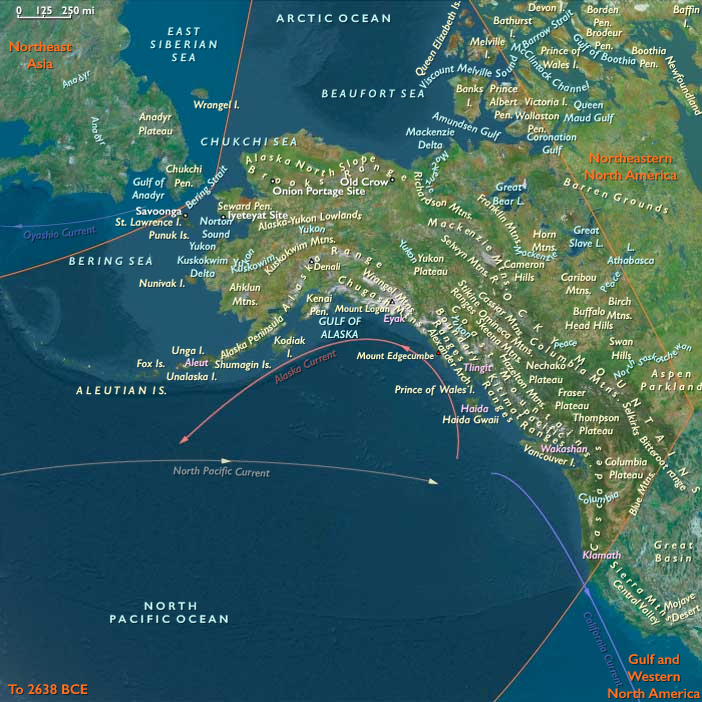
The questions of how, when, and why the first peoples entered the Americas remain subjects of active research, though recent genomic advances have significantly refined our understanding. While there is general agreement that the Americas were first settled by peoples who migrated from Asia across Beringia, the migration patterns, timing, and genetic origins have proven far more complex than previously recognized.
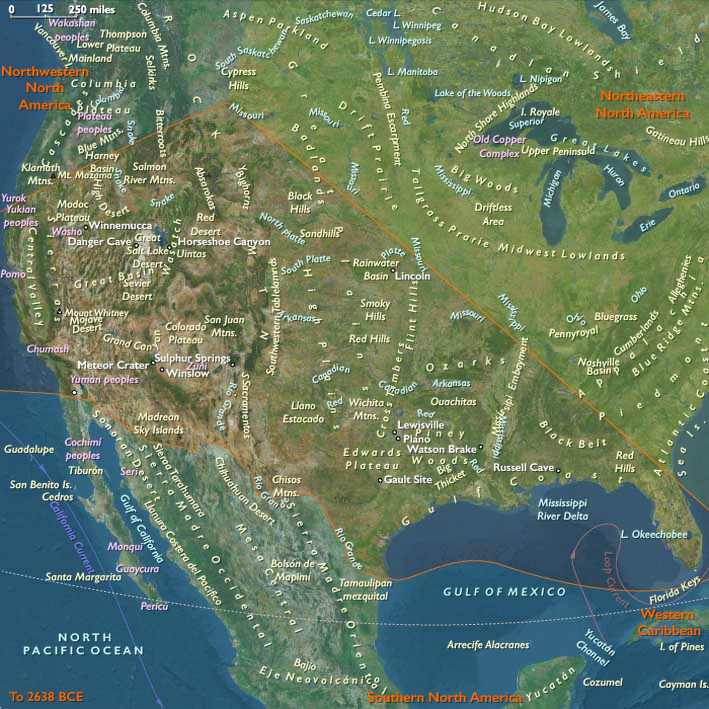
Archaeological evidence suggests that widespread human habitation of the Americas occurred during the late glacial period (roughly 16,500-13,000 years ago), following the Last Glacial Maximum. However, sites like White Sands, New Mexico, suggest human presence as early as 21,000-23,000 years ago, potentially during the height of glaciation.
Whole-genome studies have revolutionized understanding of Native American origins, revealing that while most ancestry stems from a shared founding population, at least four distinct streams of Eurasian migration contributed to present-day and prehistoric Native American populations. Ancient DNA analysis of individuals like the 12,600-year-old Anzick-1 child (associated with Clovis artifacts) confirms genetic continuity between early inhabitants and modern Native Americans, contradicting theories of population replacement.
Current research supports a model involving initial migration from a structured Northeast Asian source population, followed by a period of isolation in Beringia, and subsequent coastal migration into the Americas. This founding population then diversified within the continent, splitting into northern and southern lineages around 14,500-17,000 years ago. Additionally, some Amazonian populations show genetic signatures suggesting ancestry from a second source related to indigenous Australasians, indicating an even more complex founding history.
Rather than simple single versus multiple migration models, the genetic evidence points to a nuanced process involving multiple ancestral streams, periods of isolation, rapid expansion, and subsequent diversification within the Americas.
Years: 28577BCE - 7821BCE
Groups
Topics
Subjects
Regions
Subregions