
Horemheb, Tutankhamen’s general, repels Hittite incursions on …
Years: 1329BCE - 1318BCE
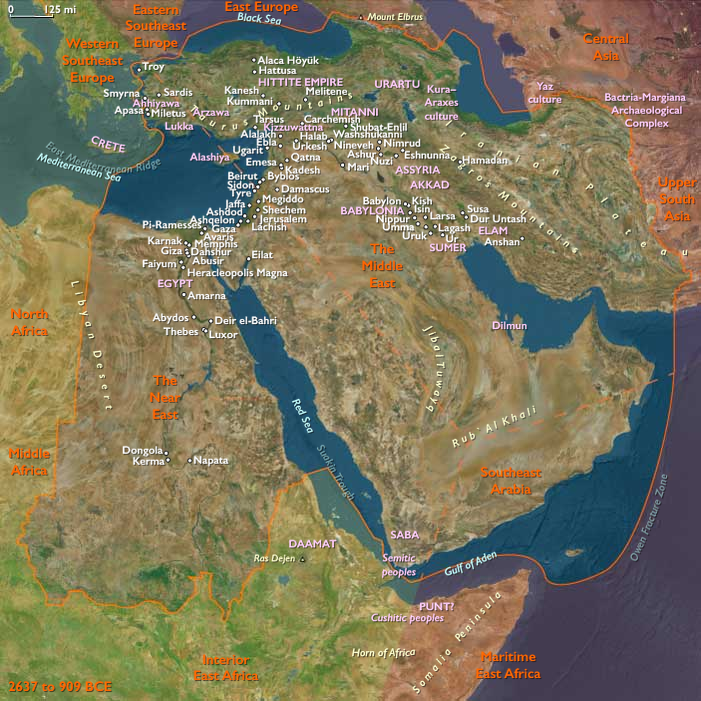
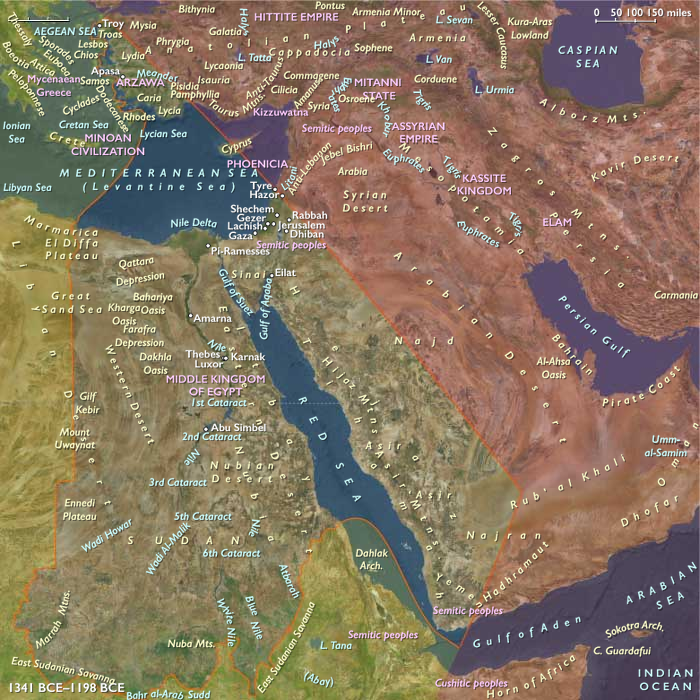
Horemheb, Tutankhamen’s general, repels Hittite incursions on the Egyptian empire in northern Syria.
Tutankhamen, apparently once an active leader of his troops but weakened by a virulent strain of malaria and degenerative bone disease, dies at the age of nineteen or so of infection resulting from a leg fracture.
He is succeeded by his vizier Ay, who marries Tutankhamen's widow and appropriates the king's tomb for himself.
The young king is buried, with linen gloves and numerous pieces of fine gold jewelry embedded with precious stones, at Thebes in the Valley of the Kings; a curse reading "Death comes on swift wings to he who opens this tomb," is inscribed on the tomb’s doorway.
His rich tomb furnishings include a gold sarcophagus with a (now-famous) gold and lapis lazuli funerary mask.
Among the burial items are an iron dagger with a golden hilt.
Also entombed with Tutankhamen is an example of the earliest known military game, alquerque, a two-player game played on a board marked with five diagonal lines.
Each player has twelve pieces and can move them onto vacant intersections or capture an enemy piece by jumping over it to an unoccupied point.
Two relief sets of battle-themed carvings from Tutankhamen's mortuary temple survive, one depicting a Nubian campaign and one larger group that shows the king in a chariot leading the Egyptian forces against a Syrian-style citadel.
Other blocks in the second series depict Tutankhamen receiving prisoners, booty, and the severed hands of the enemy dead, strung on spears: a detail unique in Egyptian art, which, at this time, stresses truthfulness in representation.
Therefore, Tutankhamen’s presence in these scenes indicates the likelihood that he actually participated in these campaigns.
Ay dies in 1323 or 1320; Horemheb succeeds him as pharaoh.
Locations
People
Groups
Topics
Commodoties
Subjects
- Origins
- Commerce
- Writing
- Watercraft
- Sculpture
- Painting and Drawing
- Environment
- Labor and Service
- Conflict
- Games and Sports
- Faith
- Government
- Technology
Regions
Subregions
Related Events
Showing 10 events out of 67253 total
Years: 1329BCE - 1318BCE
Locations
People
Groups
Topics
Commodoties
Subjects
- Origins
- Commerce
- Writing
- Watercraft
- Sculpture
- Painting and Drawing
- Environment
- Labor and Service
- Conflict
- Games and Sports
- Faith
- Government
- Technology
Regions
Subregions