
Holy Roman Emperor Frederick III dies at …
Years: 1493 - 1493
Holy Roman Emperor Frederick III dies at Linz on August 19, 1493, a few weeks shy of his seventy-eighth birthday.
His left foot had become gangrenous, and was amputated.
He survived this procedure, but continued infection prompted amputation of his left leg, after which he was said to have bled to death.
His thirty-four-year-old son Maximilian had been elected King of the Romans in 1486 on his father's initiative, and they had been ruling jointly since then.
Maximilian now also takes over his father's possessions and thus unites the whole Habsburg territory in his hands.
In the same year, the Peace of Senlis also marks the end of his wars against the French about his Burgundian possessions; he keeps the territories in the Netherlands and also the County of Burgundy, but has to cede the Duchy of Burgundy to the French king.
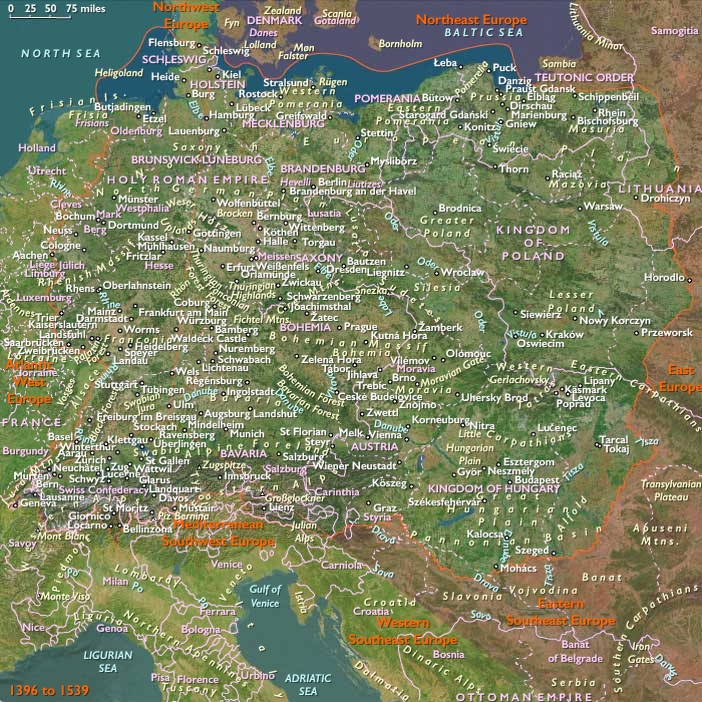
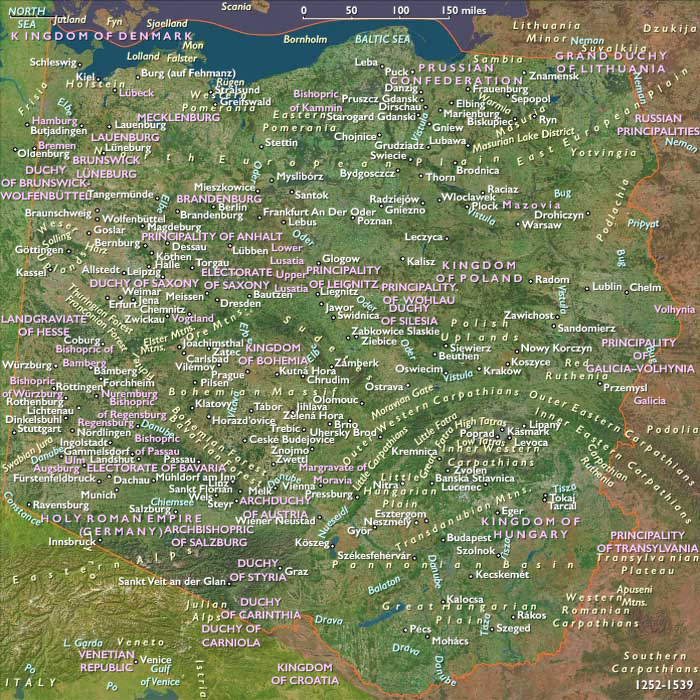
Maximilian thus controls thus territories that nearly encircle the Old Swiss Confederacy: Tyrol and Vorarlberg in the east, Further Austria in the north, and the County of Burgundy in the west.
Locations
People
Groups
- Tyrol, County of
- Austria, Archduchy of
- France, (Valois) Kingdom of
- Holy Roman Empire
- Franche-Comté (province of the Holy Roman Empire)
- Netherlands, Habsburg
Topics
Commodoties
Subjects
Regions
Subregions
Related Events
Filter results
Showing 10 events out of 40265 total
Maximilian I had formed the first mercenary Landsknecht regiments in 1487.
Holy Roman Emperor from 1493 to 1519, he calls upon Georg von Frundsberg, sometimes referred to as the Father of the Landsknechts, to assist him in their organization.
Frundsberg, born to Ulrich von Frundsberg, a captain of the Swabian League forces, and his wife Barbara von Rechberg at Mindelheim, into an old line of Tyrolean knights who had settled in Upper Swabia, had followed his father in the campaign of the Hohenzollern margrave Frederick I of Brandenburg-Ansbach, authorized to execute the Imperial ban against Duke Albert IV of Bavaria in 1492.
As Albert gave in, the expedition had been canceled.
The Landsknechts, formed in conscious imitation of the Swiss mercenaries (and, initially, using Swiss instructors), will eventually contribute to the defeat of the redoubtable Swiss, whose battle formations—over-dependent on hand-to-hand fighting—are becoming vulnerable to the increased firepower of arquebus and artillery.
French artillery or Spanish firepower will deal serious blows to the Swiss formations, and the Landsknecht pike blocks will be there to fight off the depleted Swiss attack columns once this occurs.
Landsknechts will later go on to fight in almost every sixteenth-century military campaign, sometimes on both sides of the engagement.
Books, because they had to be handwritten, had been rare and very expensive before Johannes Gutenberg's invention of the printing press in 1447 had made it feasible to print books and maps for a larger customer basis.
Germany has by the late fifteenth century become the publishing center of Europe.
Hartmann Schedel is best known for his writing the text for the Nuremberg Chronicle, known as Schedelsche Weltchronik, or Schedel's World Chronicle), commissioned by Sebald Schreyer and Sebastian Kammermeister, and published in 1493 in Nuremberg.
Maps in the Chronicle are the first ever illustrations of many cities and countries.
Its publisher, Anton Koberger, born to an established Nuremberg family of bakers, had made his first appearance in 1464 in the Nuremberg list of citizens.
He had married Ursula Ingram in 1470 and after her death he remarried in 1491 to another member of the Nuremberg patriciate, Margarete Holzschuher.
In all, he will father twenty-five children, of whom thirteen will survive to adulthood.
Koberger is the godfather of Albrecht Dürer, whose family lives on the same street.
In the year before Dürer's birth in 1471 he had ceased goldsmithing to become a printer and publisher.
He quickly became the most successful publisher in Germany, absorbing his rivals over the years to become a large capitalist enterprise, with twenty-four presses in operation, printing numerous works simultaneously and employing at its height one hundred workers: printers, typesetters, typefounders, illuminators, and the like.
Koberger’s illustrated edition of Die Weltchronik includes six hundred and forty-five separate woodcuts, among which the most famous are the views of European towns.
Koberger employs as designers such artists as Wilhelm Pleydenwurff, Michael Wolgemut, and the young Albrecht Dürer, who had entered Wolgemut's studio in 1486 at the age of fifteen.
Perkin Warbeck, who, claiming to be Richard of Shrewsbury, Duke of York, had first claimed the English throne at the court of Burgundy in 1490, had explained his (i.e., Richard of Shrewsbury's) mysterious disappearance, by claiming that his brother Edward V had been murdered, but he had been spared by his brother's (unidentified) killers because of his age and "innocence".
He had been made to swear an oath, however, not to reveal his true identity for "a certain number of years".
He had lived from 1483 to 1490 on the continent of Europe under the protection of Yorkist loyalists, but when his main guardian, Sir Edward Brampton, returned to England, he was left free.
He then declared his true identity.
Warbeck had landed in Ireland in 1491 in the hope of gaining support for his claim as Lambert Simnel had four years previously.
However, little support was found and he was forced to return to the European mainland.
Here his fortunes have improved.
He was first received by Charles VIII of France, but in 1492 was expelled under the terms of the Treaty of Etaples, by which Charles had agreed not to shelter rebels against Henry VII.
He has been publicly recognized as Richard of Shrewsbury by Margaret of York, the widow of Charles the Bold, the sister of Edward IV and thus the aunt of the Princes in the Tower.
Whether Margaret truly believes that the pretender is her nephew Richard, or whether she considers him a fraud but supported him anyway, is unknown, but she tutors him in the ways of the Yorkist court.
Henry complains to Philip of Habsburg, Duke of Burgundy, about the harboring of the pretender, and, since he is ignored, imposed a trade embargo on Burgundy, cutting off important Burgundian trade-links with England.
The pretender is also welcomed by various other monarchs and is known in international diplomacy as the Duke of York.
At the invitation of Duke Philip's father, King Maximilian I, in 1493 he attends the funeral of the Emperor Frederick III and is recognized as King Richard IV of England.
The pretender also promises that if he dies before becoming king, his claim will fall to Maximilian.
Frederick’s grave, built by Nikolaus Gerhaert von Leyden, in St. Stephen's Cathedral, Vienna, is one of the most important works of sculptural art of the late Middle Ages. (His amputated leg is buried with him.)
The heavily adorned tomb will not be completed until 1513, two decades after Frederick's death; it survives today in its original condition.
Stephen Bathory, a member of the prominent Hungarian family of the same name and Hungary’s chief justice for twenty-two years, has been governor (vajda) of Transylvania from 1479.
Accused of using excessive cruelty against the Székelys in Transylvania, he is deposed by Vladislaus II in 1493; he dies shortly afterwards.
His family will return to rule as Voivodes, then Princes, of Transylvania.
Songhai emperor Sonni Baru had succeeded his father Sonni Ali on the latter's death on November 6, 1492.
However, one of Sonni Ali's generals, Muhammad Ture, plots to take power, challenging Baru because he is not seen as a faithful Muslim.
As soon as he had made his arrangements for a coup, he attacks Sonni Bāru on February 18, 1493.
Sonni Bāru's army is defeated here and in a second, more decisive battle on April 2, 1493, after which Sonni Bāru flees into exile.
The usurper now takes power as Askia Muhammad Ture, develops an efficient administrative system, organizes a standing army, and makes Islam the empire's official religion.
European influence has been noticeable in Ethiopia during the reign of Eskander.
In a manuscript written by Francesco Suriano (dated to 1482 by Somigli), Suriano describes finding ten Italians "of good repute" residing at Eskender's court, some who had been living there for twenty-five years.
Suriano adds that since 1480, seven more had traveled to the Ethiopian court "to seek jewels and precious stones", but "since the king did not allow them to return, they were all ill content, although they were all well rewarded, each in accordance with his rank." (O.G.S. Crawford, Ethiopian Itineraries, circa 1400-1524 (Cambridge: Hakluyt Society, 1958), pp. 40-54.)
It is in the last years of Eskender's reign that Pêro da Covilhã arrives in Ethiopia, as an envoy from king John II of Portugal.
However, Covilhã is not allowed to return to Portugal, and will be forced to live out his days in Ethiopia—although as a trusted advisor to the Emperors.
Europeans quickly identify Ethiopia’s Coptic Christian rulers with the legendary Christian emperor Prester John.
There are conflicting versions of Emperor Eskender's death, which occurs when he is only twenty-two.
One source holds he was killed fighting the Maya, a vanished ethnic group known for using poisoned arrows, east of Enderta.
On the other hand, both Bruce and the explorer Richard Burton write that Eskender was assassinated at Tegulet: Bruce stating that Zasillus of Amhara was responsible while Burton claiming that the predatory Mahfuz of Zeila had him assassinated.
He is buried in the church of Atronsa Maryam, which his father had begun construction on.
His early death immediately leads to civil war.
While the court keeps the Emperor's death a secret, one major noble, Zasillus, immediately marches to the royal prison of Amba Geshen, frees Na'od, the second son of Baeda Maryam I and his second wife Kalyupe (also called "Calliope"), and proclaims him Emperor.
Another noble, Tekle Kristos, who had remained at the Imperial court, champions Eskender's son Amda Seyon II as emperor.
Although Tekle Kristos' forces defeat the followers of Zasillus, warfare continues through the realm.
The Crnojevic rulers of Zeta, or Montenegro, establishes a Cyrillic printing press—the first printing press in southern Europe—in 1493 at Obod near their new capital of Cetinje.
Girolamo Savonarola had entered the Dominican order at Bologna in 1475 when he was twenty-three, and thirty in 1482 when he was assigned to teach theology at the priory of San Marco in Florence.
The sermons that he preached had been marked by the theme of warning against coming doom.
He had then gone to preach in northern Italy, but had been recalled to Florence in 1490 and become prior of San Marco.
It seems that this was due to the initiative of the humanist philosopher-prince, Giovanni Pico della Mirandola, who had heard Savonarola in a formal disputation in Reggio Emilia and had been impressed with his learning and piety.
Pico is in trouble with the Church for some of his unorthodox philosophical ideas (the famous "900 theses") and is living under the protection of Lorenzo the Magnificent, the Medici de facto ruler of Florence.
To have Savonarola beside him as a spiritual counselor, he had persuaded Lorenzo that the friar would bring prestige to the convent of San Marco and its Medici patrons.
After some delay, apparently due to the interference of his former professor, Fra Vincenzo Bandelli, now Vicar General of the Order, Lorenzo had succeeded in bringing Savonarola back to Florence, where he arrived in May or June of that year.
His sermons have grown more popular and more pointed, with direct attacks on the vices and tyrannical abuses of the Medici government.
Savonarola preaches on the First Epistle of John and on the Book of Revelation, drawing such large crowds that he eventually moves to the Cathedral.
Without mentioning names, he makes pointed allusions to tyrants who usurp the freedom of the people, and he excoriates their allies, the rich and powerful who neglect and exploit he poor.
Complaining of the evil lives of a corrupt clergy, he now calls for repentance and renewal before the arrival of a divine scourge.
Scoffers dismiss him as an overexcited zealot and "preacher of the desperate" and sneer at his growing band of followers as Piagioni – "Weepers" or "Wailers", an epithet they adopt.
In 1492, Savonarola had warned of "the Sword of the Lord over the earth quickly and soon" and envisioned terrible tribulations to Rome.
Around 1493 (these sermons have not survived) he begins to prophesy that a New Cyrus is coming over the mountains to begin the renewal of the Church.
The center of art patronage has shifted from Florence to Rome following the death in 1492 of Medici dynast Lorenzo the Magnificent.
Cesare Borgia, an illegitimate son of Rodrigo de Borgia, the recently elected Pope Alexander VI, is in 1493 created a cardinal at eighteen by his father.
The same year, twenty-five-year-old Alessandro Farnese, a worldly member of the influential Farnese family who has received a thorough education in Rome and Florence, is created a cardinal-deacon.
The new pope, upon receiving the news of Columbus’s landing in the New World, is asked by the Spanish monarchy to confirm their ownership of these newly found lands.
The bulls issued by Pope Alexander VI: Eximiae devotionis (May 3, 1493), Inter Caetera (May 4, 1493) and Dudum Siquidem (September 23, 1493), grant rights to Spain with respect to the newly discovered lands in the Americas similar to those Pope Nicholas V had previously conferred with the bulls Romanus Pontifex and Dum Diversas.
While the enterprising explorers of Spain and Portugal are quick to enslave the indigenous peoples they meet in Africa and the New World, some popes spoke out against the practice.
Pope Eugene IV in 1435 had issued an attack on slavery in his papal bull Sicut Dudum, which included the excommunication of all those who engaged in the slave trade.
A form of indentured servitude is allowed, being similar to a peasant's duty to his liege lord in Europe.
Andrea della Robbia, an able imitator of his late uncle Luca’s style, and the most important artist of ceramic glaze of the times, has carried on the production of the enameled reliefs on a much larger scale than his uncle had ever done; he also extends its application to various architectural uses, such as friezes and to the making of lavabos, fountains and large retables.
One variety of method i introduced in his enameled work.
Sometimes he omits the enamel on the face and hands of his figures, especially in those cases where he has treated the heads in a realistic manner; as, for example, in 1493’s tympanum relief of the meeting of St. Dominick and St. Francis in the loggia of the Florentine hospital of San Paolo, a design suggested by a fresco of Fra Angelico's in the cloister of St Mark's.
Years: 1493 - 1493
Locations
People
Groups
- Tyrol, County of
- Austria, Archduchy of
- France, (Valois) Kingdom of
- Holy Roman Empire
- Franche-Comté (province of the Holy Roman Empire)
- Netherlands, Habsburg
