
Holy Roman Charles IV, ruling from Prague, …
Years: 1372 - 1383
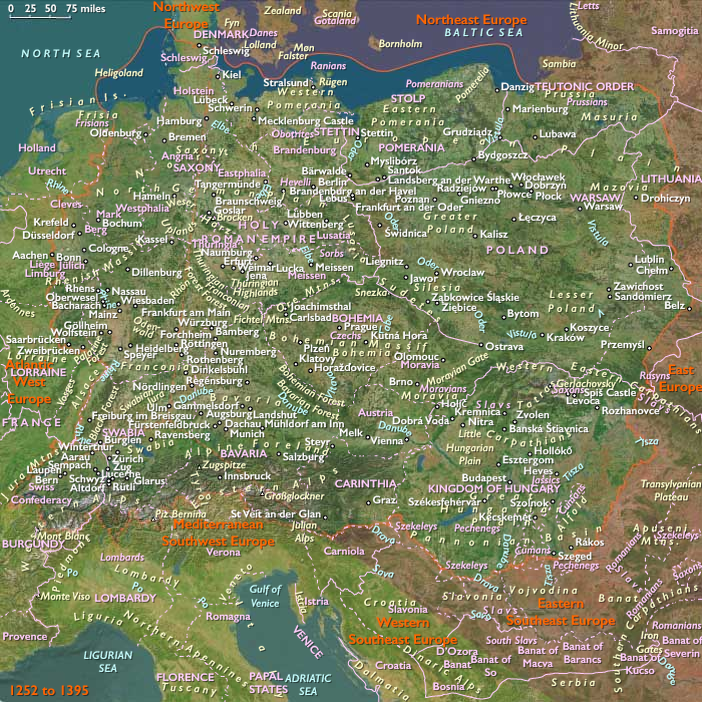
Holy Roman Charles IV, ruling from Prague, adds Brandenburg and Lusatia to his Luxembourg patrimony.
In his core territory of Bohemia, where he is Charles I, he encourages national sentiment without ethnic biases, he has stimulated cultural growth by founding in Prague the first university east of the Rhine; has constructed a magnificent castle, cathedral, and bridge; encourages artists of all kinds; and promotes the writing of historical chronicles.
Locations
People
Groups
- Bohemia, Kingdom of
- Holy Roman Empire
- Luxembourg, independent Duchy of
- Brandenburg, (Luxembourg) Margravate of
Topics
Subjects
Regions
Subregions
Related Events
Filter results
Showing 10 events out of 43832 total
Chế Bồng Nga or Che Bunga, who rules Champa from 1360 until 1390, is the last strong king of the Cham.
Called The Red King in Vietnamese stories, Chế Bồng Nga apparently had managed to unite the Cham lands under his rule and by 1372 he is strong enough to attack and almost conquer Đại Việt from the sea.
Cham forces had sacked Thăng Long, the capital city of Đại Việt located at the site of modern Hanoi, in 1371 and then again in 1377.
This second attack is soon after Tran Due Tong dies attacking Vijaya.
Champa attacks in 1380, 1382, and 1383 are checked by the Vietnamese General Hồ Quý Ly, future founder of the Hồ Dynasty.
Timur the Lame (Tamerlane), having conquered Khwarezm by 1381, initiates a successful onslaught against the rulers and peoples of the Middle East and Transcaucasia, although he is diverted several times by military threats from Tokhtamysh, his former ally and khan of the Golden Horde.
East Europe (1372–1383 CE): Muscovite Dominance and Regional Realignments
Political and Military Developments
Further Decline of Golden Horde Power
Between 1372 and 1383 CE, the internal fracturing of the Golden Horde accelerated, significantly diminishing its political influence over East Europe. This continued fragmentation created opportunities for increased autonomy among regional principalities.
Expansion and Stabilization of Muscovite Control
Moscow significantly expanded its territorial reach and reinforced political authority, benefiting from weakening Mongol oversight. Muscovite leaders consolidated regional governance, enhancing administrative structures and fortifying centralized rule.
Ethnic Integration and Governance
Integration of ethnic groups, including the Mari, Mordvins, Udmurts, Komi, and Vepsians, deepened further. These communities became increasingly central to the administrative and demographic frameworks of the growing Muscovite domain.
Economic and Technological Developments
Economic Expansion and Local Prosperity
The regional economy continued to flourish, supported by robust internal trade networks and enduring Eurasian commercial ties. Cities such as Moscow, Novgorod, and Tver prospered significantly, benefiting from increased trade activities and stable governance.
Military Enhancements and Technological Innovation
Muscovite principalities further advanced military technologies, refining cavalry tactics, siege warfare, and fortification designs. These improvements substantially bolstered regional defensive and offensive military capabilities.
Cultural and Artistic Developments
Continuing Cultural Synthesis and Innovation
Artistic and architectural traditions flourished with influences from Rus', Mongol, and various ethnic groups merging into distinct, innovative styles. Religious and secular arts reflected this diverse cultural blending.
Literary and Intellectual Productivity
Chroniclers and scholars continued robust literary production, documenting historical, religious, and cultural narratives. This intellectual work preserved and reinforced regional identity amid changing political landscapes.
Settlement Patterns and Urban Development
Urban Growth and Infrastructure Improvement
Cities such as Moscow, Novgorod, and Tver continued their demographic and economic expansion. Urban infrastructure developed further, supporting increasing populations, commerce, and administrative needs.
Advancement in Fortifications and Defense
Strategic fortifications were continually enhanced, protecting urban centers from internal and external threats. Improved defense systems helped maintain regional stability and security.
Social and Religious Developments
Complex Social Hierarchies and Integration
Social structures evolved with greater complexity, integrating diverse ethnic communities into broader Muscovite society. Aristocratic and administrative hierarchies adapted to reflect this diversity and maintain regional cohesion.
Orthodox Church as Cultural Keystone
The Orthodox Church solidified its central role further, continuing to guide cultural norms, education, and community cohesion. Its moral and social influence was vital in preserving regional identity and continuity.
Long-Term Consequences and Historical Significance
The period from 1372 to 1383 CE marked significant Muscovite expansion, further decline of the Golden Horde, and increased ethnic integration. These developments profoundly influenced regional stability, contributing substantially to the foundation of a unified Russian state and diverse cultural identity.
Northeast Europe (1372–1383 CE): Diplomatic Realignments, Regional Stability, and Economic Resurgence
Between 1372 and 1383 CE, Northeast Europe continued its trajectory toward regional stability, following the severe disruptions caused by earlier demographic crises. The Teutonic Order strengthened its territorial holdings, diplomatic interactions among Scandinavian powers intensified, and economic revival gained momentum, shaping the region's political and economic landscape.
Teutonic Order’s Strengthened Control in Estonia and Prussia
During this period, the Teutonic Order continued consolidating its authority in the recently acquired territory of Estonia (1346). The administrative center of Reval (Tallinn) saw significant military and administrative enhancements, notably on fortified Toompea Hill. Similarly, in Prussia, the Order reinforced its governance structures and fortified cities such as Königsberg, enhancing its political and economic presence across the region.
Diplomatic Foundations Among Scandinavian Powers
Diplomatic engagement among the Scandinavian kingdoms of Denmark, Norway, and Sweden intensified, driven by mutual interests in economic cooperation, maritime trade, and collective security. These ongoing discussions established foundational diplomatic patterns that would later culminate in the Kalmar Union. Strategic considerations, such as countering external threats and promoting internal stability, motivated these initial diplomatic overtures.
Continued Swedish Integration and Administration in Finland
Sweden expanded its efforts to integrate southern Finland politically, economically, and culturally. By reinforcing strategic fortifications, ecclesiastical institutions, and administrative systems, Sweden ensured robust defense and coherent governance in Finnish territories, further solidifying regional stability and cultural integration.
Stability and Prosperity in the Livonian Confederation
The Livonian Confederation, centered in the economically vibrant city of Riga, continued to successfully navigate regional complexities through effective diplomacy, fortified urban defenses, and internal administrative reforms. Leveraging its strategic location for maritime trade, the Confederation maintained economic prosperity and political autonomy, effectively balancing relationships with neighboring powers.
Economic Resurgence in Major Urban Centers
Urban centers, notably Reval (Tallinn), Riga, Königsberg, and Visby on Gotland, experienced sustained economic growth through revitalized trade networks and merchant activities. Maritime commerce expanded significantly, helping cities rebound from prior disruptions and strengthening regional economic stability.
Ecclesiastical Institutions and Cultural Cohesion
Influential ecclesiastical institutions, notably the Teutonic Order and regional bishoprics, remained critical to the region’s social, educational, and cultural continuity. These institutions upheld Latin Christian traditions, supported education and social welfare, and provided cohesive structures during a period of broader geopolitical changes.
Strategic Geopolitical Realignments
Diplomatic engagements and shifting alliances characterized geopolitical interactions across Northeast Europe. The Teutonic Order, Scandinavian kingdoms, and the Livonian Confederation engaged in strategic diplomacy, seeking equilibrium amidst complex regional rivalries and internal challenges. This diplomacy was essential in maintaining regional stability and shaping future political alignments.
Legacy of the Era
The era from 1372 to 1383 CE marked continued territorial consolidation, increased diplomatic interaction, sustained economic revival, and strengthened regional integration. These developments significantly influenced the region’s political structures, economic foundations, and cultural identities, laying critical groundwork for subsequent historical progress in Northeast Europe.
Venice, supported by the Ottoman Turks, wars with Genoa, backed by Hungary.
The Western Schism (1378–1417): A Divided Papacy
The Western Schism was a major crisis in the Roman Catholic Church that lasted from 1378 to 1417, during which there were two, and later three, rival popes, each claiming legitimate authority. This deep division shattered Catholic unity, weakened papal authority, and destabilized European politics.
Origins of the Schism (1378)
- The crisis began in 1378 following the death of Pope Gregory XI, who had recently returned the papacy from Avignon to Rome after nearly 70 years of papal residency in France (1309–1377).
- Amid intense pressure from the Roman populace, the College of Cardinals elected Urban VI, an Italian, as pope.
- Many French cardinals, unhappy with Urban VI's temperament and reforms, declared his election invalid and elected Clement VII, who returned the papal court to Avignon.
- This resulted in two rival popes, each claiming to be the true successor of St. Peter.
The Rival Papacies and Their Alliances
- Rome (Pope Urban VI and successors) – Supported by England, the Holy Roman Empire, Portugal, and most of Italy.
- Avignon (Pope Clement VII and successors) – Supported by France, Scotland, Castile, and Aragon.
For nearly 40 years, Catholic Europe was divided, with each pope excommunicating the followers of the other and maintaining his own Sacred College of Cardinals and Curia.
The Three-Pope Crisis (1409–1417)
- In 1409, the Council of Pisa attempted to resolve the schism by deposing both rival popes and electing a new pope, Alexander V.
- However, instead of resolving the issue, this resulted in three competing popes, as the two deposed popes refused to step down.
- The crisis deepened, discrediting the moral and political authority of the papacy.
The Council of Constance and the End of the Schism (1417)
- The crisis was finally resolved at the Council of Constance (1414–1418).
- In 1417, all three competing popes were either deposed or resigned, and the council elected Martin V, restoring a single papacy in Rome.
- This ended the Western Schism, but the Church’s credibility suffered lasting damage, fueling anti-clerical sentiment and calls for reform that later contributed to the Protestant Reformation (1517).
Impact of the Western Schism
- Weakened Papal Authority – The schism shattered the idea of an unquestionable pope, reducing the Church’s influence over European monarchs.
- Rise of Conciliarism – The crisis strengthened the belief that Church councils, not just the pope, should have ultimate authority, a notion that clashed with papal supremacy.
- Political Consequences – The division deepened national rivalries, as popes became aligned with secular rulers, entangling the papacy in dynastic struggles.
The Western Schism was one of the most damaging crises in Church history, exposing the political nature of the papacy and laying the groundwork for future religious upheavals in Europe.
Wallachia becomes independent of Hungary.
East Central Europe (1372–1383 CE): Dynastic Unions, Bohemian Prestige, Hungarian-Polish Union, and Imperial Fragmentation
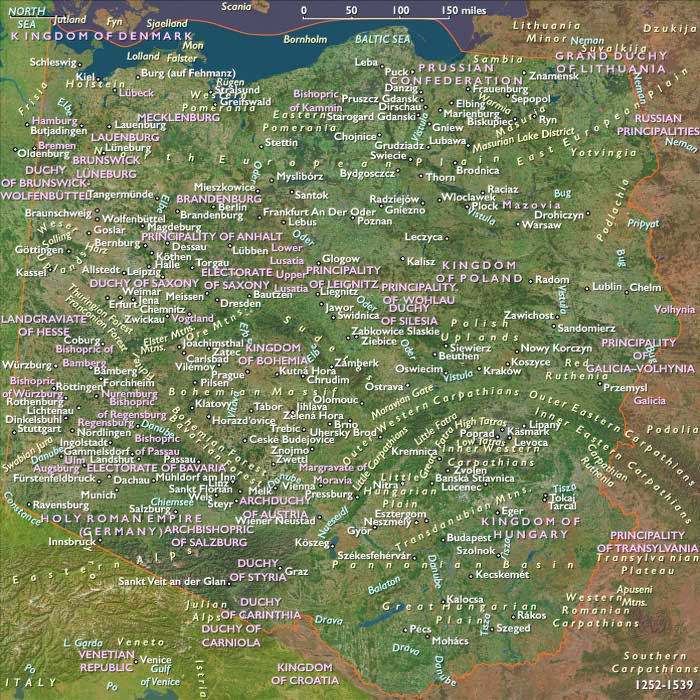
Between 1372 and 1383 CE, East Central Europe experienced significant dynastic transformations, highlighted by the personal union of Hungary and Poland under Louis I, continued Bohemian prestige under Emperor Charles IV, and deepening rivalries among the Habsburg, Luxembourg, and Wittelsbach dynasties. Imperial fragmentation intensified as regional states and cities pursued greater autonomy, reshaping political alignments. Meanwhile, cultural and economic life flourished, driven by urban growth and expanded trade networks connecting the Hanseatic cities of the Baltic to wider European markets.
Political and Military Developments
Hungarian-Polish Personal Union under Louis I
-
In 1370, following the death of Poland’s Casimir III, Louis I of Hungary assumed the Polish throne, establishing a dynastic union between Hungary and Poland. Although his rule over Poland proved complicated by powerful local nobility and differing political traditions, this union substantially altered regional geopolitical dynamics.
-
Louis’s administrative reforms strengthened centralized monarchy in Hungary, reinforcing its position as a major European power.
Bohemian Prestige under Charles IV
-
Emperor Charles IV of Luxembourg (r. Holy Roman Emperor 1355–1378; King of Bohemia 1346–1378) maintained Bohemia’s cultural and political prestige within Europe. Under his patronage, Prague flourished as an imperial capital, cultural center, and diplomatic hub.
-
The end of Charles’s reign (1378) introduced new uncertainties, setting the stage for future conflicts, notably between his sons, Wenceslaus IV and Sigismund.
Intensified Imperial Rivalries and Fragmentation
-
Imperial rivalries among the dynasties of the Holy Roman Empire intensified, particularly between the Luxembourgs in Bohemia, the Habsburgs in Austria, and the Wittelsbachs in Bavaria. Fragmentation and competition among these dynasties reshaped alliances and destabilized regional politics.
-
In Austria, Habsburg territories saw increased internal consolidation, setting the foundation for future Austrian prominence.
Brandenburg, Mecklenburg, and Northern Principalities
-
The Margraviate of Brandenburg, ruled by the House of Luxembourg after 1373, experienced strategic territorial consolidations and administrative reforms.
-
Northern principalities, such as the Duchy of Mecklenburg and the Principality of Brunswick-Wolfenbüttel, retained political stability, experiencing moderate growth and greater economic integration within the Hanseatic trade networks.
Thuringian Succession and Territorial Stability
-
The aftermath of the earlier War of the Thuringian Succession stabilized the political landscape in central Germany, allowing the Duchy of Thuringia to recover economically and politically, while still influencing regional politics within the empire.
Economic and Technological Developments
Expansion of Hanseatic Commerce
-
Economic growth intensified across the Baltic and North Sea regions, driven by the robust trade activities of Hanseatic cities such as Lübeck, Gdańsk, Wrocław, Toruń, and Kraków. This growth supported urban prosperity and reinforced economic links throughout northern and central Europe.
Urban Infrastructure and Technological Improvements
-
Continued urbanization and infrastructure improvements supported trade and economic development, with notable expansions in Prague, Vienna, Kraków, Bratislava, and Wrocław.
-
Technological innovations, especially in textile production, metalworking, and agriculture, further stimulated regional economies, supporting recovery from earlier demographic crises.
Cultural and Artistic Developments
Prague’s Continued Cultural Prominence
-
Under Charles IV’s late reign, Prague solidified its position as a major cultural and intellectual center, characterized by significant Gothic architectural projects and flourishing literary and artistic production.
-
After Charles IV’s death (1378), Prague’s cultural vitality continued, although political uncertainties introduced greater instability.
Polish and Hungarian Artistic Flourishing
-
Polish territories under the brief Hungarian union experienced notable artistic and architectural developments, evident in the expansion of royal and ecclesiastical structures, illuminated manuscripts, and Gothic architectural projects in Kraków and Gniezno.
-
Hungarian territories under Louis I saw continued cultural patronage, particularly through church-building, castle construction, and artistic commissions in Buda and Visegrád.
Ecclesiastical Influence and Patronage
-
Ecclesiastical institutions such as the Archbishopric of Salzburg and prominent bishoprics like Passau, Regensburg, and Bamberg remained significant cultural patrons, supporting extensive artistic and scholarly activities.
Settlement and Urban Development
Increased Urbanization and Economic Stability
-
Urban centers, notably Prague, Vienna, Kraków, Lübeck, Toruń, Bratislava, and Gdańsk, grew significantly, supported by increased trade, improved infrastructure, and strengthened fortifications. These developments promoted regional economic stability and resilience.
Continued Germanic Migration (Ostsiedlung)
-
Germanic settlement continued reshaping regional demographics, especially in Brandenburg, Silesia, Lusatia, and Mecklenburg, further influencing cultural integration, urban development, and economic productivity.
Social and Religious Developments
Aristocratic Power and Feudal Stability
-
Aristocratic and noble power structures remained robust, adapting to demographic and economic shifts. Feudal arrangements continued evolving, stabilizing regional governance despite broader imperial fragmentation and dynastic tensions.
Ecclesiastical Authority and Religious Culture
-
Powerful ecclesiastical institutions maintained substantial social, economic, and cultural influence, fostering religious education, charity, artistic production, and reinforcing societal cohesion during periods of dynastic and political uncertainty.
Long-Term Consequences and Historical Significance
The era 1372–1383 CE was marked by significant dynastic unions and shifts in East Central Europe. The Hungarian-Polish personal union under Louis I profoundly reshaped regional political alliances and governance structures. The enduring cultural prestige of Bohemia under Charles IV underscored Prague’s continued importance in Central Europe. Simultaneously, intensified imperial rivalries among the Habsburg, Luxembourg, and Wittelsbach dynasties contributed to regional fragmentation and set the stage for prolonged dynastic conflicts. Economic prosperity and cultural vitality fostered resilience, enabling urban and rural societies to stabilize and flourish. Collectively, these developments significantly influenced East Central Europe’s subsequent historical trajectory, defining political alignments and cultural identities for centuries to come.
East Central Europe (1372–1383 CE): Dynastic Unions, Bohemian Prestige, Hungarian-Polish Union, and Imperial Fragmentation
Between 1372 and 1383 CE, East Central Europe experienced significant dynastic transformations, highlighted by the personal union of Hungary and Poland under Louis I, continued Bohemian prestige under Emperor Charles IV, and deepening rivalries among the Habsburg, Luxembourg, and Wittelsbach dynasties. Imperial fragmentation intensified as regional states and cities pursued greater autonomy, reshaping political alignments. Meanwhile, cultural and economic life flourished, driven by urban growth and expanded trade networks connecting the Hanseatic cities of the Baltic to wider European markets.
Political and Military Developments
Hungarian-Polish Personal Union under Louis I
-
In 1370, following the death of Poland’s Casimir III, Louis I of Hungary assumed the Polish throne, establishing a dynastic union between Hungary and Poland. Although his rule over Poland proved complicated by powerful local nobility and differing political traditions, this union substantially altered regional geopolitical dynamics.
-
Louis’s administrative reforms strengthened centralized monarchy in Hungary, reinforcing its position as a major European power.
Bohemian Prestige under Charles IV
-
Emperor Charles IV of Luxembourg (r. Holy Roman Emperor 1355–1378; King of Bohemia 1346–1378) maintained Bohemia’s cultural and political prestige within Europe. Under his patronage, Prague flourished as an imperial capital, cultural center, and diplomatic hub.
-
The end of Charles’s reign (1378) introduced new uncertainties, setting the stage for future conflicts, notably between his sons, Wenceslaus IV and Sigismund.
Intensified Imperial Rivalries and Fragmentation
-
Imperial rivalries among the dynasties of the Holy Roman Empire intensified, particularly between the Luxembourgs in Bohemia, the Habsburgs in Austria, and the Wittelsbachs in Bavaria. Fragmentation and competition among these dynasties reshaped alliances and destabilized regional politics.
-
In Austria, Habsburg territories saw increased internal consolidation, setting the foundation for future Austrian prominence.
Brandenburg, Mecklenburg, and Northern Principalities
-
The Margraviate of Brandenburg, ruled by the House of Luxembourg after 1373, experienced strategic territorial consolidations and administrative reforms.
-
Northern principalities, such as the Duchy of Mecklenburg and the Principality of Brunswick-Wolfenbüttel, retained political stability, experiencing moderate growth and greater economic integration within the Hanseatic trade networks.
Thuringian Succession and Territorial Stability
-
The aftermath of the earlier War of the Thuringian Succession stabilized the political landscape in central Germany, allowing the Duchy of Thuringia to recover economically and politically, while still influencing regional politics within the empire.
Economic and Technological Developments
Expansion of Hanseatic Commerce
-
Economic growth intensified across the Baltic and North Sea regions, driven by the robust trade activities of Hanseatic cities such as Lübeck, Gdańsk, Wrocław, Toruń, and Kraków. This growth supported urban prosperity and reinforced economic links throughout northern and central Europe.
Urban Infrastructure and Technological Improvements
-
Continued urbanization and infrastructure improvements supported trade and economic development, with notable expansions in Prague, Vienna, Kraków, Bratislava, and Wrocław.
-
Technological innovations, especially in textile production, metalworking, and agriculture, further stimulated regional economies, supporting recovery from earlier demographic crises.
Cultural and Artistic Developments
Prague’s Continued Cultural Prominence
-
Under Charles IV’s late reign, Prague solidified its position as a major cultural and intellectual center, characterized by significant Gothic architectural projects and flourishing literary and artistic production.
-
After Charles IV’s death (1378), Prague’s cultural vitality continued, although political uncertainties introduced greater instability.
Polish and Hungarian Artistic Flourishing
-
Polish territories under the brief Hungarian union experienced notable artistic and architectural developments, evident in the expansion of royal and ecclesiastical structures, illuminated manuscripts, and Gothic architectural projects in Kraków and Gniezno.
-
Hungarian territories under Louis I saw continued cultural patronage, particularly through church-building, castle construction, and artistic commissions in Buda and Visegrád.
Ecclesiastical Influence and Patronage
-
Ecclesiastical institutions such as the Archbishopric of Salzburg and prominent bishoprics like Passau, Regensburg, and Bamberg remained significant cultural patrons, supporting extensive artistic and scholarly activities.
Settlement and Urban Development
Increased Urbanization and Economic Stability
-
Urban centers, notably Prague, Vienna, Kraków, Lübeck, Toruń, Bratislava, and Gdańsk, grew significantly, supported by increased trade, improved infrastructure, and strengthened fortifications. These developments promoted regional economic stability and resilience.
Continued Germanic Migration (Ostsiedlung)
-
Germanic settlement continued reshaping regional demographics, especially in Brandenburg, Silesia, Lusatia, and Mecklenburg, further influencing cultural integration, urban development, and economic productivity.
Social and Religious Developments
Aristocratic Power and Feudal Stability
-
Aristocratic and noble power structures remained robust, adapting to demographic and economic shifts. Feudal arrangements continued evolving, stabilizing regional governance despite broader imperial fragmentation and dynastic tensions.
Ecclesiastical Authority and Religious Culture
-
Powerful ecclesiastical institutions maintained substantial social, economic, and cultural influence, fostering religious education, charity, artistic production, and reinforcing societal cohesion during periods of dynastic and political uncertainty.
Long-Term Consequences and Historical Significance
The era 1372–1383 CE was marked by significant dynastic unions and shifts in East Central Europe. The Hungarian-Polish personal union under Louis I profoundly reshaped regional political alliances and governance structures. The enduring cultural prestige of Bohemia under Charles IV underscored Prague’s continued importance in Central Europe. Simultaneously, intensified imperial rivalries among the Habsburg, Luxembourg, and Wittelsbach dynasties contributed to regional fragmentation and set the stage for prolonged dynastic conflicts. Economic prosperity and cultural vitality fostered resilience, enabling urban and rural societies to stabilize and flourish. Collectively, these developments significantly influenced East Central Europe’s subsequent historical trajectory, defining political alignments and cultural identities for centuries to come.
Years: 1372 - 1383
Locations
People
Groups
- Bohemia, Kingdom of
- Holy Roman Empire
- Luxembourg, independent Duchy of
- Brandenburg, (Luxembourg) Margravate of
Topics
Subjects
Regions
Subregions