
…Hierapytna and their other Cretan allies. …
Years: 200BCE - 200BCE
…Hierapytna and their other Cretan allies.
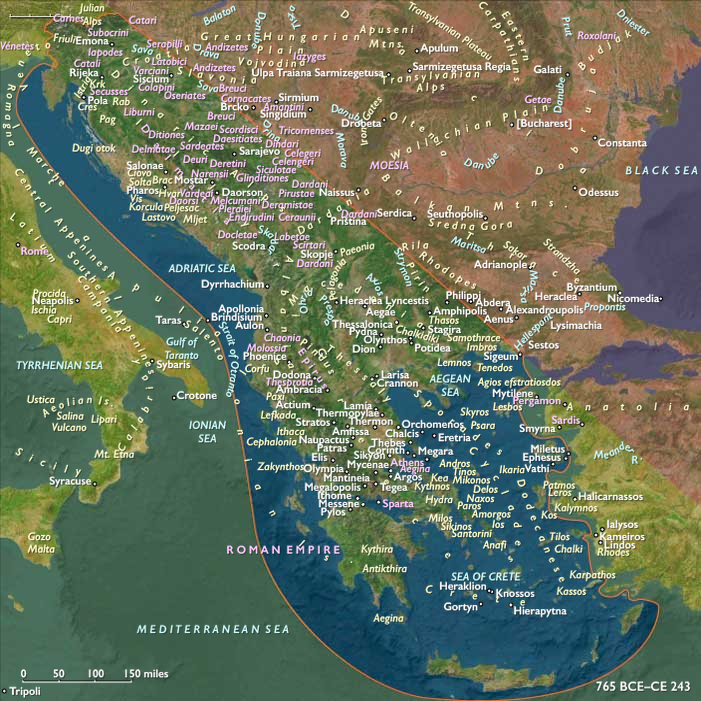
Rhodes' search for allies in Crete bears fruit when the Cretan city of Knossos sees that the war is going in Rhodes' favor and decides to join Rhodes in an attempt to gain supremacy over the island.
Many other cities in central Crete subsequently join Rhodes and Knossos against Hierapytna and Olous.
Now under attack on two fronts, Hierapytna surrenders.
Under the treaty signed at the conclusion of the war, Hierapytna agrees to break off all relations and alliances with foreign powers and to place all its harbors and bases at Rhodes' disposal.
Olous, among the ruins of which the terms of the treaty have been found, has to accept Rhodian domination.
As a result, Rhodes is left with control of a significant part of eastern Crete after the war.
The conclusion of the war leaves the Rhodians free to help their allies in the Second Macedonian War.
The war has no particular short-term effect on the rest of Crete.
Pirates and mercenaries here continue in their old occupations after the war's end.
In the Battle of Cynoscephalae during the Second Macedonian War three years later, Cretan mercenary archers will fight for both the Romans and the Macedonians.
The war has been costly for Philip and the Macedonians, losing them a fleet that had taken three years to build as well as the triggering the defection of their Greek allies, the Achean League and the Aetolian League to the Romans.
Locations
People
Groups
- Rhodes, City-States of
- Sparta, Kingdom of
- Roman Republic
- Athens, City-State of
- Aetolian League
- Greece, Hellenistic
- Macedon, Antigonid Kingdom of
- Egypt, Ptolemaic Kingdom of
- Bithynia, Kingdom of
- Pergamon (Pergamum), Kingdom of
- Achaean League, Second
- Seleucid Empire
Topics
Commodoties
Subjects
Regions

Subregions
Years: 200BCE - 200BCE
Locations
People
Groups
- Rhodes, City-States of
- Sparta, Kingdom of
- Roman Republic
- Athens, City-State of
- Aetolian League
- Greece, Hellenistic
- Macedon, Antigonid Kingdom of
- Egypt, Ptolemaic Kingdom of
- Bithynia, Kingdom of
- Pergamon (Pergamum), Kingdom of
- Achaean League, Second
- Seleucid Empire
Topics
Commodoties
Subjects
Regions
Subregions