Herod, while in Aquileia in 12 BCE, …
Years: 11BCE - 11BCE
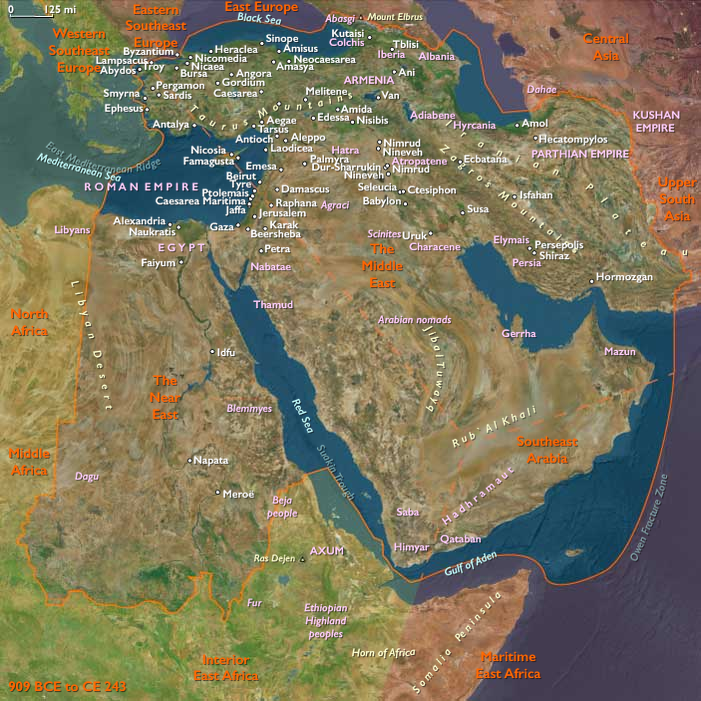
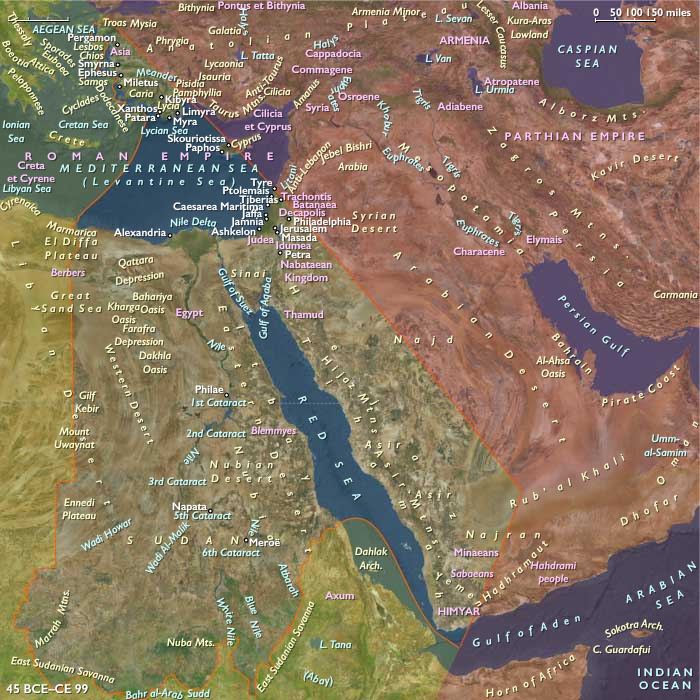
Herod, while in Aquileia in 12 BCE, had obtained from Augustus the lease copper mining rights on Cyprus, after which many Jews emigrate to the island.
Locations
People
Groups
Topics
Commodoties
Subjects
Regions
Subregions
Related Events
Filter results
Showing 10 events out of 62133 total
Julia has become a widow for the second time.
Augustus, who has no son, wishes to prevent a recurrence of civil warfare by arranging for his successors during his lifetime.
He wants Julia suitably married at once and chooses Tiberius as her third husband, against both their wishes.
Obediently, Tiberius divorces Vipsania (daughter of a previous marriage of Agrippa), the woman he dearly loves, and marries Julia in 11 BCE.
The same year, Augustus adopts Julia and Agrippa’s infant sons Gaius and Lucius as his sons.
In case of Augustus' death, Tiberius is to act as tutor of the emperor’s two grandsons, a role that he resents.
Drusus had been sent in 13 BCE to govern Gaul to quell riots caused by the actions of a previous administrator.
While he was present, a tribe of Germans had entered Gaul and proceeded to attack Roman settlements.
Drusus had mobilized his legions and beat the invaders back across the Rhine, then marched into Germany to defeat a superior force of Sicambri at the Lippe River the following year.
Penetrating deep into German territory, he travels as far as the North Sea and places a yearly tribute on the Frisii.
The Romans thus extend their empire north as far as the Rhine River in the present Netherlands, long occupied by such Germanic tribes as the Batavi and Frisii.
The victorious Drusus, in a show of Roman might, parades his legions back and forth between the Elbe and the Rhine.
As a reward, Drusus is made praetor urbanus for 11 BCE.
Drusus, who does not have it in him to stay in Rome, sets out in the spring of his term for the German border once more.
He pushes again into the territory of the various German tribes, only stopping at the onset of winter.
Attacked while making his way back to Roman territory, he manages to rout the German force.
His troops proclaim him Imperator and he is granted triumphal ornaments, as well as the office of proconsul for the following year.
Caesarea Maritima, where Herod has built his palace on a promontory jutting out into the sea, with a decorative pool surrounded by stoas, had in 13 BCE become the civilian and military capital of Iudaea Province and the official residence of the Roman procurators.
Josephus describes the harbor as being as large as the one at Piraeus, the major harbor of Athens.
Herod in 10 BCE completes the construction of the city.
The newly expanded temple in Jerusalem is inaugurated in 10 BCE; in this year, Herod initiates another war against the Nabateans.
Agrippa's death in 12 BCE had elevated Tiberius and Drusus with respect to the succession.
The marriage between Tiberius and Julia was blighted almost from the start, and the son that Julia will bear him dies in infancy.
Suetonius alleges that Tiberius had a low opinion of Julia's character, while Tacitus claims that she disdained Tiberius as an unequal match and even sent her father a letter, written by Sempronius Gracchus, denouncing him.
Reportedly, Tiberius once ran into Vipsania again, and proceeded to follow her home crying and begging forgiveness; soon afterwards, Tiberius met with Augustus, and steps were taken to ensure that Tiberius and Vipsania would never meet again.
The Chatti join with the Sicambri in 10 BCE and attack Drusus' camp, but are easily defeated.
Drusus then goes to meet Augustus and Tiberius in Lugdunum (at which point Claudius was born), and travels with them to Rome.
The Middle East: 9 BCE–CE 3
Diplomatic Compromise and Continued Rivalry
Tensions between Rome and Parthia threaten renewed hostilities until a diplomatic compromise is reached in CE 1. Phraates V of Parthia negotiates with Gaius Caesar, the adopted son and heir apparent of Emperor Augustus, securing a crucial agreement. Under this accord, Parthia commits to withdrawing its military forces from Armenia and acknowledges a de facto Roman protectorate over the strategically vital region.
Despite this diplomatic resolution, the rivalry between Rome and Parthia over Armenia remains intense. The kingdom continues to serve as a critical buffer state, pivotal to both powers' ambitions for regional dominance and influence. This arrangement thus does little to ease long-term geopolitical tensions, as Roman-Parthian competition for influence in Armenia is set to continue unabated for decades to come.
Throughout this era, Roman diplomacy and military strategy in the broader Middle East are marked by caution combined with assertiveness. Rather than seeking direct military confrontations, Rome reinforces its regional dominance through a system of client states and carefully brokered treaties. This nuanced diplomatic approach aims at securing regional stability and protecting Rome’s eastern frontier, highlighting a period defined by strategic diplomacy amid persistent underlying rivalries.
Tensions between Rome and Parthia threaten renewed war until Phraates V of Parthia works out a compromise with Gaius Caesar, the adopted son of Emperor Augustus, in CE 1.
According to the agreement, Parthia undertakes to withdraw its forces from Armenia and to recognize a de facto Roman protectorate there, but Roman–Persian rivalry over control and influence in Armenia will continue unabated for the next several decades.
Near East (9 BCE–CE 3): Consolidation Under Rome and Herodian Rule
The Near East in this era remains firmly within the Roman imperial orbit, as Augustus Caesar continues to consolidate his vast territorial dominions. Egypt, now securely established as a critical Roman province, remains the Empire’s essential breadbasket, supplying Rome with grain shipments vital for urban stability and imperial control.
In Judea, Herod the Great, Rome’s influential and powerful client king, continues his extensive construction projects, further reshaping the region’s landscape and infrastructure. The Second Temple in Jerusalem, whose reconstruction Herod had initiated around 20 BCE, progresses toward completion, becoming a spectacular architectural and religious monument symbolic of Jewish identity and Herod’s political ambitions.
Herod also maintains diplomatic relations with Augustus and seeks to strengthen his regime through marriages and political alliances among the various ethnic and religious communities under his rule. Despite these efforts, his reign is marked by family intrigues, paranoia, and ruthless suppression of potential rivals, leading to growing tensions among his subjects.
Around 4 BCE, following Herod’s death, Judea becomes embroiled in succession struggles among his sons, eventually resulting in the division of his kingdom. Rome intervenes directly, appointing Herod’s son Herod Archelaus as ethnarch over Judea, Samaria, and Idumea, while dividing the remainder of Herod’s territories among other sons such as Herod Antipas and Philip the Tetrarch.
Legacy of the Era
The period from 9 BCE to CE 3 solidifies Rome’s administrative and cultural influence in the Near East, marked prominently by Herodian building projects and political structures. The death of Herod the Great and subsequent political fragmentation significantly impact the region, setting the stage for further Roman intervention and administration, and ultimately shaping the socio-political context into which early Christianity would soon emerge.