Herod supports the Jews in Anatolia and …
Years: 14BCE - 14BCE
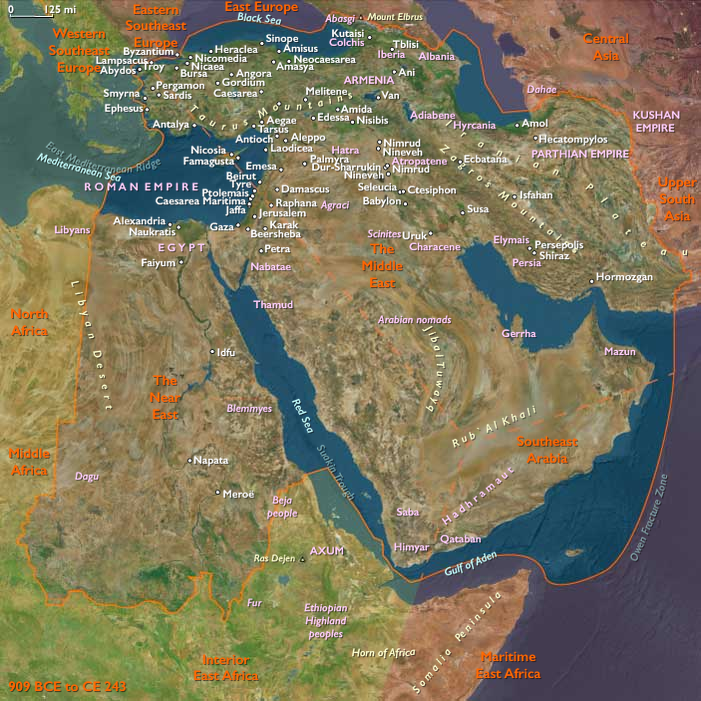
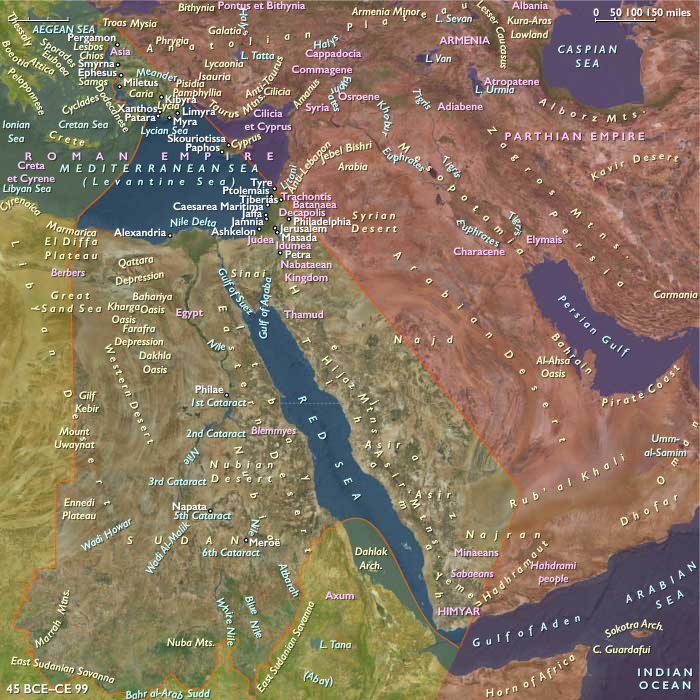
Herod supports the Jews in Anatolia and Cyrene: in 14 BCE, owing to the prosperity in Judaea, he waives a quarter of the customary taxes.
Locations
People
Groups
Topics
Commodoties
Subjects
Regions
Subregions
Related Events
Filter results
Showing 10 events out of 62140 total
Marcus Vinicius, born the son of a Roman knight at Cales in Regio I (Latium et Campania) of Italia, had distinguished himself as legatus Augusti pro praetore (governor) of the Roman province of Gallia Belgica in 25 BCE, when he led a successful campaign into Germania.
At some point, Vinicius may also have served as governor of the Roman province of Achaea; an inscription from Corinth, dated to 18-12 BCE and honoring his fellow-general, and the Emperor's right-hand man, Agrippa, reveals that an administrative division of the city had been named the tribus Vinicia, apparently in Vinicius' honor.
In recognition of his services, Vinicius, the archetypal homo novus, had been appointed suffect consul in 19 BCE, replacing C. Sentius Saturninus and holding the office together with Q. Lucretius Vespillo.
After his consulship, Vinicius continues to be entrusted with important military commands.
Starting in 14 or 13 BCE, Vinicius serves as governor of Illyricum where he is in charge of the early stages of the Roman conquest of Pannonia (the bellum Pannonicum, 14 - 9 BCE) until Augustus' stepson and future successor as Emperor, Tiberius, assumes overall command.
With the Scordisci as allies, Vinicius takes Sirmium.
During or shortly after this war, he becomes the first Roman general to campaign on the far side of the river Danube: he routs an army of Dacians and Bastarnae and subjugates the Celtic tribes of the Hungarian Plain.
Throughout his life, Vinicius seems to have enjoyed a close friendship with the emperor: the historian Suetonius quotes a letter by Augustus in which he talks about playing dice with Vinicius and his fellow homo novus, Publius Silius Nerva.
The Pyramid of Cestius, built about 18–12 BCE as a funerary monument for Gaius Cestius, a magistrate and member of one of the four great religious corporations in Rome, the Septemviri Epulonum, is the first (and, for centuries to come, the only) European structure built in imitation of the pyramids of ancient Egypt.
It stands at a fork between two ancient roads, the Via Ostiensis and another road that runs west to the Tiber along the approximate line of the modern Via della Marmorata.
It is constructed of brick-faced concrete covered with slabs of white marble standing on a travertine foundation, measuring one hundred Roman feet (29.6 meters) square at the base and standing one hundred and twenty-five Roman feet (thirty-seven meters) high.
In the interior is the burial chamber, a simple barrel-vaulted rectangular cavity measuring 5.95 meters long, 4.10 meters wide and 4.80 meters high.
It stands today near the Porta San Paolo and the Protestant Cemetery.
Due to its incorporation into the city's fortifications, it is today one of the best-preserved ancient buildings in Rome.
When it was (re)discovered in 1660, the chamber was found to be decorated with frescoes, which were recorded by Pietro Santi Bartoli, but only scant traces of these now remain.
There was no trace left of any other contents in the tomb, which had been plundered in antiquity.
The tomb had been sealed when it was built, with no exterior entrance; it is not possible for visitors to access the interior, except by special permission typically only granted to scholars.
Horace works on a final book of Odes until 13 BCE, and publishes two additional longer Epistles on literary matters.
Publius Ovidius Naso, who passed his youth in his native Sulmo, untouched by the civil wars, and went to Rome to continue his education shortly after peace resumed, quietly rebels against the political career intended for him by his father.
Spectacularly talented and unable to resist the literary temptations of the now-peaceful capital, he is drawn into writing poetry.
By 23 BCE, Ovid—the name by which he is commonly known—not yet twenty, was reading his works to appreciative audiences.
By the time he turns thirty in 13, he Rome’s most successful poet.
Agrippa had been appointed governor of the eastern provinces a second time in 17 BCE, where his just and prudent administration have won him the respect and goodwill of the provincials, especially from the Jewish population.
Agrippa has also restored effective Roman control over the Cimmerian Chersonnese (modern-day Crimea) during his governorship.
Agrippa's tribunicia potestas is renewed in 13 BCE, and at this time, without doubt he receives (or had renewed) a grant of imperium majus.
At the death of Lepidus toward the end of the year, Augustus adds to his own string of honorifics his former partner’s title of high priest (pontifex maximus), head of the Roman state religion.
Herod had made his first-born son Antipater (his son by Doris) first heir in his will in 13 BCE.
The following year, suspecting both his sons (from his marriage to Mariamne I) Alexander and Aristobulus of threatening his life, Herod takes them to Aquileia to be tried.
Augustus reconciles the three.
Herod amends his will so that Alexander and Aristobulus rise in the royal succession, but Antipater is higher in the succession.
He also supports the financially strapped Olympic Games and ensures their future.
Alexandria’s Caesareum, a temple conceived by Cleopatra VII, the last pharaoh of Egypt, either to honor Julius Caesar or her subsequent lover, Roman politician and general Marc Antony, is finished by Augustus, after his defeat of Antony and Cleopatra.
Destroying all traces of Antony in Alexandria, he has apparently dedicated the temple to his own cult.
To grace the grounds of the Caesareum, Augustus in 12 BCE orders the removal to Alexandria of the ancient obelisks—the so-called “Cleopatra’s Needles”—originally erected around 1450 BCE in the city of Heliopolis by Thutmose III.
Elements of the temple will survive until the nineteenth century.
Cleopatra's Needles will be toppled some time later: fortuitously so, as this buries their faces and so preserves most of the hieroglyphs from the effects of weathering.
The obelisks now stand in Central Park in New York City and on the Thames Embankment, in London.
Agrippa’s last public service is his beginning of the conquest of the upper Danube River region, which becomes the Roman province of Pannonia.
He dies at Campania in March, 12 BCE, at the age of fifty-one.
His posthumous son, Marcus Vipsanius Agrippa Postumus, is named in his honor.
Augustus delivers a funeral oration in honor of his colleague (a fragment of that oration, in Greek translation, has recently become known).Although Agrippa had built a tomb for himself, Augustus has Agrippa's remains placed in Augustus' own mausoleum.
Honoring his friend’s memory by a magnificent funeral, Augustus spends over a month in mourning.
He will personally oversee the education of all Agrippa's children.
One of Agrippa's five children (not all survive) by Augustus' daughter Julia, Agrippina the Elder, is to become the mother of one emperor (Caligula) and the grandmother of another (Nero).
The Theater of Marcellus, named after Augustus's nephew, who died five years before its completion, is an open-air theater in Rome, is built in the closing years of the Roman Republic.
At the theater, locals and visitors alike are able to watch performances of drama and song.
Space for the theater was cleared by Julius Caesar, who was murdered before it could be begun; the theater was so far advanced by 17 BCE that part of the celebration of the ludi saeculares took place within the theater.
Completed in 13 BCE , it is formally inaugurated in 12 BCE by Augustus.
The theater, one hundred and eleven meters in diameter, can hold eleven thousand spectators.
It is an impressive example of what is to become one of the most pervasive urban architectural forms of the Roman world.
The theater is built mainly of tuff, and concrete faced with stones in the pattern known as opus reticulatum, completely sheathed in white travertine.
The network of arches, corridors, tunnels and ramps that give access to the interiors of such Roman theaters is normally ornamented with a screen of engaged columns in Greek orders: Doric at the base, Ionic in the middle.
It is believed that Corinthian columns were used for the upper level but this is uncertain as the theater was reconstructed in the Middle Ages, removing the top tier of seating and the columns.
Like other Roman theaters in suitable locations, it has openings through which the natural setting can be seen, in this case the Tiber Island to the southwest.
The permanent setting, the scaena, also rises to the top of the cavea as in other Roman theaters.
Today, the ancient edifice in the rione of Sant'Angelo provides one of the city's many popular spectacles or tourist sites.

Herod, while in Aquileia in 12 BCE, had obtained from Augustus the lease copper mining rights on Cyprus, after which many Jews emigrate to the island.
Julia has become a widow for the second time.
Augustus, who has no son, wishes to prevent a recurrence of civil warfare by arranging for his successors during his lifetime.
He wants Julia suitably married at once and chooses Tiberius as her third husband, against both their wishes.
Obediently, Tiberius divorces Vipsania (daughter of a previous marriage of Agrippa), the woman he dearly loves, and marries Julia in 11 BCE.
The same year, Augustus adopts Julia and Agrippa’s infant sons Gaius and Lucius as his sons.
In case of Augustus' death, Tiberius is to act as tutor of the emperor’s two grandsons, a role that he resents.
Drusus had been sent in 13 BCE to govern Gaul to quell riots caused by the actions of a previous administrator.
While he was present, a tribe of Germans had entered Gaul and proceeded to attack Roman settlements.
Drusus had mobilized his legions and beat the invaders back across the Rhine, then marched into Germany to defeat a superior force of Sicambri at the Lippe River the following year.
Penetrating deep into German territory, he travels as far as the North Sea and places a yearly tribute on the Frisii.
The Romans thus extend their empire north as far as the Rhine River in the present Netherlands, long occupied by such Germanic tribes as the Batavi and Frisii.
The victorious Drusus, in a show of Roman might, parades his legions back and forth between the Elbe and the Rhine.
As a reward, Drusus is made praetor urbanus for 11 BCE.
Drusus, who does not have it in him to stay in Rome, sets out in the spring of his term for the German border once more.
He pushes again into the territory of the various German tribes, only stopping at the onset of winter.
Attacked while making his way back to Roman territory, he manages to rout the German force.
His troops proclaim him Imperator and he is granted triumphal ornaments, as well as the office of proconsul for the following year.