
Herod had pitched his camp north of …
Years: 37BCE - 37BCE
Herod had pitched his camp north of the Temple, near a saddle allowing access to the city walls, the same location chosen by Pompey twenty-six years earlier.
Herod had thirty thousand men under his command according to Josephus, though a modern estimate puts the number at about half of that.
These are reinforced by several Roman legions, six thousand cavalry and Syrian auxiliaries sent by Antony and led by Gaius Sosius.
With the coming of spring, Herod begins executing his siege with vigor.
His engineers follow Roman practices, erecting a wall of circumvallation and guard towers, cutting down the trees surrounding the city, and employing siege engines and artillery.
The besieged suffer from lack of provisions, compounded by a famine brought about by the sabbatical year, but are nevertheless able to put up an effective defense.
They sally from the walls, ambushing the besieging troops and hindering Herod's attempts to raise ramparts, and fight Roman efforts to mine under the walls with countermining.
Herod's forces after forty days breach what Josephus calls "the north wall", apparently Jerusalem's second wall.
The first wall falls fifteen days later, and soon the outer court of the Temple falls also, during which its outer porticoes are burnt down, apparently by Antigonus' supporters.
While Antigonus shuts himself up in citadel known as the Baris, the defenders are left holding the Temple's inner court and Jerusalem's upper city (southwestern quarter of the city).
These now appeal to Herod to permit the passage of animals and other offerings into the temple for the sacrifices to continue.
Antigonus during the siege has used Herod's lack of pedigree as propaganda, calling him a "commoner and an Idumaean, that is a half-Jew", publicly questioning Herod's right to the throne.
Herod, fearful for his legitimacy and popularity, therefore complies with the requests.
Further negotiations prove fruitless, however, and Herod's forces assault the city.
The Herodian troops, having taken Jerusalem by storm and despite Herod's pleas for restraint, now act without mercy, pillaging and killing all in their path, prompting Herod to complain to Mark Antony.
Herod also attempts to prevent Roman soldiers from descecrating the temple's inner sanctuary, eventually bribing Sosius and his troops in order that they do not leave him "king of a desert".
Herod's conquest of the kingdom is complete in 37 BCE with the fall of Jerusalem.
Antigonus surrenders to Sosius, and is sent to Antony for the triumphal procession in Rome.
Herod, fearing that Antigonus will also win backing in Rome, bribes Antony to execute Antigonus.
Antony, who recognizes that Antigonus will remain a permanent threat to Herod, has the Hasmonean beheaded in Antioch, the first time the Romans have executed a subjugated king.
Herod also has forty-five leading men of Antigonus' party executed.
Reestablishing himself at Jerusalem, Herod assumes the sole rulership of Judea and takes for himself the title of basileus, ushering in the Herodian Dynasty and ending the Hasmonean Dynasty.
Herod is of Edomite descent, though of Jewish faith, and is allied through his mother with the nobility of Nabataean Petra, the rich Arab state that lies to the east of the Jordan River.
His accession averts a clash with Jewish nationalism and brings to Palestine the peace that in the years of independence it has often lacked.
He marries at about the same time a teenaged niece of Antigonus, Mariamne, to whom he has been betrothed for two years, thus probably consoling those who remain loyal to the memory of the nearly defunct Hasmonean house while helping to secure him a claim to the throne and gaining some Jewish favor.
Inconveniently, Herod already has a wife, Doris, and a three-year-old son, Antipater; he therefore chooses to banish Doris and her child.
Locations
People
Groups
Topics
Commodoties
Subjects
Regions
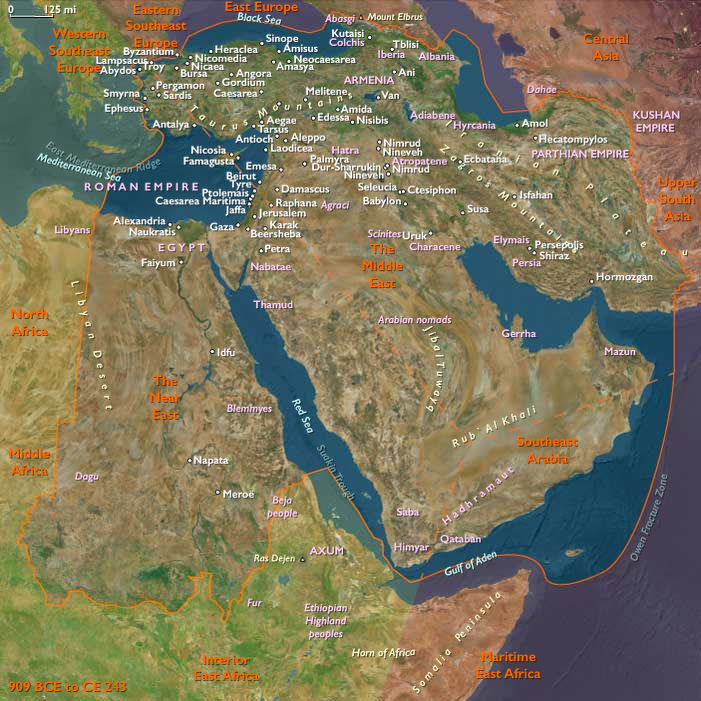
Subregions
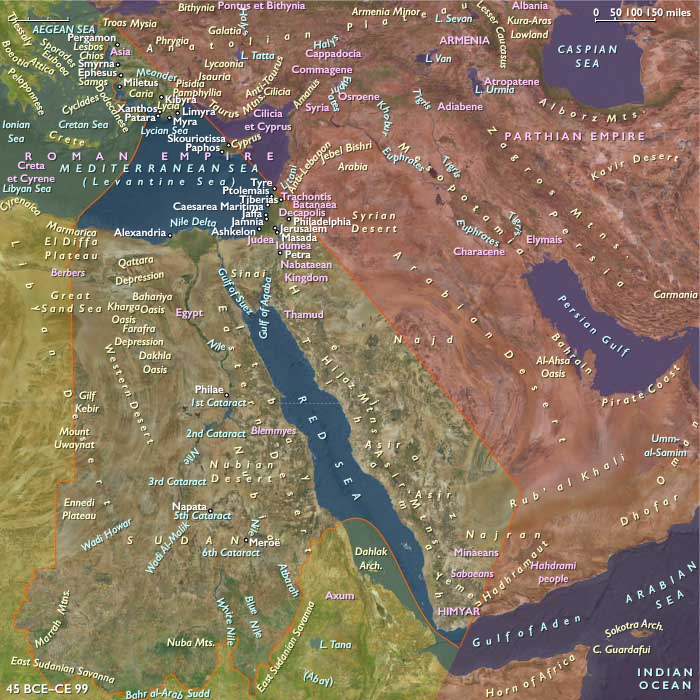
Related Events
Showing 10 events out of 62281 total
Years: 37BCE - 37BCE
Locations
People
Groups
Topics
Commodoties
Subjects
Regions
Subregions