
Hernández and his would-be conquistadors sail some …
Years: 1517 - 1517
April
Hernández and his would-be conquistadors sail some six days in good weather and another four in a tempest that almost wrecks their ships.
Their supply of good drinking water is now yet again exhausted, owing to the poor condition of the containers.
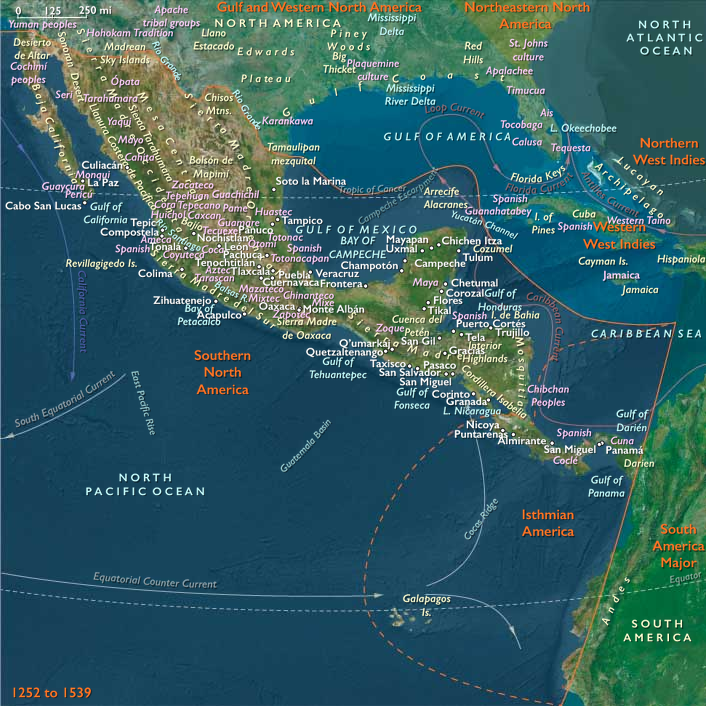
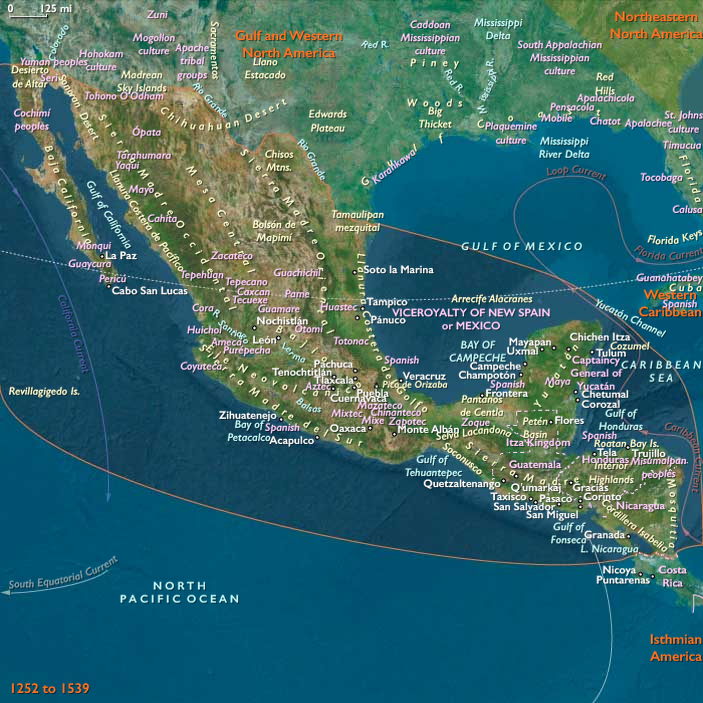
Being now in an extreme situation, they stop to gather water in a place that Bernal sometimes calls Potonchán and sometimes by its present-day name of Champotón, where the river of the same name meets the sea.
When they have filled the jugs, they find themselves surrounded by great assemblies of Indians.
They pass the night on land, with great precautions and wakeful vigilance.
This time the Spaniards decide not to take flight as in Lázaro-Campeche: they need water, and any retreat, hindered by the Indians, seems more dangerous than attack.
They decide to stay and fight, but the outcome is bad for them: when dawn broke, they are evidently vastly outnumbered ("by two hundred to one", claims Bernal), and only shortly into the ensuing battle Bernal speaks of eighty injured Spaniards.
Keeping in mind that the original number of the expedition was about a hundred, not all soldiers, this suggests that at this moment the expedition is close to destruction.
They soon discover that the legions of Indians are being continually replenished by fresh reinforcements, and if good swords, crossbows, and muskets had astonished them at first, they have now overcome the surprise and maintain a certain distance from the Spaniards.
At the cry of "Calachuni", which the conquistadors soon learn is a word for "chief" or "captain", the Indians are particularly merciless in attacking Hernández de Córdoba, who is hit by ten arrows.
The Spanish also learn the dedication of their opponents to capturing people alive: two are taken prisoner and certainly sacrificed afterwards; of one we know that his name was Alonso Boto, and of the other Bernal is only able to say of him that he was "an old Portuguese".
Eventually, with only one Spanish soldier remaining unhurt, the captain practically unconscious, and the aggression of the Indians only increasing, they decide that their only recourse is to form a close phalanx and break out of their encirclement in the direction of the launches, and to return to board them—leaving behind the water jugs—and get back to the ships.
Fortunately for them, the Indians hadn't concerned themselves to take away the boats or to render them useless, as they might easily have done.
When attacking the retreating boats with arrows, stones, and pikes they make a particular effort to interfere with their balance by weight and impact, and end up dumping some of the Spaniards into the water.
The survivors among Hernández's men have to get quickly out to their ships, half swimming and hanging onto the edges of the launches, but in the end they are recovered by the boat with the shallowest draft, and reach safety.
The Spaniards have lost fifty companions, including the two taken alive.
The survivors are badly injured, with the sole exception of a soldier named Berrio, who is surprisingly unscathed.
Five die in the following days, the bodies being buried at sea.
The Spanish call the place the "La Costa de Mala Pelea" "coast of the evil battle", a name it will have on maps for many years.
Locations
People
Groups
- Maya peoples
- Santo Domingo, Captaincy General of
- Tierra Firme, Province of
- Spain, Habsburg Kingdom of
- Cuba (Spanish Colony)
Topics
Commodoties
Subjects
Regions
Subregions
Related Events
Showing 10 events out of 38928 total
Years: 1517 - 1517
April
Locations
People
Groups
- Maya peoples
- Santo Domingo, Captaincy General of
- Tierra Firme, Province of
- Spain, Habsburg Kingdom of
- Cuba (Spanish Colony)
Topics
Commodoties
Subjects
Regions
Subregions