
Hernán Cortés had sailed with eleven ships, …
Years: 1519 - 1519
March
Hernán Cortés had sailed with eleven ships, thirteen horses, a small number of cannon, and about six hundred and thirty men (including thirty crossbowmen and twelve arquebusiers, wielding an early form of firearm), a doctor, several carpenters, at least eight women, a few hundred Cuban Arawak indigenous and some Africans, both freedmen and slaves.
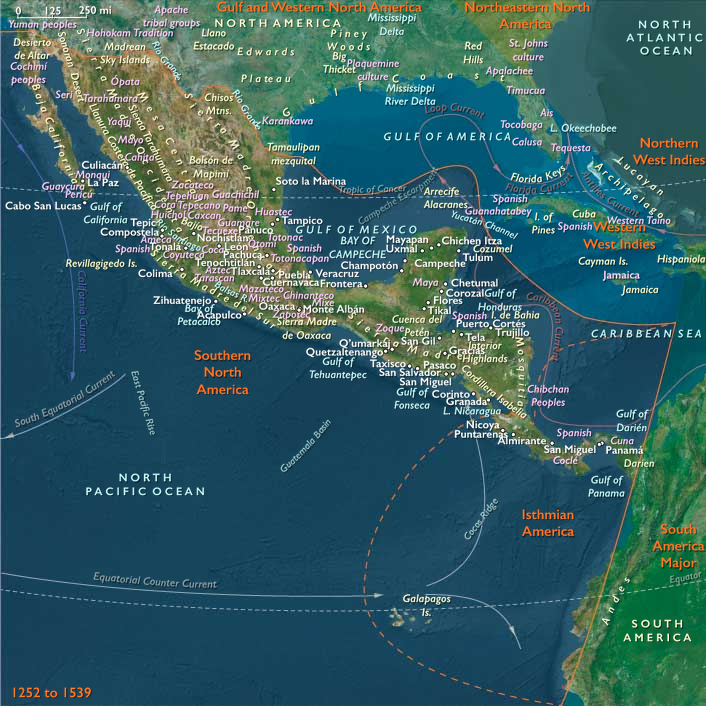
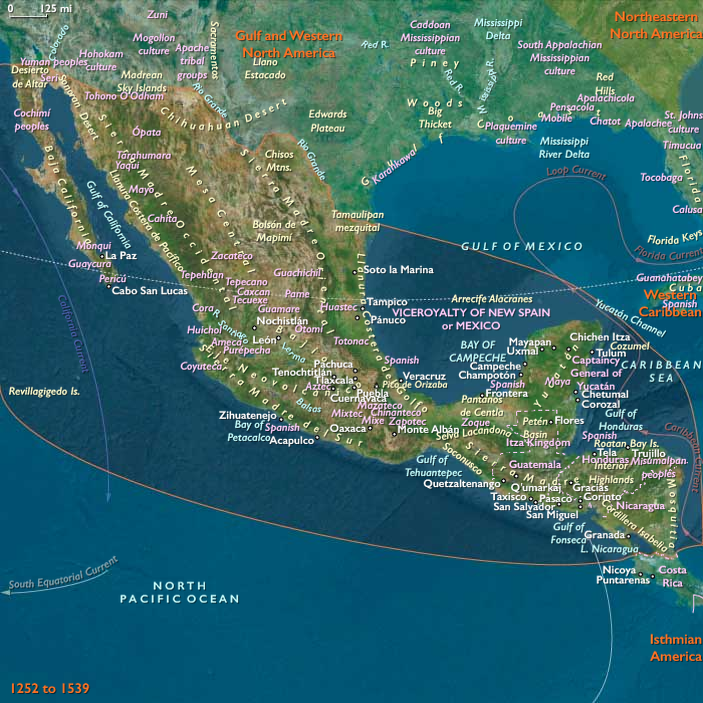
Landing on the Yucatan Peninsula in Mayan territory, he spends some time at Cozumel island, trying to convert the locals to Christianity and achieving mixed results.
The Grijalva and Cortés expeditions have both been received peacefully by the Maya of Cozumel, unlike the expeditions’ experiences on other parts of the mainland.
Cortés destroys some of the Maya idols on Cozumel and replaces them with an image of the Virgin Mary, but even so the native inhabitants of the island will continue to help the Spanish resupply their ships with food and water so they can continue their voyages.
While at Cozumel, Cortés hears reports of bearded men among a neighboring tribe.
Cortés sends messengers to these reported castilianos, who turned out to be the survivors of the Spanish shipwreck that had occurred in 1511, Gerónimo de Aguilar and Gonzalo Guerrero.
Aguilar, a Spanish Franciscan priest, has spent eight years in captivity with the Maya.
His continued fidelity to his religious vows had led him to refuse the offers of women made to him by the chief.
Aguilar petitions the chief to be allowed leave to join with his former countrymen, and he is released and makes his way to Cortés's ships.
According to Bernal Díaz, Aguilar relayed that before coming he had unsuccessfully attempted to persuade Guerrero to leave as well.
Guerrero had declined on the basis that he was by now well-assimilated with the Maya culture, had a Maya wife and three children, and as looked upon as a figure of rank within the Maya settlement of Chetumal where he lives.
Although Guerrero's later fate is somewhat uncertain, it appears that for some years he will continue to fight alongside the Maya forces against Spanish incursions, providing military counsel and encouraging resistance; it is speculated that he may have been killed in a later battle.
Aguilar demonstrates his fidelity to his faith by correctly identifying the day of week, from a steadfast following of his breviary, which he had been able to keep through all the years of his captivity.
Having become quite fluent in the the Chontal Maya language as well as some other indigenous languages, will prove to be a valuable asset for Cortés as a translator—a skill of particular significance to the later conquest of the Aztec Empire that is to be the end result of Cortés' expedition.
Cortés formally claims the land for the Spanish crown in March 1519.
Locations
People
Groups
- Christians, Roman Catholic
- Franciscans, or Order of St. Francis
- Santo Domingo, Captaincy General of
- Santiago, Colony of (Spanish Jamaica)
- Spain, Habsburg Kingdom of
Topics
Commodoties
Subjects
- Commerce
- Language
- Watercraft
- Labor and Service
- Conflict
- Exploration
- Faith
- Government
- Technology
- Finance
Regions
Subregions
Related Events
Showing 10 events out of 38849 total
Years: 1519 - 1519
March
Locations
People
Groups
- Christians, Roman Catholic
- Franciscans, or Order of St. Francis
- Santo Domingo, Captaincy General of
- Santiago, Colony of (Spanish Jamaica)
- Spain, Habsburg Kingdom of
Topics
Commodoties
Subjects
- Commerce
- Language
- Watercraft
- Labor and Service
- Conflict
- Exploration
- Faith
- Government
- Technology
- Finance
Regions
Subregions