
Heraclius occupies Yerevan in 1749, and in …
Years: 1751 - 1751
June
Locations
People
Groups
- Georgians
- Persian people
- Kurdish people
- Azerbaijani people (Azeris)
- Yazidi
- Uzbeks
- Qajars (Turkic Oghuz tribe)
- Turkish people
- Ottoman Empire
- Kakheti, Kingdom of
- Kartli, Kingdom of
- Karakalpaks, or Qaraqalpaqs
- Khiva, Khanate of (Khwarezm)
- Bukhara, (Astrakhanid) Khanate of
- Persia, Afsharid Kingdom of
Topics
Commodoties
Subjects
Regions
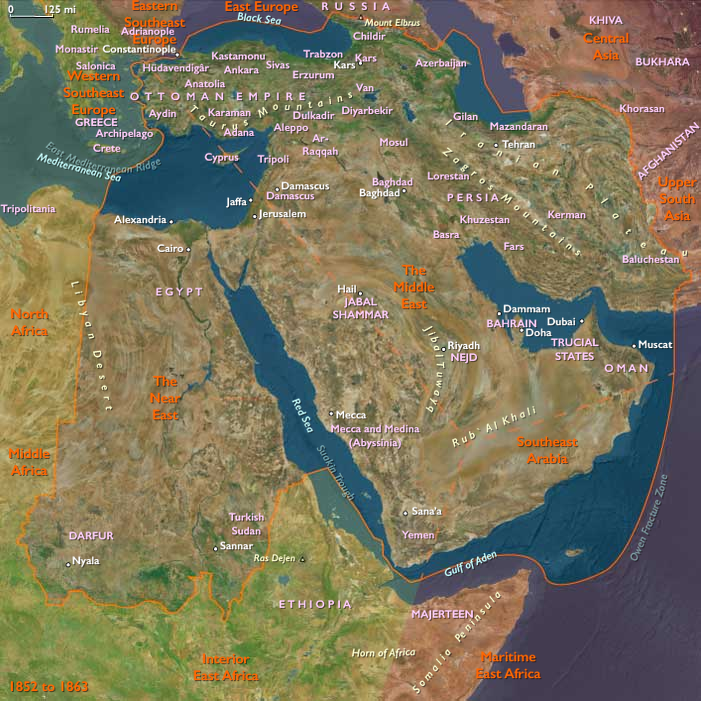
Subregions
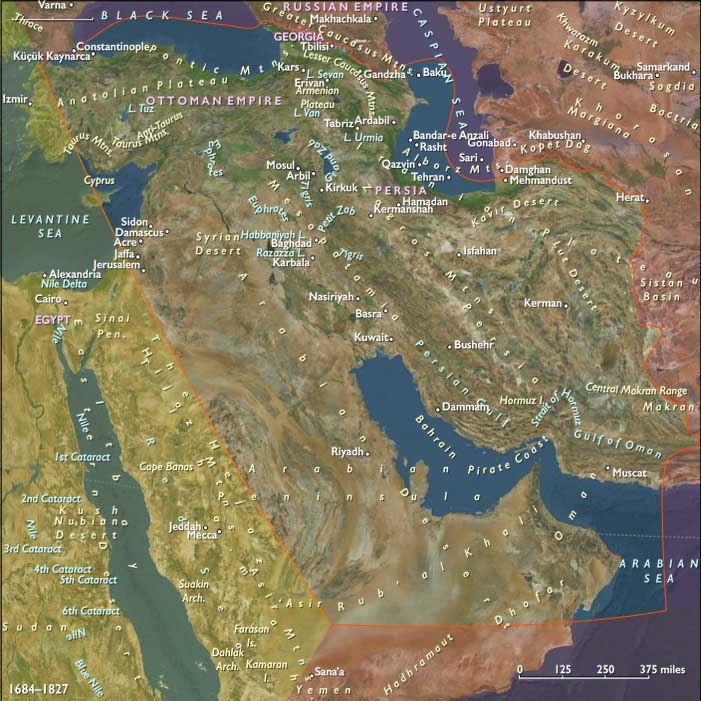
Related Events
Filter results
Showing 10 events out of 26947 total
Alaungpaya, the future king of a Burma united for the third time, was born Aung Zeya ("Victorious Victory") at Moksobo, a village of a few hundred households in the Mu River Valley about sixty miles northwest of Ava on August 24, 1714 to Min Nyo San and his wife Saw Nyein Oo.
He was the second son of a lineage of gentry families that had administered the Mu Valley for generations.
His father was a hereditary chief of Moksobo and his uncle, Kyawswa Htin, better known as Sitha Mingyi, was the lord of the Mu Valley District.
Alaungpaya sclaim descent from kings Narapati I and Thihathura and ultimately the Pagan royal line.
He comes from a large family, and is related by blood and by marriage to many others among the gentry throughout the valley.
In 1730, Alaungpaya married his first cousin Yun San, daughter of chief of a neighboring village, Siboktara.
They have six sons and three surviving daughters; a fourth daughter died young.
Aung Zeya had grown up during a period in which the authority of the Taungoo Dynasty was in rapid decline.
The "palace kings" at Ava had been unable to defend against the Manipuri raids that had been ransacking increasingly deeper parts of Upper Burma since 1724.
Ava had failed to recover southern Lanna (Chiang Mai), which had revolted in 1727, and in the 1730s did nothing to prevent the annexation of the northern Shan States by the Qing dynasty.
The Mu Valley is directly on the path of Manipuri raids year after year.
Although Burma is far larger than Manipur, Ava had been unable to defeat the raids or organize a punitive expedition to Manipur itself.
The people watched helplessly as the raiders torched villages, ransacked pagodas, and carried away captives.
Aung Zeya assumed his father's responsibilities as chief of his village in his early twenties. A tall man for the times, at five-feet eleven inches [one point eight meters] as described by an English envoy), Aung Zeya was a leader among the gentry in organizing the defenses of the valley.
The declining regime at Ava was wary of any potential rivals.
Taungoo Yaza, commander-in-chief of the army of Ava in 1736, summoned Aung Zeya to Ava to determine whether the village headman was a potential threat to the regime.
Satisfied that the twenty-two-year-old had no designs on the throne, Taungoo Yaza on behalf of the king bestowed on Aung Zeya the title Bala Nanda Kyaw.
Aung Zeya became deputy to his uncle the lord of Mu Valley, and the administrative officer kyegaing, responsible for tax collection and for the preservation of order.
The authority of Ava continued to decline in the following years.
The Mon of Lower Burma had broken away in 1740 and founded the Restored Hanthawaddy Kingdom with the capital at Bago.
Ava's feeble attempts to recover the south had failed to make a dent.
Low-grade warfare between Ava and Bago had continued until late in 1751, when Bago launched its final assault, invading Upper Burma in full force.
The leader of the rebellion, Lobsang Trashi, and fourteen other rebels are executed.
Further afield, military campaigns against Nepalese and Gurkhas force these peoples to submit and send tribute.
A type of distilled liquor designated by the Russian word vodka had come to Russia in the late fourteenth century.
In 1386, the Genoese ambassadors had brought the first aqua vitae ("the water of life") to Moscow and presented it to Grand Duke Dmitry Donskoy.
The liquid obtained by distillation of grape must was thought to be a concentrate and a "spirit" of wine (spiritus vini in Latin), from where came the name of this substance in many European languages (like English spirit, or Russian спирт, spirt).
According to a legend, around 1430, a monk named Isidore from Chudov Monastery inside the Moscow Kremlin made a recipe of the first Russian vodka.
Having a special knowledge and distillation devices, he became the creator of a new, higher quality type of alcoholic beverage.
This "bread wine", as it was initially known, was for a long time produced exclusively in the Grand Duchy of Moscow and in no other principality of Rus' (this situation persisted until the era of industrial production).
Thus, this beverage was closely associated with Moscow.
Until the mid-eighteenth century, the drink had remained relatively low in alcohol content, not exceeding 40% ABV.
Multiple terms for the drink are recorded, sometimes reflecting different levels of quality, alcohol concentration, filtering, and the number of distillations; most commonly, it is referred to as "burning wine", "bread wine", or even in some locations simply "wine".
In some locations, grape wine may have been so expensive that it was a drink only for aristocrats.
Burning wine is usually diluted with water to 24% ABV or less before drinking.
It is mostly sold in taverns and is quite expensive.
At the same time, the word vodka is already in use, but it describei herbal tinctures (similar to absinthe), containing up to 75% ABV, and made for medicinal purposes.
The first written usage of the word vodka in an official Russian document in its modern meaning is dated by the decree of Empress Elizabeth of June 8, 1751, which regulats the ownership of vodka distilleries.
It is "the first textbook of descriptive systematic botany and botanical Latin".
It also contains Linnaeus's first published description of his binomial nomenclature.
Philosophia Botanica represents a maturing of Linnaeus's thinking on botany and its theoretical foundations, being an elaboration of ideas first published in his Fundamenta Botanica (1736) and Critica Botanica (1737), and set out in a similar way as a series of stark and uncompromising aphorisms.
The book also establishes a basic botanical terminology.
Baron Axel Fredrik Cronstedt, a Swedish chemist and mineralogist, in 1751 isolates an impure sample of nickel in 1751 from a copper-colored ore containing niccolite (nickel arsenide) by reduction of the green efflorescence that forms on this mineral in moist air.
The thaler had been debased in 1750 to ten thalers to the Vienna Mark (a weight approximating half a pound of fine silver).
The new standard is effectively adopted across the German-speaking world when that standard is accepted formally in the Bavarian monetary convention the following year.
It is owing to the date of the Bavarian Monetary convention that many writers erroneously state that the Maria Theresa Thaler was first struck in 1751.
Named after Empress Maria Theresa, who rules Austria, Hungary, and Bohemia from 1740, the word thaler gives rise to daalder and daler, which will become dollar in English.
In Britain and its colonies, 1751 has only 282 days due to the Calendar (New Style) Act 1750 (c.23) (also known as Chesterfield's Act after Philip Stanhope, 4th Earl of Chesterfield).
An Act of the Parliament of Great Britain, it reforms the calendar of England and British Dominions so that the new legal year begins on 1 January rather than 25 March (Lady Day); and it adopts the Gregorian calendar, as already used in most of western Europe.
Robert Clive leads British troops to capture Arcot in 1751, his success leading to additional victories for the British and their Nizam and Arcot allies.
Cumberland's unpopularity, which had steadily increased since Culloden, has interfered greatly with his success in politics, and when the death of the Prince of Wales brings the latter's son, a minor, next in succession to the throne, the Duke is not able to secure for himself the contingent regency.
As a compromise, the regency is vested in the Dowager Princess of Wales, Augusta of Saxe-Gotha, who considers him an enemy, but her powers are curtailed and she is to be advised by a committee of twelve men, headed by Cumberland.
There are frequent references to the Prince of Wales as a patron of cricket and as an occasional player in the years following 1733.
Frederick's death at Cliveden House on March 20, 1751, closely follows that of Charles Lennox, 2nd Duke of Richmond, the game's greatest financial patron at this time.
Accordingly, the number of top-class matches will decline for several years, although economic difficulties and priorities from the wars of the period will certainly inhibit many potential investors.
Frederick's death at the age of forty-four had initially been attributed to a burst lung abscess caused by a blow from a cricket or a real tennis ball, but it is today thought to have been from a pulmonary embolism.
King George II, Frederick's father, disliked the Prince of Wale and had taken little interest in his grandchildren. George, becoming heir apparent to the throne, inheritsone of his father's titles and becomes the Duke of Edinburgh.
Now more interested in his grandson, three weeks later the King creates George Prince of Wales (the title is not automatically acquired).
Years: 1751 - 1751
June
Locations
People
Groups
- Georgians
- Persian people
- Kurdish people
- Azerbaijani people (Azeris)
- Yazidi
- Uzbeks
- Qajars (Turkic Oghuz tribe)
- Turkish people
- Ottoman Empire
- Kakheti, Kingdom of
- Kartli, Kingdom of
- Karakalpaks, or Qaraqalpaqs
- Khiva, Khanate of (Khwarezm)
- Bukhara, (Astrakhanid) Khanate of
- Persia, Afsharid Kingdom of
