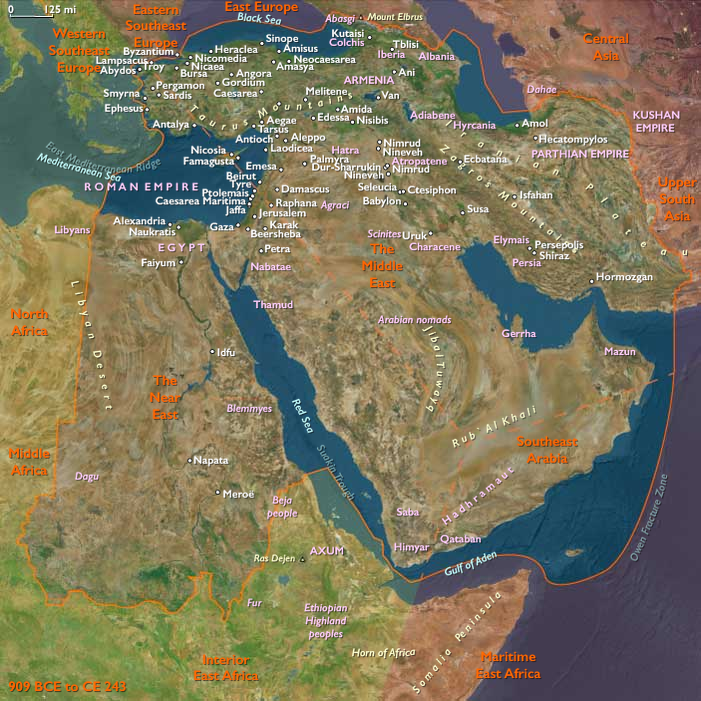
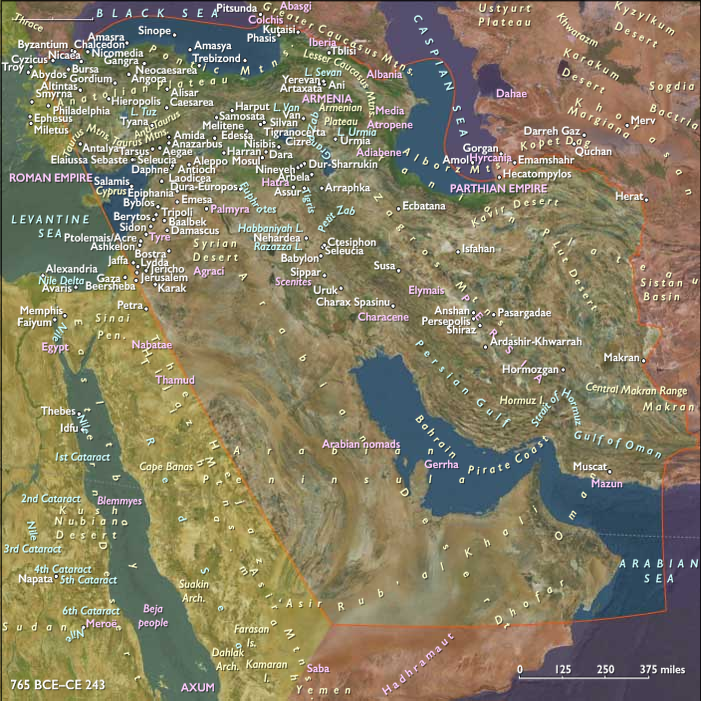
Hephaestion dies in Ecbatana in autumn 324 …
Years: 324BCE - 324BCE
Hephaestion dies in Ecbatana in autumn 324 BCE, and …
Locations
People
Groups
Topics
Commodoties
Subjects
Regions
Subregions
Related Events
Filter results
Showing 10 events out of 64314 total
Alexander now proceeds farther with the policy of replacing senior officials and executing defaulting governors on which he had already embarked before leaving India.
Between 326 and 324, over a third of his satraps have been superseded and six have been put to death, including the Persian satraps of Persis, Susiana, Carmania, and Paraetacene; three generals in Media, including Cleander, the brother of Coenus (who had died a little earlier), are accused of extortion and summoned to Carmania, where they are arrested, tried, and executed.
How far the rigor that from now onward Alexander displays against his governors represents exemplary punishment for gross maladministration during his absence and how far the elimination of men he has come to distrust (as in the case of Philotas and Parmenio) is debatable; but the ancient sources generally favorable to him comment adversely on his severity.
Alexander’s policy issue comes to a head at Opis, near Babylon, when Alexander's decision to send home Macedonian veterans under Craterus is interpreted as a move toward transferring the seat of power to Asia.
There is an open mutiny involving all but the royal bodyguard; but when Alexander dismisses his whole army and enrolls Persians instead, the opposition breaks down.
After haranguing the troops, threatening them, and finally sulking, Alexander wins back their affections; following this meretricious and emotional performance, he chooses to heal the rift symbolically by a more organized piece of theater, a great banquet of reconciliation with nine thousand guests.
Ten thousand veterans are now sent back to Macedonia with gifts, and the crisis is surmounted.
…Alexander indulges in extravagant mourning for his closest friend; he is given a royal funeral in Babylon with a monstrous funeral pyre (never completed) costing ten thousand talents.
His post of chiliarch (grand vizier) is left unfilled.
It is probably in connection with a general order now sent out to the Greeks to honor Hephaestion as a hero that Alexander links the demand that he himself should be accorded divine honors.
For a long time his mind has dwelt on ideas of godhead.
Greek thought draws no very decided line of demarcation between god and man, for legend offers more than one example of men who, by their achievements, acquired divine status.
Having on several occasions encouraged favorable comparison of his own accomplishments with those of Dionysus or Heracles, Alexander now seems to have become convinced of the reality of his own divinity and to require its acceptance by others.
There is no reason to assume that his demand has any political background (divine status gives its possessor no particular rights in a Greek city); it is rather a symptom of growing megalomania and emotional instability.
The cities comply, but often ironically: the Spartan decree reads, “Since Alexander wishes to be a god, let him be a god.”
Alexander is by spring 324 BCE back in Susa, capital of Elam and administrative center of the Persian Empire (the story of his journey through Carmania in a week-long drunken revel, dressed as Dionysus, is embroidered, if not wholly apocryphal.)
He finds that his treasurer, Harpalus, evidently fearing punishment for peculation, has absconded with six thousand mercenaries and five thousand talents to Greece.
Alexander holds a feast to celebrate the seizure of the Persian Empire, at which, in furtherance of his policy of fusing Macedonians and Persians into one master race, he and eighty of his officers take Persian wives; he and Hephaestion marry Darius' daughters Barsine (also called Stateira) and Drypetis, respectively, and ten thousand of his soldiers with native wives are given generous dowries.
Alexander also marries Parysatis, the daughter of Artaxerxes III.
Ptolemy, whom Alexander has decorated several times for his deeds, is in the ceremony married to the Persian Artacama.
Seleucus marries Apama, the daughter of Spitamenes, the ruler of Bactria.
This policy of racial fusion brings increasing friction to Alexander's relations with his Macedonians, who have no sympathy for his changed concept of the empire.
His determination to incorporate Persians on equal terms in the army and the administration of the provinces is bitterly resented.
This discontent is now fanned by the arrival of thirty thousand native youths who have received a Macedonian military training and by the introduction of Orientals from Bactria, Sogdiana, Arachosia, and other parts of the empire into the Companion cavalry; whether Orientals had previously served with the Companions is uncertain, but if so they must have formed separate squadrons.
In addition, Persian nobles have been accepted into the royal cavalry bodyguard.
Peucestas, the new governor of Persis, gives this policy full support to flatter Alexander; but most Macedonians see it as a threat to their own privileged position.

Alexander attempts in summer 324 BCE to solve another problem: that of the wandering mercenaries, of whom there are thousands in Asia and Greece, many of them political exiles from their own cities.
A decree brought by Nicanor of Stageira to Europe and proclaimed in September at Olympia requires the cities of the Hellenistic League to receive back all exiles and their families (except the Thebans), a measure that implies some modification of the oligarchic regimes maintained in the Greek cities by Alexander's governor Antipater.
Alexander now plans to recall Antipater and supersede him with Craterus; but he will die before this can be done.
Demosthenes, accused of taking twenty talents deposited in Athens by Harpalus, is found guilty, fined fifty talents, and imprisoned.
The circumstances of the case are still unclear.
Demosthenes may well have intended to use the money for civic purposes, and it is perhaps significant that the court fines him only two and one-half times the amount involved instead of the ten times usually levied in such cases.
His escape from prison makes it impossible for him to return to Athens to raise money for the fine.
The onetime leader of the Athenians is now a refugee from his own people.
Harpalus, arrested in Athens, escapes.
He will soon be murdered in Crete, and the exact fate of the money he had taken with him from Asia remains a celebrated mystery.
Alexander's ongoing plans are abandoned by common consent among his generals, who have to be content with the office of governor.
In the distribution of satrapies that follows Alexander's death, Lysimachus, one of Alexander's bodyguards during the conquest of Asia, is assigned one of the less attractive governorships, that of Thrace.
Alexander carries out a savage punitive expedition against the Cossaeans (Kassites) in the hills of Luristan in the winter of 324-323.
Alexander receives complimentary embassies the following spring at Babylon, which he plans to make the capital of his empire, from the Libyans and from the Bruttians, Etruscans, and Lucanians of Italy. (The story that more distant peoples, such as Carthaginians, Celts, Iberians, and even Romans, had sent embassies is most probably a later invention.)
Representatives of the cities of Greece also appear, garlanded as befits Alexander's divine status.
Following up Nearchus' voyage, he now founds an Alexandria at the mouth of the Tigris and makes plans to develop sea communications with India, for which an expedition along the Arabian coast is to be a preliminary.
He also dispatches Heracleides, an officer, to explore the Hyrcanian (i.e., Caspian) Sea.