Heondeok of Silla, troubled by threats from …
Years: 824 - 824
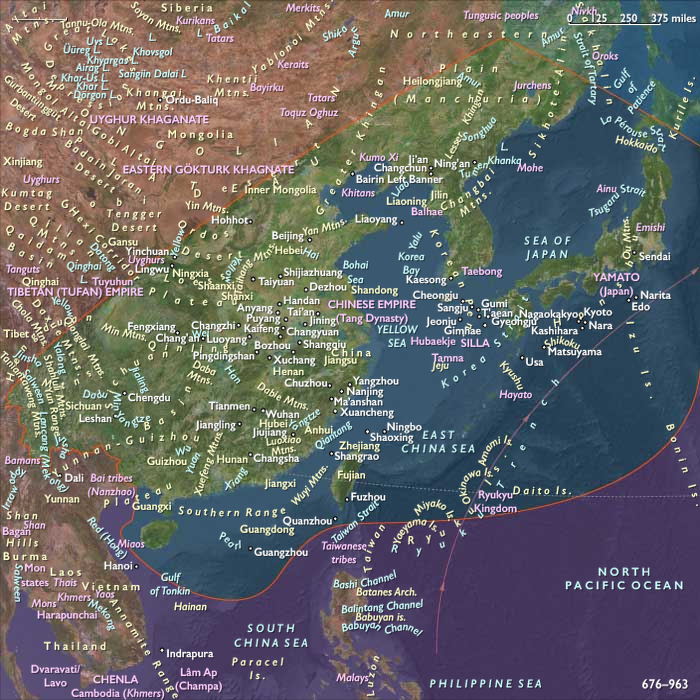
Heondeok of Silla, troubled by threats from the north in 824, orders three hundred-ri-long wall built near the Taedong River, which is at this time the country's northern border.
Locations
People
Groups
Topics
Subjects
Regions
Subregions
Related Events
Filter results
Showing 10 events out of 54420 total
The early career of Abdallah, the second son of the Persian general Tahir ibn Husayn, governor of Khurasan, had consisted of serving with his father in pacifying the lands of the Abbasid Caliphate following the civil war between al-Amin and al-Ma'mun.
He later succeeded his father as governor of Al-Jazira, with the task of defeating the rebel Nasr ibn Shabath, and earlier in 824 had persuaded Nasr to surrender.
He had next been sent to Egypt, where he successfully ends an uprising led by 'Abd-Allah ibn al-Sari.
He also recovers Alexandria, which had been seized seven years before by Andalusian Muslim refugees.
Abd-ar-Rahman, after his Damascus-based dynasty, the Umayyads, lost the position of Caliph in 750, had run from Abbasid persecutors for six years before arriving in Spain intent on regaining a position of power.
Defeating the existing Islamic rulers of the area, Abd-ar-Rahman had united various local fiefdoms into an emirate in 756 to become Emir of Córdoba in the Al-Andalus (Moorish Iberia).
Eventually reaching Alexandria, they had dominated the city until their expulsion in 824, following which the refugees head to Crete.
Crete, as the target of Muslim attacks since the first wave of the Muslim conquests in the mid-seventh century, had in 654 suffered a first raid in 674/675 another; parts of the island had been temporarily occupied between 705 and 715 during the reign of the Umayyad Caliph al-Walid I.
The island had never been conquered, however, and despite occasional raids in the eighth century it has remained securely in imperial hands; a quiet cultural backwater, Crete is too distant from the Arab naval bases in the Levant for an effective expedition against it to be undertaken.
A group of Andalusian exiles at some point in the second half of the reign of Emperor Michael II, who reigns from 820 to 829, land on Crete and begin its conquest.
These exiles, with a long history of wanderings behind them, are the survivors of a failed revolt in 818 against the emir Al-Hakam I of Córdoba.
In the aftermath of its suppression, the citizens of the Cordovan suburb of al-Rabad had been exiled en masse.
Some had settled in Fez in Morocco, but others, numbering over ten thousand, had taken to piracy, probably joined by other Andalusians.
Some of the latter group, under the leadership of Umar ibn Hafs ibn Shuayb ibn Isa al Balluti, commonly known as Abu Hafs, had landed in Alexandria and had taken control of the city until 827, when they had been besieged and expelled by the Abbasid general Abdullah ibn Tahir al-Khurasani.
The exact chronology of their landing in Crete is uncertain.
Following the Muslim sources, it is usually dated to 827 or 828, after the Andalusians' expulsion from Alexandria.
Byzantine sources, however seem to contradict this, placing their landing soon after the suppression of the large revolt of Thomas the Slav (821–823).
Further considerations regarding the number and chronology of the campaigns launched against the invaders and prosopographical questions of the imperial generals that headed them have led other scholars like Vassilios Christides and Christos Makrypoulias to propose an earlier date, around 824.
The Andalusians and their families, under the terms of their agreement with Ibn Tahir, had left Alexandria in forty ships.
Historian Warren Treadgold estimates them at some twelve thousand people, of whom about three thousand would be fighting men.
The Andalusians according to Byzantine historians were already familiar with Crete, having raided it in the past.
They also claim that the Muslim landing was initially intended as a raid, and was transformed into a bid for conquest when Abu Hafs himself set fire to their ships.
This is probably later invention, however, as the Andalusian exiles had brought their families along.
The Andalusians' landing-place is also unknown; some scholars think that it was at the north coast, at Suda Bay or near where their main city and fortress Chandax (”Castle of the Moat", modern Heraklion) will later be built, but others think that they most likely landed on the south coast of the island, then moved to the more densely populated interior and the northern coast.
Archbishop Cyril of Gortyn is assassinated and his city so thoroughly devastated it will never be reoccupied.

Pope Paschal, who dies in February 824, had attempted to curb the rapidly increasing power of the Roman nobility, who, to strengthen their positions against him, had turned for support to the Franks.
These nobles now make strenuous efforts to replace him with a candidate of their own; and despite the fact that the clergy put forward a candidate likely to continue the policy of Paschal the nobles are successful in their attempt.
They secure the consecration of Eugene, who is the archpriest of St. Sabina on the Aventine, although by a decree of the Roman Council of 769, under Stephen IV, they have no right to a real share in a papal election.
Another candidate, Zinzinnus, had been proposed by the plebeian faction, and the presence of King Lothair is necessary in order to maintain the authority of the new pope.
Lothair takes advantage of this opportunity to redress many abuses in the papal administration, to vest the election of the pope in the nobles, and to confirm the statute that no pope should be consecrated until his election had the approval of the Frankish emperor.
Lothair, Emperor Louis’ eldest son by Ermengarde, is the heir to the entire Carolingian Empire, but has to share it with his brothers because of the traditional Frankish practice of division of patrimonies among all surviving sons.
Lothair had probably passed his early life at the court of his grandfather Charlemagne, until 815 when he became king of Bavaria.
When Louis divided the Empire between his sons in 817, Lothair had been crowned joint emperor at Aix-la-Chapelle (Aachen) and given a certain superiority over his brothers, Pepin and Louis, who had respectively received Aquitaine and Bavaria.
Lothair was also given the Iron Crown of Lombardy, then still held by Louis the Pious' nephew Bernard.
After Bernard’s death, Lothair had received the Italian kingdom.
In 821, he had married Ermengarde, daughter of Hugh, count of Tours, and in 822 assumed the government of Italy.
On April 5, 823, he had been crowned co-emperor again by Pope Paschal I, this time at Rome.
In November 824, he promulgates a statute concerning the relations of pope and emperor which reserves the supreme power to the secular potentate, and from this time he is to issue various ordinances for the good government of Italy.
The Basques extend their territory southeast to the limits of the county of Barcelona to obtain their first kingdom, Navarre, at the expense of the neighboring Kingdom of León (the former Galician kingdom) and the once-formidable Umayyad Caliphate.
Both Aragon and Pamplona have remained outside Carolingian control; western Gascony continues in revolt.
According to the Vita Hludowici, the counts Aznar Sánchez and Aeblus, Frankish vassals, lead an army across the Pyrenees in 824 against rebellious Pamplona to reestablish control.
According to the Annales regni Francorum of Einhard, they (Aeblus and Aznar) bring a great deal of wealth with them.
They are defeated by joint Pamplonese and Banu Qasi forces in a "second Roncesvalles", and Pamplona gains its independence as the kingdom of Navarre while the two counts are captured.
Aznar, however, being a relative of his captors, according to Astronomus, is released.
Aeblus is sent a prisoner to the Emir of Córdoba, where he will die a captive.
García the Bad and Musa ibn Musa al-Qasawi of the Banu Qasi had probably lent their support to the Basque Íñigo, leading to the defeat of the Frankish counts.
The Basque victors are not named, but it is in the context of this defeat that Íñigo Arista is said to have been pronounced "King of Pamplona" in that city by the people.
Abu Muhammad Ziyadat Allah I had succeeded his brother Abdallah I (812–817) to the Emirate of Ifriqiya.
During his rule, the relationship between the ruling dynasty on the one hand and the jurists and Arab troops on the other remains strained.
When Ziyadat Allah I attempts to disband the Arab units in 824, it leads to a great revolt at Tunis, which will only be put down in 836 with the help of the Berbers.
Pegu, on the Pegu River in southern Burma, is founded in about 825 as the capital of the Mon state, which is organized according to Indian political principles and ruled by kings held to be divine.
Kukai, the founder of the Shingon or "True Word" school of Buddhism, establishes Zenpuku-ji, a Shingon Buddhist temple in 824, located in the Azabu district of present Tokyo, Japan.
It is today one of the oldest Tokyo temples, after the Sensō-ji in Asakusa, founded in 628.
The expanding Bai kingdom of Nanzhao captures the city of Chengdu in Sichuan province, China.
It is a great prize, as it enables Nanzhao to lay claim to the whole of Sichuan province, with its rich paddy fields.
This is too much for the Tang Dynasty, who lose no time in counterattacking.