Henry's attempts at reconciliation between the factions …
Years: 1458 - 1458
March
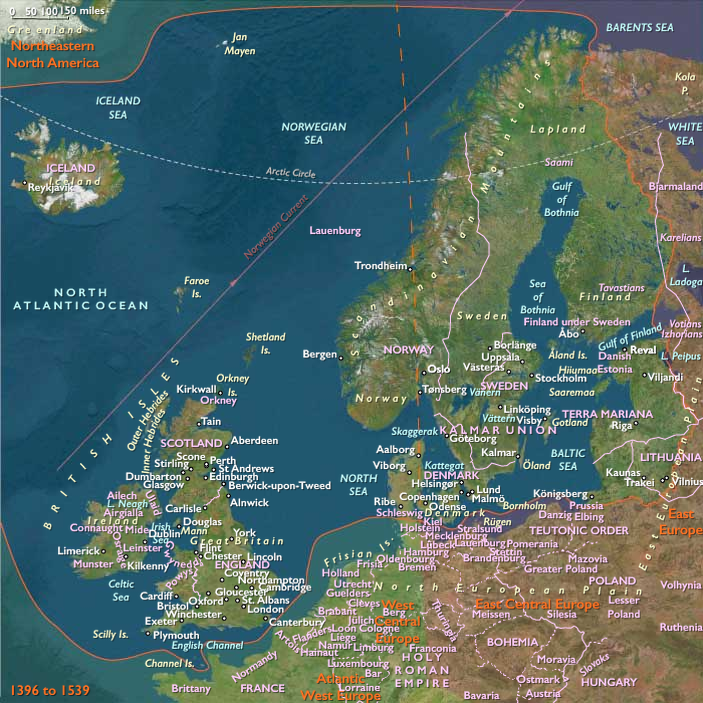
Henry's attempts at reconciliation between the factions divided by the killings at St. Albans reach their climax on March 24, 1458, with the Loveday.
The lords concerned have earlier turned London into an armed camp, however, and the public expressions of amity seem not to have lasted beyond the ceremony.
Locations
People
- Edward IV of England
- Henry VI of England
- Margaret of Anjou
- Richard Neville
- Richard Neville, 16th Earl of Warwick
- Richard of York
Groups
Topics
Commodoties
Subjects
Regions
Subregions
Related Events
Filter results
Showing 10 events out of 41314 total
John IV of Trebizond had sent his brother David to ratify the treaty before Mehmed II himself, which he does in 1458, but the tribute is raised to three thousand gold pieces.
An alliance with the powerful Aq Qoyunlu tribe, who are the Ottomans' most powerful rival, appears more than beneficial.
Trebziond and the Aq Qoyunlu have a history of cooperation.
The-great aunt of John IV of Trebizond, the reigning emperor, had married Qara Osman, emir of the Aq Qoyunlu.
Uzun Hassan eagerly agrees to be the protector of Trebizond, as well as making other concessions, in return for the hand of John’s daughter Theodora, who is widely famous for her great beauty.
News of the Princess of Trebizond as the consort of the powerful Uzun Hassan will spread to the West, and helps to foster stories of Princess of Trebizond.
However, this alliance will fail to help John's successor, his brother David.
Jahan Shah, recognizing the weakness of Timurid authority in Herat, invades on June 28, 1458, and takes the city.
He is unable to keep it, however, due to pressures from within his principality of Kara Koyunlu plus the increasing threat from Uzun Hasan of Aq Qoyunlu.
Obliged to negotiate the borders of his state with Abu Sa'id Mirza, he decides after negotiations to return territorial demarcations to what they had been during the reign of Shahrukh Mirza.
Thus, Khurasan, Mazandaran and Gurgan are returned to the Timurids and Abu Sa'id Mirza returns and takes Herat a second time on December 22, 1458.
While leaving the territory, however, the Turkmens had ravaged Khurasan, and when Abu Sa'id Mirza arrives to take Herat, he finds its residents frightened.
In order to ease their fears, he sends the major portion of his army back towards Bukhara.
His rival claimants to Samarkand—namely, Ala-ud-Daulah Mirza bin Baysonqor, his son Ibrahim Mirza bin Ala-ud-Daulah and Sultan Sanjar Mirza—seeing his position thus weakened, decide to form an alliance and take this opportunity to destroy Abu Sa'id once and for all.
The Greeks attempt to retain control of their vestigial territories, and the other remaining bastions of Hellenism hold out for a short time longer, but by mid-decade most of peninsular Greece is already in Ottoman hands.
Athens has fallen to the Turks, who in 1458 issue a decree to protect the Acropolis.
John II of Aragon, who has been King of Navarre since 1425 through his first wife, Blanche I of Navarre, who had married him in 1420, had retained the government of Blanche's lands at her death in 1441, and dispossessed his own eldest son, Charles, who at age two had been made Prince of Viana in 1423.
John had tried to assuage his son with the lieutenancy of Navarre, but his son's French upbringing and French allies, the Beaumonteses, had brought the two into conflict.
They had engaged in open warfare in Navarre in the early 1450s.
Charles had been captured and released; and John had tried to disinherit him by illegally naming his daughter Eleanor, who was married to Gaston IV of Foix, his successor.
John's new wife, Juana Enríquez, had given birth in 1451 to a son, Ferdinand.
Charles had fled his father in 1452, first for France, later for the court of his uncle, John's elder brother, Alfonso V at Naples.
John has governed his brother's Spanish realms—the Crown of Aragon—as lieutenant from 1454.
When Alfonso dies in 1458, Charles is arrested and brought to Majorca.
John succeeds Alfonso as ruler of the Crown of Aragon and in his will names Charles as his heir.
Among John's early unpopular acts is to quit the war against Genoa, upsetting the merchants of Barcelona.
He has also refused to aid his nephew, Ferdinand I of Naples, in securing his throne.
Construction begins in 1458 on the Pitti Palace, the residence of the Florentine magnate Luca Pitti, designed by an unknown architect, possibly from designs by the late Filippo Brunelleschi.
Pitti, a banker, is a loyal friend and servant to the Medici and the republic.
As the head magistrate of Florence, known as "The Gonfalonier of Justice," he wields great power and influence.
In August, 1458, he stages a coup to seize control of Florentine government in the name of its existing ruler, the elderly and now frail Cosimo de' Medici.
In effect, he wishes to strengthen the existing government.
As a result many leading citizens are banished, and many other citizens were driven from power.
The newly formed government is to last eight years with Cosimo as its figurehead, the reality being that he is too frail to maintain power alone.
Awarded a knighthood, Pitti receives lavish presents from both the Signory of Firenze and the Medici family as a reward.
Mino da Fiesole sculpts a bust of Giovanni de'Medici in 1458.
Influenced by his master Desiderio da Settignano and by Antonio Rossellino, Mino’s sculpture, characterized by its sharp, angular treatment of drapery, is remarkable for its finish and delicacy of details, as well as for its spirituality and strong devotional feeling.
Magdalen College, founded as Magdalen Hall in 1448 by William of Waynflete, Bishop of Winchester, in 1458 becomes Magdalen College.
The founder's statutes had included provision for a choral foundation of men and boys (a tradition that has continued to the present day) and made reference to the pronunciation of the name of the College in English (”maudlin”). (One of the constituent colleges of the University of Oxford in England, Magdalen is regarded by some as one of the most beautiful of the Oxford and Cambridge colleges. It is also one of the most visited. )
The death, amid rumors of poisoning, of the young Habsburg king, Ladislaus Posthumus in November of 1457 had ended the two-year struggle between Hungary's various barons and its king.
George of Poděbrady, governor of Bohemia and friend of the Hunyadis who aims to raise a national king to the Magyar throne, has taken hostage Janos Hunyadi’s younger son Matthias Corvinus.
Knighted at the siege of Belgrade in 1456, Matthias had married Elizabeth of Celje, the only known daughter of Ulrich II of Celje and Catherine Cantakuzina; her maternal grandparents were Đurađ Branković and Eirene Kantakouzene.
But the young Elizabeth had died in 1455, before the marriage was consummated, leaving Matthias a widower at the age of fifteen.
Poděbrady has treated Matthias hospitably and affianced him with his daughter Kunhuta, but still detains him, for safety's sake, in Prague, even after a Magyar deputation has hastened thither to offer the youth the crown.
Matthias takes advantage of the memory left by his father's deed, and by the general population's dislike of foreign candidates; most of the barons, furthermore, consider that the young scholar will be a weak monarch in their hands.
An influential section of the magnates, headed by the palatine Ladislaus Garai and by the voivode of Transylvania, Miklós Újlaki, who had been concerned in the judicial murder of Matthias's brother László, and hates the Hunyadis as semi-foreign upstarts, are fiercely opposed to Matthias's election; however, they are not strong enough to resist against Matthias's uncle Mihály Szilágyi and his fifteen thousand veterans.
Thus, over the elections of Emperor Frederick II, who seeks to retain Habsburg control of Bohemia, Matthias is elected king by the Diet on January 20, 1458.
Poděbrady releases him under the condition of marrying his daughter (later to be known as Catherine).
On January 24, 1458, forty thousand Hungarian noblemen, assembled on the ice of the frozen Danube, unanimously elect Matthias Hunyadi king of Hungary, and on February 14 the new king makes his state entry into Buda.
This is the first time in the medieval Hungarian kingdom that a member of the nobility, without dynastic ancestry and relationship, mounts the royal throne.
The Ottomans and the Venetians threaten Hungary from the south, the emperor Frederick III from the west, and Casimir IV of Poland from the north, both Frederick and Casimir claiming the throne.
The Czech mercenaries under Giszkra hold the northern counties and from thence plunder those in the center.
Meanwhile Matthias's friends have only pacified the hostile dignitaries by engaging to marry the daughter of the palatine Garai to their nominee, whereas Matthias refuses to marry into the family of one of his brother's murderers, and on February 9 confirms his previous nuptial contract with the daughter of Poděbrady, …

…who, chosen unanimously on February 27 by the estates of Bohemia, ascends the throne on March 2, 1458.
The struggle in Bohemia of the Hussites against the papal party has continued without interruption.
Podebrady’s position had become a very difficult one when the young king Ladislaus, who was crowned in 1453, had expressed his pro-Roman sympathies, though he had recognized the compacts and the ancient privileges of Bohemia.
Even the adherents of the papal party had voted for him, however, some in honor of his moderate policies, and some in deference to popular feeling, which had opposed the election of a foreign ruler.
Mahmud Shah, the fourth sultan of the Jaunpur sultanate, had been successful in his conquest of Chunar, but had failed to capture Kalpi.
He has also conducted campaigns against Bengal and Orissa.
In 1452, he had invaded Delhi but had been defeated by Bahlul Lodi.
He had made a subsequent attempt to conquer Delhi and marched into Etawah.
Finally, he had agreed to a treaty which accepted the right of Bahlul Lodi over Shamsabad.
But when Bahlul had tried to take possession of Shamsabad, the forces of Jaunpur had opposed him.
At this juncture, Mahmud Shah dies and is succeeded by his son Bhikhan in 1457, who had assumed the title of Muhammad Shah, made peace with Bahlul Lodi and recognized his right over Shamsabad.
He picked up a quarrel with his nobles.
In 1458, while Muhammad Shah is in Kanauj, his brother proclaims himself as Sultan Hussain Shah in Jaunpur; Muhammad Shah is soon killed by his army.
Years: 1458 - 1458
March
Locations
People
- Edward IV of England
- Henry VI of England
- Margaret of Anjou
- Richard Neville
- Richard Neville, 16th Earl of Warwick
- Richard of York