Henry the Lion, Duke of Bavaria and …
Years: 1166 - 1166
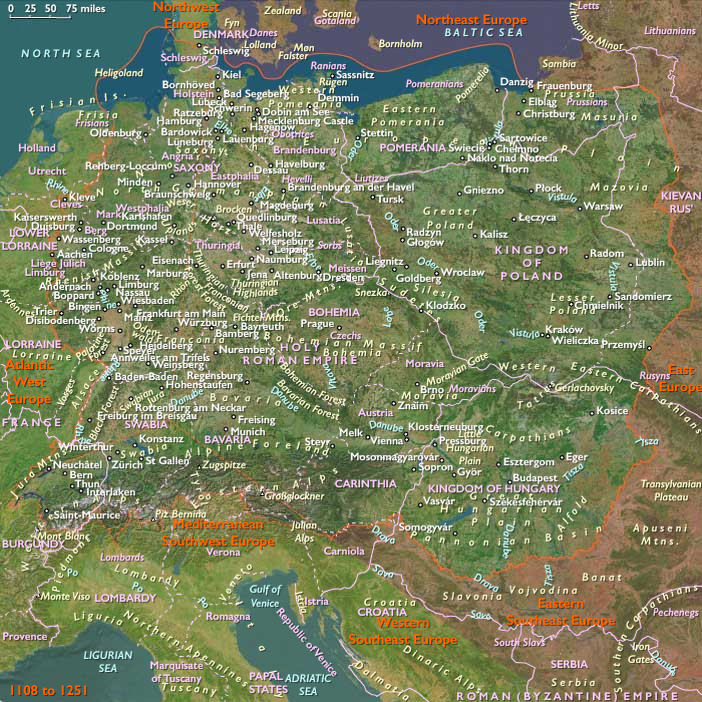
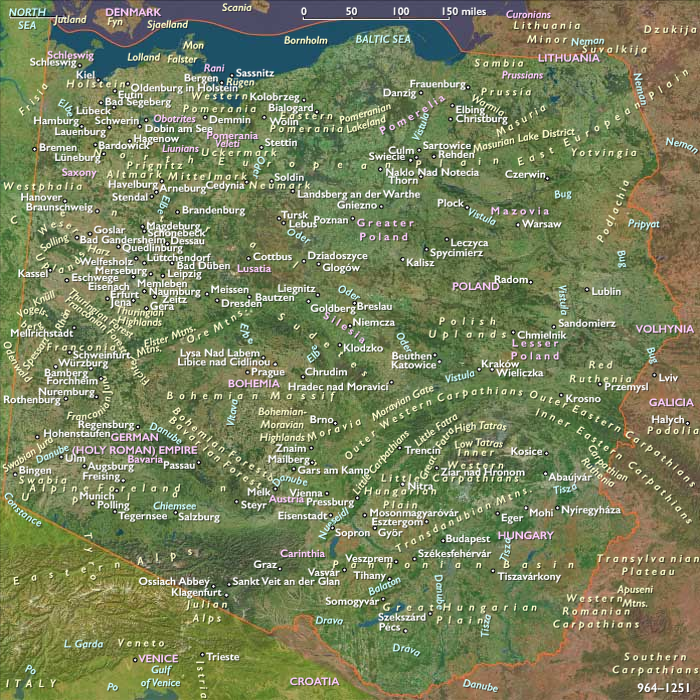
Henry the Lion, Duke of Bavaria and Saxony, has a lion statue built during his reign in his Residenz at Brunswick around 1166 as a symbol of his ducal authority and jurisdiction.
The Brunswick Lion is the oldest, preserved large sculpture from the Middle Ages north of the Alps and the first large hollow casting of a figure since antiquity.
The bronze casting by an unknown artist, probably from Brunswick, weighs eight hundred and eighty kilograms, has a height of 1.78 meters, a length of 2.79 meters and a maximum thickness of twelve millimeters.
Locations
People
Groups
Topics
Subjects
Regions
Subregions
Related Events
Filter results
Showing 10 events out of 48450 total
William I of Sicily dies in 1166; his son succeeds him as William II.
As William is only eleven years old, he is placed under the regency of his mother, Margaret of Navarre, who appeals to her cousin, Rotrou, Archbishop of Rouen, to send her a family member to aid and support her in government.
Coincidentally, another cousin, Stephen du Perche, is at that moment preparing to go on crusade to the Holy Land and so decides to visit Palermo, the capital of Sicily, for a few months; he will end up staying for two years.
He is very young at the time, described as puer and adolescens by William of Tyre, and may have still been in his teens.
Nevertheless, in November, Margaret appoints him chancellor.
His appointment is resented by the local nobility.
Gerald the Fearless (Geraldo Sem Pavor) had assembled a private army (a mesnada) around 1162, and had rapidly developed tactics that prove remarkably successful in seizing Muslim strongholds, though his technique—nocturnal surprise in wintry or stormy weather, stealthy scaling of walls by picked commandos, cutting down of sentries and opening of town gates to the larger force stationed without—is not adapted for siege warfare.
The town of Évora, which had been wrested from the Moors through a surprise attack by Gerald in September 1165, comes under the rule of the Portuguese king Afonso I in 1166.
The same year (or soon after), Gerald takes Cacéres, Trujillo, Montánchez, Lobon, Moura, Monsaraz and Alconchel.
Rising Tensions Between Henry II and Louis VII and the Conquest of Brittany (1160s CE)
During the 1160s, the long-standing tensions between Henry II of England and Louis VII of France continued to escalate, as the French king became increasingly concerned with Henry’s growing power in Europe. By the middle of the decade, their relations had deteriorated once again, as Louis formed new alliances, while Henry consolidated his control over Brittany.
Louis VII’s Strengthening of Alliances (1160–1165)
- In 1160, Louis sought to counterbalance Henry’s influence by forming alliances in central France, strengthening ties with:
- The Count of Champagne (Henry I).
- Odo II, Duke of Burgundy.
- In 1163, Philip, Count of Flanders, wary of Henry’s increasing power, openly allied himself with the French king, further isolating Henry in France.
- In 1165, Louis and his wife, Adèle of Champagne, had a long-desired male heir, Philip Augustus.
- This greatly improved Louis’s position, as he no longer lacked a direct Capetian successor.
- With a secure dynastic future, Louis became more confident in his rivalry with Henry, leading to a renewed deterioration in relations by the mid-1160s.
Henry II’s Intervention and Conquest of Brittany (1164–1166)
At the same time, Henry II had begun shifting his policy in Brittany:
- Previously, he had ruled indirectly, relying on Duke Conan IV to manage the duchy while maintaining nominal Angevin overlordship.
- By 1164, Henry began exerting direct control, seizing lands along the Brittany-Normandy border.
- In 1166, he launched a full-scale invasion, punishing the Breton barons who resisted his rule.
Deposition of Conan IV and Betrothal of Constance (1166)
-
After securing Brittany by military force, Henry forced Conan IV to abdicate as Duke.
-
Instead of taking the title himself, Henry:
- Arranged for Conan’s daughter, Constance, to inherit the duchy.
- Had Constance betrothed to his son, Geoffrey (then a child).
-
This arrangement was highly unusual under medieval law, as:
- Conan IV could have had male heirs, who traditionally would have had a stronger claim to inherit.
- By controlling Constance’s marriage, Henry effectively secured Brittany as an Angevin possession for his son.
Consequences of Henry’s Moves in Brittany
- The conquest of Brittany expanded Angevin power, giving Henry direct control over the entire region.
- Louis VII, already worried about Henry’s strength, viewed this move as another aggressive expansion.
- The increased tensions between England and France during the mid-1160s laid the foundation for further conflicts between the Angevins and the Capetians.
Henry’s strategic maneuvering in Brittany was part of his broader goal to secure his dynasty’s dominance in France, further straining his already fragile relationship with Louis VII and escalating tensions across western Europe.
Henry II had inherited the throne of a troubled kingdom.
The Crusades, a military endeavor that keeps noble landowners away from their castles for years at a time, are in full swing.
Unoccupied and unclaimed land invites squatters; since there is no central recording office for real property in England at this time, and sorting out who owns what fief is entrusted to human memory, disputes arise when aristocrats return, or died thousands of miles from home.
Another, even more serious problem requiring royal action had been the aftermath of the disastrous civil war between King Stephen and the Empress Matilda.
The two competing factions had hired mercenary soldiers, and when there was no one left to pay them, many of them took up robbery and other forms of violence as a profession.
Crime had followed the breakdown of local authority.
The quarrel between the King and the Empress had created more property troubles; as communities were divided, both factions were happy to reward their supporters with the lands of the local opponents.
Finally, there is the long-standing difficulty involving the Church, which will culminate in the murder of Thomas Becket, the Archbishop of Canterbury.
The problem for the King is that the Church acts like an imperium in imperio, a "kingdom within a kingdom", only partially subject to Henry's laws if at all.
The Church operates its own court system, which answers not to Henry but to the Pope; it is a large landowner and a powerful vested interest.
Henry wishes to establish a system of justice that will enlarge the power of the Crown at the expense of the clergy.
Henry has therefore founded various assizes, known respectively as the assize of novel disseisin, of mort d'ancestor, and of darrein presentment.
The most popular one becomes the assize of novel disseisin, which in Law French means something close to the "assize of recent dispossession".
Those who had been recently put out of their lands could recover the beneficial use of them by resort to this assize, which led to a then innovative method of trial.
Twelve "sword-girt" knights of the locality are summoned to determine, upon their own knowledge, who is entitled to the property.
This innovative method of proceeding, the origin of the civil petit jury at common law, is aimed at the chaos introduced into property rights by crusade and civil war.
Under the Assize of Clarendon, issued in 1166, Henry initiates a procedure by which jurors are commanded to appear before a royal judge and relate any knowledge they have of crimes or criminals in a given area.
This the beginning of the transformation of English law from such systems for deciding the prevailing party in a case as trial by ordeal or trial by battle to an evidentiary model, in which evidence and inspection is made by laymen.
This act greatly fosters the methods that will eventually be known in common law countries as trial by jury.

A new class of professional royal officials emerges under Henry II, who institutes many governmental reforms, and new record-keeping practices reflect the increasing complexity of English society.
Henry orders inquiries into the operations of local government and, in 1166, a survey of knight service.
Tribhuvanāditya, the Khmer ruler from 1166, comes to power after he assassinates Yasovarman II.
Bishop Absalon leads the Danes in constructing a fortification in 1167 on Slotsholmen, or Castle Isle, situated on the eastern shore of the island of Sjaelland, or Zealand, at the southern end of Oresund (The Sound), the waterway that separates Denmark from Sweden and links the Baltic with the North Sea.
Today a part of Copenhagen Inner City, the city's first castle is situated at the site where Christiansborg Palace, the seat of the Danish Parliament, lies today.
King Charles is killed on the island of Visingsö by supporters of Canute Eriksson, head of the rival Eric dynasty, who usurps the Swedish throne in the spring of 1167.
Charles is buried in Alvastra monastery.
Starting from Charles' death, his kinsmen (probably his half-brothers) Burislev and Kol together oppose Canute's kingship and are rival kings, recognized in some Gothenlander parts of Sweden.
Schwerin is surrounded by many picturesque lakes.
The largest of these lakes, the Schweriner See, has an area of sixty square kilometrs.
A settlement of the Slavic Obotrite in the middle of these lakes dates back to the eleventh century.
The area is called Zuarin (Zwierzyn), and the name Schwerin is derived from that designation.
In 1160, Henry the Lion, Duke of Saxony, had defeated the Obotrites and captured Schwerin.
The town is subsequently expanded into a powerful regional center, and is made a bishopric in 1167.
Vladislaus had gradually taken control of the strongholds of Moravia after the revolt of the Moravian dukes: Brno with the death of Vratislaus II in 1156, Olomouc with the death of Otto III (in spite of the claims of Sobeslav, the son of Duke Sobeslav, who was imprisoned), and finally Znojmo with the death of Conrad II.
Vladislav had also intervened in Hungary in 1163 on behalf of the emperor.
He has married his second son, Sviatopluk, to a Hungarian princess and had diplomatic contact with Manuel I Komnenos.
He had in 1164 even married his six-year-old daughter Helena to Peter, son of Manuel.
Vladislav has entrusted the command of the Czech contingent during the Italian expeditions of 1161, 1162, and 1167, to his brother Duke Děpold I of Jamnitz and his son Frederick.