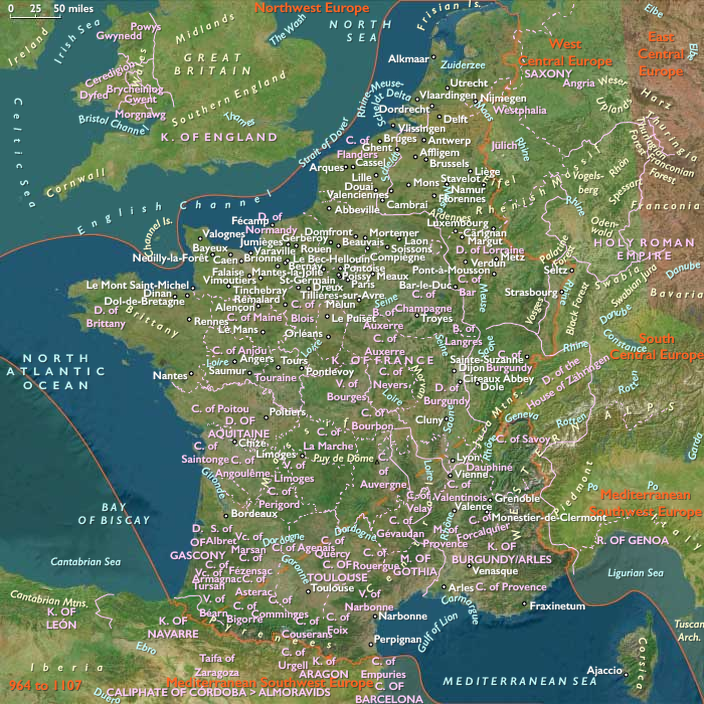
Henry III’s Attempt at Conciliation and the Final Division of Lorraine (1046)
After years of rebellion and conflict, Emperor Henry III chose a strategy of limited reconciliation toward Godfrey the Bearded, the former Duke of Lower Lorraine. Rather than punishing him further, Henry restored him to his position in Upper Lorraine but denied him Lower Lorraine, which was granted to a new ruler. This decision, however, failed to pacify Godfrey, who remained dissatisfied with his diminished power.
Restoration of Godfrey in Upper Lorraine
- Despite his repeated rebellions against imperial rule, Godfrey the Bearded was restored as Duke of Upper Lorraine.
- Henry hoped to reconcile with Godfrey, recognizing his military strength and noble lineage.
- However, Godfrey's strongest claim had been to rule both Upper and Lower Lorraine, and his ambitions were not easily satisfied.
Verdun Handed to the Bishop
- To weaken Godfrey’s power further, Henry stripped him of the County of Verdun, a valuable imperial fiefthat had been a source of his strength.
- The county was instead granted to the Bishop of Verdun, reinforcing Henry’s policy of supporting ecclesiastical rulers over secular nobles.
- This move further alienated Godfrey, as it reduced his direct control over key territories within his duchy.
Lower Lorraine Granted to Frederick
- Instead of restoring Lower Lorraine to Godfrey, Henry appointed Frederick of Luxembourg, a loyal imperial supporter, as the new Duke of Lower Lorraine.
- Frederick’s rule ensured that Lower Lorraine remained under imperial influence, preventing Godfrey from reuniting the two duchies.
- This final division of Lorraine between Upper and Lower halves became a permanent political structure, shaping the future of the region.
Godfrey’s Continued Defiance
- Despite being restored to Upper Lorraine, Godfrey was not placated, as he had hoped to regain his full inheritance.
- The loss of Lower Lorraine to Frederick and Verdun to the bishop only deepened his resentment toward Henry III.
- This failed reconciliation meant that tensions between Godfrey and the emperor would continue, leading to further conflicts in the years ahead.
Legacy and Impact
- Henry III successfully prevented the reunification of Lorraine, ensuring that the region remained divided and under firm imperial control.
- The appointment of Frederick of Luxembourg in Lower Lorraine strengthened imperial oversight, but it also deepened Godfrey’s discontent, prolonging the Lotharingian unrest.
- The granting of Verdun to the bishop reinforced Henry’s use of the Church as a counterweight to feudal lords, a hallmark of his imperial policies.
Though Henry III attempted to pacify Godfrey, his refusal to fully restore his power ensured that the Duke of Upper Lorraine would remain a dangerous opponent, continuing to challenge imperial rule in the coming years.