
Filters:
Henry III’s Campaign in Lower Lorraine and …
Years: 1045 - 1045
Henry III’s Campaign in Lower Lorraine and the Defeat of Dirk IV (1046)
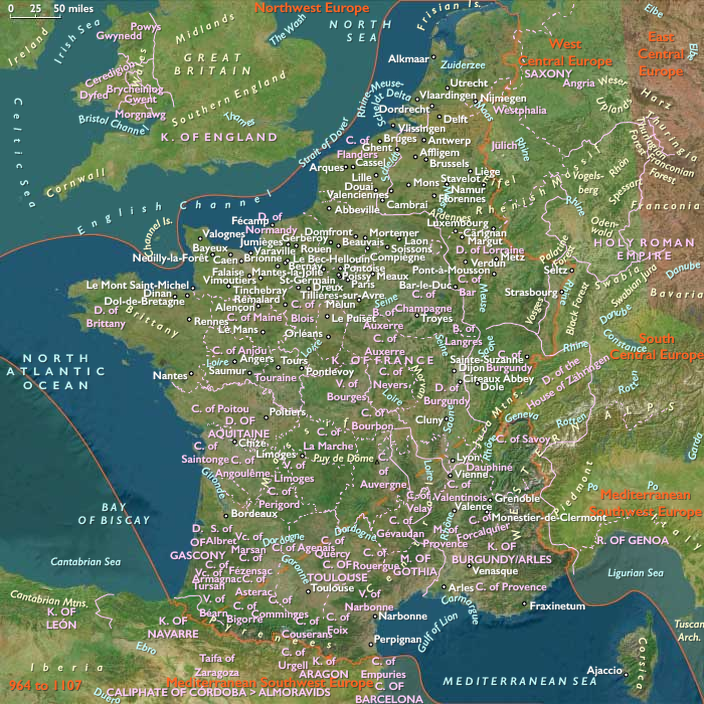
Following his successful consolidation of Burgundy, Emperor Henry III turned his attention to Lower Lorraine, where a new crisis had emerged. Gothelo II, Duke of Lower Lorraine, had just died, creating a power vacuum that destabilized the region. Meanwhile, Dirk IV, Count of Holland, had taken advantage of the situation to seize Flushing, prompting Henry III to launch a river campaign to reclaim imperial authority.
Campaign Against Dirk IV and the Recapture of Flushing
- Henry III personally led a river-based military expedition against Count Dirk IV of Holland, who had occupied Flushing, a crucial strategic port in the Scheldt estuary.
- The campaign involved naval and land forces, demonstrating the emperor’s ability to wage war in the difficult terrain of the Low Countries.
- Dirk IV was decisively defeated, and Flushing fell back into imperial hands.
- To reinforce imperial influence in the region, Henry III granted Flushing to Bernold, Bishop of Utrecht, further strengthening ecclesiastical power as a counterbalance to rebellious secular lords.
Return to Aachen and the Fate of Lorraine
- After securing Flushing and pacifying Holland, Henry III returned to Aachen, the historic capital of Charlemagne, to celebrate Pentecost and convene a court to decide the fate of Lorraine.
- With Gothelo II’s death, Henry was now in a position to reconfigure the ducal structure of Lower Lorraine, a region still reeling from the rebellion of Godfrey the Bearded.
- His decision on Lorraine’s governance would be critical in determining the future balance of power in the Low Countries and the empire.
Legacy and Consequences
- Henry III’s campaign against Dirk IV demonstrated his firm commitment to maintaining imperial control over the rebellious feudal lords of the Low Countries.
- The transfer of Flushing to the Bishop of Utrecht reinforced the imperial strategy of using the Church as a counterweight to local nobility, a tactic Henry had already employed in Burgundy and Lorraine.
- With Lorraine still in turmoil, Henry’s next move would shape the course of the ongoing Lotharingian conflict, as Godfrey the Bearded remained defiant despite multiple setbacks.
Henry III’s swift military actions and political maneuvering reflected his strong personal leadership, securing imperial territories while preparing for the next stage of the Lotharingian rebellion.
Locations
People
- Eckard II
- Godfrey III, Duke of Lower Lorraine
- Henry I of France
- Henry III, Holy Roman Emperor
- Henry VII of Bavaria
- Peter, King of Hungary
Groups
- Germans
- Hungarian people
- Flanders, County of
- Swabia, Duchy of
- Bavaria, Ottonian Duchy of
- German, or Ottonian (Roman) Empire
- Meissen, March of
- Lorraine, (second) Duchy of
- Lorraine (Lothier), Lower, (second) Duchy of
Commodoties
Subjects
Regions
Subregions

Years: 1045 - 1045
Locations
People
- Eckard II
- Godfrey III, Duke of Lower Lorraine
- Henry I of France
- Henry III, Holy Roman Emperor
- Henry VII of Bavaria
- Peter, King of Hungary
Groups
- Germans
- Hungarian people
- Flanders, County of
- Swabia, Duchy of
- Bavaria, Ottonian Duchy of
- German, or Ottonian (Roman) Empire
- Meissen, March of
- Lorraine, (second) Duchy of
- Lorraine (Lothier), Lower, (second) Duchy of
Commodoties
Subjects
Regions
Subregions