Henry is besieged at Harzburg by the …
Years: 1073 - 1073
August
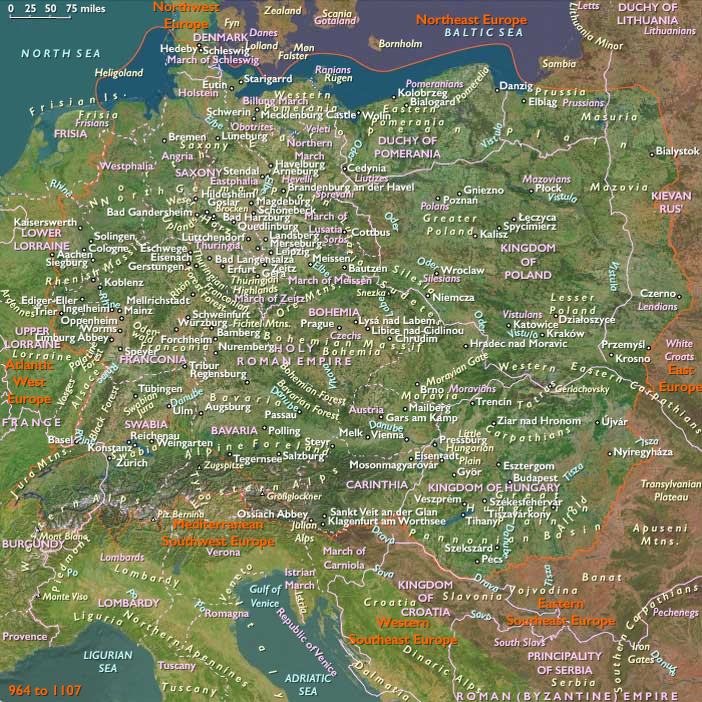
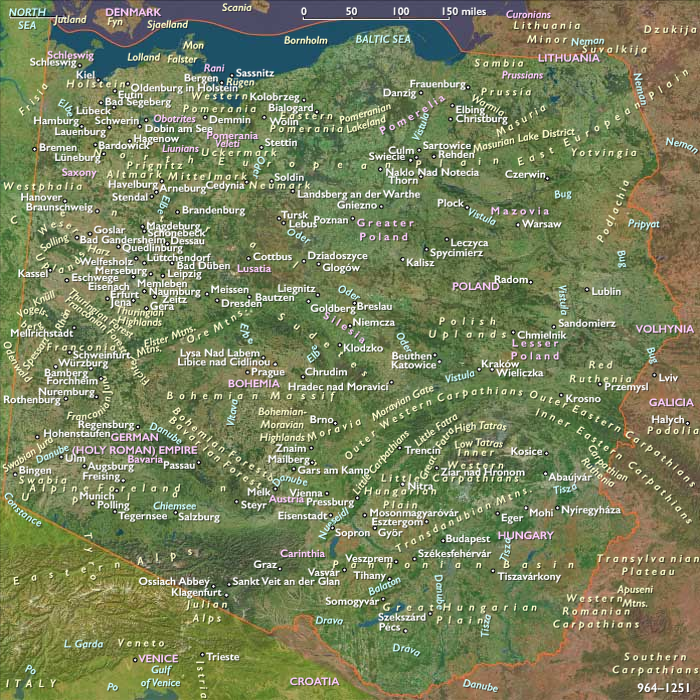
Henry is besieged at Harzburg by the Saxon rebels, again led by Count Otto of Nordheim together with Bishop Burchard II of Halberstadt.
The besieging force allegedly numbers sixty thousand while his garrison only has three hundred men.
The king, however, is finally able to escape on the night of August 10, 1073, allegedly through the castle's well shaft and a secret passage.
Locations
People
Groups
Topics
Commodoties
Subjects
Regions
Subregions
Related Events
Filter results
Showing 10 events out of 50730 total
The thirty-nine-year old Emperor Go-Sanjō abdicates in January 1073 favor of his son, who ascends the throne as Emperor Shirakawa.
The former emperor enters the Buddhist priesthood in May and dies within the month.
Chancellor Wang Anshi of the Song Dynasty creates a new bureau of the central government called the Directorate of Weapons, which supervises the manufacture of military armaments and ensures quality control.
Shen Kuo, while employed by the central government, is also sent out with others to inspect the granary system of the empire, investigating problems of illegal collections, negligence, ineffective disaster relief, and inadequate water-conservancy projects.
While Shen is serving as the regional inspector of Zhejiang in 1073, the Emperor Shenzong of Song requests that Shen pay a visit to the famous poet Su Shi (1037–1101), at this time an administrator in Hangzhou.
Shen takes advantage of this meeting to copy some of Su's poetry, which he presents to the Emperor indicating that it expresses "abusive and hateful" speech against the Song court; these poems will later be politicized by Li Ding and Shu Dan in order to level a court case against Su.
With his demonstrations of loyalty and ability, Shen Kuo is awarded the honorary title of a State Foundation Viscount by the emperor, who places a great amount of trust in Shen Kuo.
He is even made 'companion to the heir apparent' (’Taizi zhongyun').
Zhou Dunyi, born in Yingdao county in Daozhou prefecture in southern Hunan in 1017, was originally named Zhou Dunshi.
Raised by a scholar-official family, he had been forced to change his name in 1063 to avoid a character in the personal name of the new Emperor Yingzong.
His father died when he was fourteen and he had been taken in by his uncle Zheng Xiang, through whom he had received his first posting in government.
Although very active in his civil service career, he has never achieve a high position or attain the "Presented Scholar" degree (jinshi).
Some of the positions that he had held were district record keeper (1040), magistrate in various districts (1046–1054), prefectural staff supervisor, and professor of the directorate of education and assistant prefect (1061–1064).
In the Taiji Tushuo (Explanations of the Diagram of the Supreme Ultimate or Diagram Explaining the Supreme Ultimate), Zhou fuses Confucian ethics and concepts from the Book of Changes (I Ching) with Taoist naturalism.
He develops a metaphysics based on the idea that "the many are ultimately one and the one is ultimate."
This is the first eleventh-century Chinese text to argue for the inseparability of metaphysics or cosmology and ethics, as well as the first major Chinese text to explore the concept of the taijitu or "yin-yang symbol".
The Tong Shu (The All-Embracing Book or Penetrating the 'Book of Changes') is a reinterpretation of the Confucian doctrines.
The basis for ethics in neo-Confucianism, it states that the sage is a superior man who acts in accordance with the principles of propriety, humanity, righteousness, wisdom, faithfulness, tranquility and sincerity.
Sincerity being the basis for moral nature, it can be used to distinguish between good and evil and to perfect oneself.
Zhou Dunyi has only two students who make any major contribution to Confucianism: his nephews Cheng Yi and Cheng Hao.
The Cheng brothers had studied under Zhou Dunyi only for a short time when they were younger.
The brothers had moved on to establish the Cheng-Zhu School, which will dominate Chinese philosophy for over 700 years.
Zhou Dunyi is considered the founding father of this school although there are no references in the Cheng brothers' writings to his contributions.
Zhou had resigned from his last post 1072 and dies near Mount Lu in Jiangxi province in 1073.
After his death, Zhou will commonly be called Zhou Lianxi for a name he adopted in his retirement that honored the Lian stream near his home.
Zhou Dunyi will be a major influence on the twelfth-century philosopher Zhu Xi, who is considered one of the greatest Confucian thinkers since Confucius himself.
Zhu Xi is known to have said that Zhou Dunyi was the first great sage and first of the Song Dynasty.
Zhu Xi will defend Zhou Dunyi on the importance of his concept of Wuji.

Guo Xi is often referred to as a “Northern Song master” when it comes to painting.
His work inspires many later artists and he will even had landscapes dedicated to him.
His lesser-known “Deep Valley” scroll painting depicts a serene mountain valley covered with snow and several trees struggling to survive on precipitous cliffs.
The ink washes and amorphous brush strokes are employed to model surfaces that suggest the veiling effects of the atmosphere.
One of Guo Xi’s techniques is to layer ink washes to build up forms and his “Deep Valley” is a masterpiece of the use of light ink and magnificent composition.
Upon the death of Yaroslav the Wise in 1054, his son Sviatoslav had joined his brothers Vsevolod and Iziaslav in forming a kind of a princely triumvirate that has overseen the affairs of Kievan Rus' until 1072.
In 1067, they had defeated Vseslav of Polotsk, on the Nemiga River and had taken hm him prisoner.
A year later, the brothers had been defeated by the Polovtsi (Cumans) on the Alta River.
After a while, Sviatoslav had returned to defeat these steppe nomads with a smaller force at the town of Snov, thus enhancing his prestige among the populace.
Sviatoslav's first wife was named Kilikia (Cecilia), a lady of unknown origin, but possibly a princess from the Caucasus.
Their sons were Oleg, Gleb, Roman, and Davyd In 1072, Sviatoslav had married Oda, daughter of a certain "Count Lippold", and the sister of Burkhard, provost of Trier.
Oda's granduncles were Pope Leo IX and Henry III, Holy Roman Emperor.
The triumvirate breaks up in 1073, when Sviatoslav, supported by his younger brother Vsevolod, dethrones and replaces his older brother Iziaslav.
The dishonorable behavior of Constantinople in abrogating the post-Manzikert treaty terms gives the Seljuqs justification in continuing their raids and even encourages them to do so.
The imperial army includes a contingent of Norman mercenaries under one Roussel de Bailleul.
Roussel is possibly a Frank, but had certainly ventured with the Apulian Normans to Italy, settled in Terra d'Otranto and served under Roger de Hauteville in Sicily.
According to Geoffrey Malaterra, Roussel had distinguished himself with his bravery at the Battle of Cerami, where he urged Count Roger to pursue the fleeing Saracens.
Aside from this brief account by Malaterra, The Alexiad of Anna Comnena is the main source for Roussel.
He had been present at the Battle of Manzikert in 1071, where he refused to join the fray, which proved to be a disastrous defeat for the imperial army.
Despite this treachery, he had been kept in imperial service, where good generals are needed, and had been sent into Asia Minor again with a force of three thousand Franco-Norman heavy cavalry.
After learning of the deposition of Emperor Romanus IV Diogenes, Bailleul and his four hundred followers had turned on their former employers and set out to terrorize and plunder Anatolia, initiating a Norman conquest of Lycaonia and Galatia.
Here, Roussel conquers some territory and declares it an independent state, in 1073, with himself as prince, following the example set by his fellow Normans in the Mezzogiorno.
His capital is Ankara, now the capital of Turkey.
The new Emperor, twenty-two-year-old Michael VII Doukas, dispatches an army commanded by his uncle, John Doukas.
Engaging de Bailleul near Amorium (Ammuriye), Doukas is defeated and captured by the Normans.
Gregory Pakourianos, whose origins are a matter for scholarly dispute, is believed to have hailed from the region of Tao or Tayk, which had been annexed by Constantinople to the theme of Iberia in 1001.
According to the contemporary historian Anna Komnena, who knew Pakourianos personally, Gregory was "descended from a noble Armenian family," while the Armenian chronicler Matthew of Edessa, from the twelfth century, saying Pakourianos was of "Vrats'" origin, had in mind the religious affiliation of Pakourianos.
Gregory himself proclaimed that he belonged to "the glorious people of the Iberians" and insisted his monks of the Monastery of the Mother of God Petritzonitissa in Bachkovo, which he had founded, to know the Georgian language.
According Anna Komnena, Pakourianos was tiny of body but a mighty warrior.
In 1064, he had participated in the unsuccessful defense of Ani against the Seljuq leader Alp Arslan and his allies: the Caucasian Georgians headed by King Bagrat IV of Georgia and Albanians headed by King Goridzhan.
He has served afterwards under Michael VII Doukas in various responsible positions on both the eastern and the western frontiers of the empire.
Since 1071, he has been a governor of the Theme of Iberia.
As the Seljuq advance had forced the imperial forces to evacuate the eastern Anatolian fortresses and the Theme of Iberia, he cedes control over Kars to King George II of Georgia in 1072-1073.
This will not help to stem the Turkish advance, however, and the area will become a battleground of the Georgian-Seljuq wars.
George II faces a major aristocratic revolt led by Niania Kvabulis-dze, Ivane Liparitis-dze, and Vardan of Svaneti in 1073.
Although the king is victorious, he has to buy the rebels’ loyalty through generously awarding them additional estates.
Soon, Georgia is attacked again by the Seljuqs, the nomadic Turkic people, who will prove to be a major menace to George II’s reign.
The Bulgarian rebellion is finally crushed in 1073 Nikephoros Bryennios, who serves from 1072 to 1073 as doux of Bulgaria, where he reimposes imperial control; he will soon be elevated to the important position of doux of Dyrrhachium.