
Henry had stayed with his father-in-law, in …
Years: 1190 - 1190
Henry had stayed with his father-in-law, in Normandy before being allowed back into Germany in 1185.
He had been exiled again in 1188.
His wife Matilda dies in 1189.
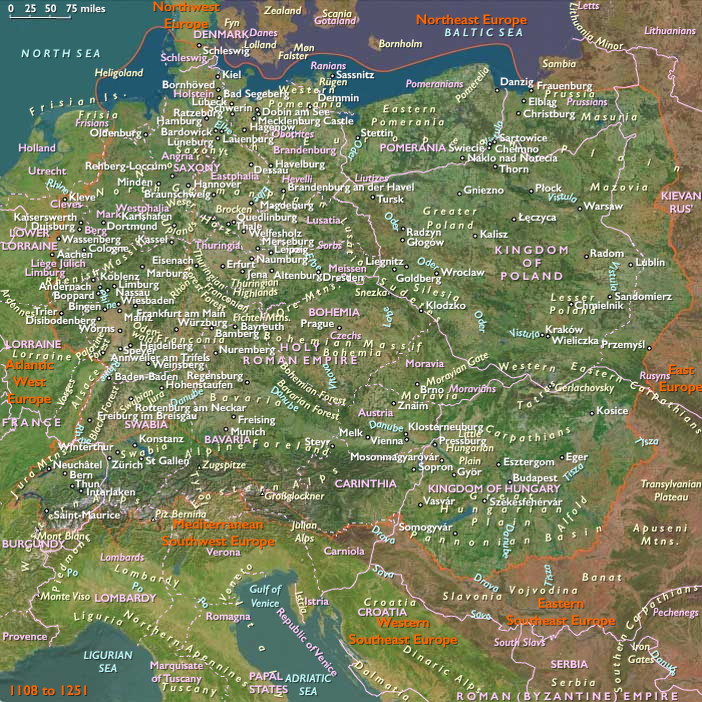
After Frederick Barbarossa goes on the Crusade of 1189, Henry returns to Saxony, mobilizes an army of his faithful, and conquers the rich city of Bardowick as punishment for her disloyalty.
Only the churches are left standing.
Locations
People
Groups
- Holy Roman Empire
- Christians, Roman Catholic
- Welf, House of
- Brandenburg (Ascanian) Margravate of
- Bavaria, Wittelsbach Duchy of
Topics
Commodoties
Subjects
Regions
Subregions
Related Events
Filter results
Showing 6 events out of 6 total
The War of Succession of Champagne (1216–1222): A Struggle for Control
The War of Succession of Champagne (1216–1222) was a two-year conflict (1216–1218) in the Champagne region of France, sparked by rival claims to the county after the death of Count Theobald III in 1201. While active hostilities ended in 1218, the war did not officially conclude until 1222, when Theobald IV of Champagne reached the age of majority and his rivals abandoned their claims.
Background: The Succession Crisis
- Theobald III of Champagne died in 1201, leaving his widow, Blanche of Navarre, pregnant.
- Their posthumous son, Theobald IV, was born in 1201, making him the rightful heir to the County of Champagne.
- Blanche acted as regent, but many powerful nobles contested Theobald IV’s succession, seeking to claim Champagne for themselves.
The War of Succession (1216–1218)
- By 1216, Champagne’s noble factions were fully engaged in war, with fighting spilling over into neighboring duchies.
- Blanche of Navarre, as regent, fought to preserve her son’s inheritance, securing support from Philip II of France.
- The war involved sieges, skirmishes, and shifting alliances but failed to produce a clear winner.
- By 1218, the conflict had largely subsided, though legal and political disputes continued.
The End of the Conflict (1222)
- While fighting had ceased by 1218, Theobald IV’s rivals only officially abandoned their claims in 1222, when he reached the age of majority.
- Theobald IV secured his rule, strengthening Champagne’s position as one of the most influential counties in France.
Consequences of the War
- Theobald IV’s ultimate victory preserved Champagne’s autonomy within the Capetian-controlled Kingdom of France.
- The war weakened Champagne’s noble families, consolidating power in the hands of the ruling count.
- Champagne remained a center of commerce, fairs, and chivalric culture, playing a key role in medieval France’s economy and politics.
The War of Succession of Champagne (1216–1222) was a critical moment in the region’s history, securing Theobald IV’s rule and maintaining Champagne’s status as a powerful feudal territory within medieval France.
The War of Succession of Champagne (1216–1222): The Struggle Between Blanche of Navarre and Erard de Brienne
The War of Succession of Champagne (1216–1222) arose from a dispute over the rightful rule of the County of Champagne, following the deaths of Henry II of Champagne (1197) and Theobald III (1201). The claimants were:
- Theobald IV of Champagne, the posthumous son of Theobald III and Blanche of Navarre, whose mother acted as regent from his birth.
- Philippa of Champagne, daughter of Henry II of Champagne, and her husband Erard de Brienne-Ramerupt, a noble from Champagne living in the Holy Land.
While Theobald IV’s claim was direct, Erard sought to challenge his right to rule through his wife Philippa, supported by several local barons and outside nobles, including Theobald I, Duke of Lorraine. However, Blanche of Navarre’s political and diplomatic skill proved decisive, ensuring that her son’s rule was eventually secured.
Background: The Origins of the Conflict
-
Henry II of Champagne’s Death and the Succession of Theobald III (1197–1201)
- Henry II of Champagne died in 1197, leaving behind only daughters, meaning his younger brother, Theobald III, inherited the county.
- Theobald III died unexpectedly in 1201, leaving his widow, Blanche of Navarre, nine months pregnant with their son, Theobald IV.
- Theobald IV’s birth made him the rightful heir, but as an infant, his rule was vulnerable to challenges.
-
Blanche of Navarre’s Regency (1201–1216)
- Blanche acted as regent, proving herself a strong and efficient ruler.
- Many nobles who might have opposed her departed on the Fourth Crusade (1202–1204), giving her time to consolidate her position.
- She was supported by Queen Mother Adèle of Champagne (aunt of Theobald III), who guided Blanche until her death in 1206.
- Blanche secured crucial alliances with King Philip II of France and Pope Innocent III, ensuring her son’s legitimacy.
The Succession Dispute and the War (1216–1222)
-
Philippa of Champagne and Erard de Brienne’s Challenge (1215–1216)
- Philippa married Erard de Brienne-Ramerupt, a nobleman linked to the ruling house of Jerusalem.
- Encouraged by Erard, Philippa claimed Champagne as her inheritance, arguing that Theobald IV was only a posthumous heir and that her father Henry II had been the rightful count.
- Erard gathered local Champagne barons to support their claim, creating a rebellion against Blanche and Theobald IV.
-
The Role of Philip II of France and Pope Innocent III
- Philip II fully supported Blanche and Theobald IV, partly due to Theobald’s bravery at the Battle of Bouvines (1214).
- Pope Innocent III excommunicated rebel barons, further weakening Erard’s support.
-
Theobald I, Duke of Lorraine, Joins the War (1216–1217)
- Theobald I of Lorraine, recently released from captivity after fighting at Bouvines on the losing side, sided with Erard de Brienne.
- However, his suzerain, Holy Roman Emperor Frederick II, opposed this and viewed it as a felony.
- Frederick retaliated by occupying Rosheim, a city he had previously granted to Theobald’s father.
The Conclusion of the War (1218–1222)
- By 1218, Erard and Philippa’s forces were weakened by papal and royal opposition.
- In 1222, when Theobald IV reached the age of majority, their remaining supporters abandoned their claims.
- Theobald IV was officially recognized as Count of Champagne, and Erard lost his bid for power.
Impact and Legacy
-
Blanche of Navarre’s Triumph
- Blanche’s political and diplomatic skill ensured Theobald IV’s succession, making her one of the most successful medieval female rulers.
-
Capetian Influence Strengthened
- With Philip II’s intervention, Champagne remained closely tied to the French Crown, reinforcing Capetian dominance.
-
Frederick II’s Growing Power
- The war demonstrated Frederick II’s authority in the Holy Roman Empire, as he punished Theobald I of Lorraine for defying him.
The War of Succession of Champagne (1216–1222) was a pivotal moment in feudal France, showcasing the increasing power of the monarchy and the Church over rebellious nobles while securing the rule of Theobald IV.
Theobald I of Lorraine Retaliates Against Emperor Frederick II (1218 CE)
In 1218, in response to Holy Roman Emperor Frederick II’s occupation of Rosheim, Theobald I, Duke of Lorraine, launched a counteroffensive, retaking the city and ravaging Alsace. This act escalated the ongoing power struggle between the emperor and rebellious regional lords.
Background of the Conflict
- Theobald I had joined the War of Succession of Champagne (1216–1222) in support of Erard de Brienne, who was challenging Theobald IV of Champagne.
- His participation in the war defied Frederick II, who had supported Theobald IV, seeing Erard’s rebellion as a violation of feudal loyalty.
- As punishment, Frederick II occupied Rosheim, a city he had previously granted to Theobald’s father.
Theobald’s Military Response (1218)
- Theobald retook Rosheim by force, demonstrating his continued defiance of the emperor.
- He led a destructive campaign in Alsace, targeting imperial holdings to weaken Frederick’s influence in the region.
Consequences of Theobald’s Offensive
- Frederick II’s authority in Alsace was directly challenged, forcing him to redirect imperial resources to secure the region.
- Theobald’s actions further strained relations with the emperor, making him a persistent adversary of the Hohenstaufens.
- The conflict foreshadowed ongoing resistance by regional lords against Frederick’s efforts to centralize imperial power.
Theobald I’s bold response in 1218, retaking Rosheim and devastating Alsace, marked a significant act of defiance against imperial authority, intensifying the broader struggles between the Holy Roman Emperor and rebellious nobles in the early 13th century.
Frederick II's Invasion of Lorraine and the Burning of Nancy (1218 CE)
In 1218, Holy Roman Emperor Frederick II swiftly counterattacked Duke Theobald I of Lorraine, who had recently retaken Rosheim and ravaged Alsace. In retaliation, Frederick invaded Lorraine, striking directly at its capital, Nancy, which he captured and burned. This decisive response was part of Frederick’s broader campaign to assert imperial control over rebellious vassals in the Holy Roman Empire.
The Context of the Conflict
- Theobald I of Lorraine had challenged Frederick II’s authority by siding with Erard de Brienne in the War of Succession of Champagne and by attacking Alsace.
- In response, Frederick launched a punitive campaign, asserting his power over defiant German lords.
Frederick’s Invasion of Lorraine
- Frederick led an imperial army into Lorraine, advancing swiftly to Nancy, the duchy’s capital.
- Upon capturing the city, he ordered it to be burned, sending a clear message of imperial dominance.
- The destruction of Nancy weakened Theobald’s ability to resist, crippling his power base.
Consequences of the Attack on Nancy
- Theobald I suffered a major setback, losing his strongest fortress and administrative center.
- Frederick II reaffirmed his authority in Lorraine, demonstrating his capacity to suppress rebellious vassals.
- The attack on Nancy became a turning point in the regional power struggle, as it forced Theobald to reconsider his resistance to the emperor.
Frederick II’s invasion of Lorraine and the burning of Nancy in 1218 underscored his determination to maintain imperial control, crushing opposition among the German nobility and punishing those who defied his rule.
Frederick II’s Capture of Theobald I of Lorraine at Amance and His Forced Submission (1218 CE)
After burning Nancy, Holy Roman Emperor Frederick II continued his punitive campaign against Theobald I, Duke of Lorraine, pursuing him to the castle of Amance, where Theobald had taken refuge. Frederick besieged the fortress, captured it, and imprisoned Theobald, forcing him to submit to harsh terms to regain his freedom.
The Siege and Capture of Theobald I at Amance
- Frederick II’s forces besieged Amance, one of Theobald’s last strongholds in Lorraine.
- The castle eventually fell to the imperial army, and Theobald was taken prisoner.
- The defeat left Theobald in a position of extreme weakness, forcing him to negotiate for his release.
The Terms of Theobald’s Release
To regain his freedom, Theobald was forced to accept humiliating conditions, including:
-
Recognizing the suzerainty of the Count of Champagne
- This effectively made Theobald a vassal of Champagne, diminishing his independent authority.
-
Acknowledging the legitimacy of Erard de Brienne’s claim to Champagne
- This strengthened the opposition against Theobald IV of Champagne, whom Theobald I had originally supported.
-
Ceding several lordships to Frederick II
- These territorial concessions further weakened Lorraine’s autonomy and expanded imperial control over the region.
Consequences of Theobald’s Defeat
- Theobald’s loss at Amance significantly reduced his power, both within Lorraine and in Champagne.
- Frederick II demonstrated his ability to suppress rebellious vassals, reinforcing imperial dominance in the Holy Roman Empire.
- The war for Champagne’s succession continued, but Theobald I’s defeat altered the balance of power in favor of Erard de Brienne.
Frederick II’s campaign in Lorraine and his capture of Theobald I at Amance in 1218 reinforced imperial authority over rebellious German lords, while also undermining Theobald IV of Champagne’s position in the ongoing War of Succession of Champagne.
The Death of Theobald I of Lorraine and the Turmoil of His Succession (1220 CE)
Theobald I, Duke of Lorraine, never recovered the lands and prestige he lost following his defeat and capture by Emperor Frederick II in 1218. His imprisonment and forced concessions significantly weakened his rule, and he died in February 1220, leaving Lorraine in a precarious state.
Theobald’s Marriage and Lack of Heirs
- In 1206, Theobald married Gertrude of Dagsburg, the only child and heir of Albert II, Count of Dagsburg and Metz.
- Their marriage produced no children, meaning there was no direct heir to his title.
- His death created a succession crisis, as power now passed to his brother, Matthias II of Lorraine.
Gertrude’s Controversial Second Marriage (May 1220)
- Just three months after Theobald’s death, Gertrude remarried—this time to his former rival, Theobald IV of Champagne, who was only nineteen years old.
- The marriage was highly controversial, as it was arranged without the approval of Emperor Frederick II, who opposed the union.
- Frederick II likely saw the marriage as a political threat, as it strengthened Champagne’s position in Lorraine and increased the influence of the Capetian-aligned nobility in the empire.
Consequences of Theobald I’s Death and Gertrude’s Remarriage
-
Matthias II Becomes Duke of Lorraine
- Matthias inherited a weakened duchy, still recovering from Frederick II’s occupation and intervention.
- His rule would be overshadowed by external pressures from both the Holy Roman Emperor and French-aligned nobility.
-
Gertrude’s Marriage to Theobald IV of Champagne Deepens Political Tensions
- Frederick II’s opposition to the marriage set the stage for further imperial interference in Lorraine and Champagne.
- Theobald IV of Champagne gained influence in the region, complicating relations between the French and the Holy Roman Empire.
The death of Theobald I in 1220 marked the end of his troubled rule and set off a chain of political conflicts in Lorraine, Champagne, and the Holy Roman Empire, influencing the balance of power between France and the empire.
Years: 1190 - 1190
Locations
People
Groups
- Holy Roman Empire
- Christians, Roman Catholic
- Welf, House of
- Brandenburg (Ascanian) Margravate of
- Bavaria, Wittelsbach Duchy of
