Henry goes north in 1054 to deal …
Years: 1054 - 1054
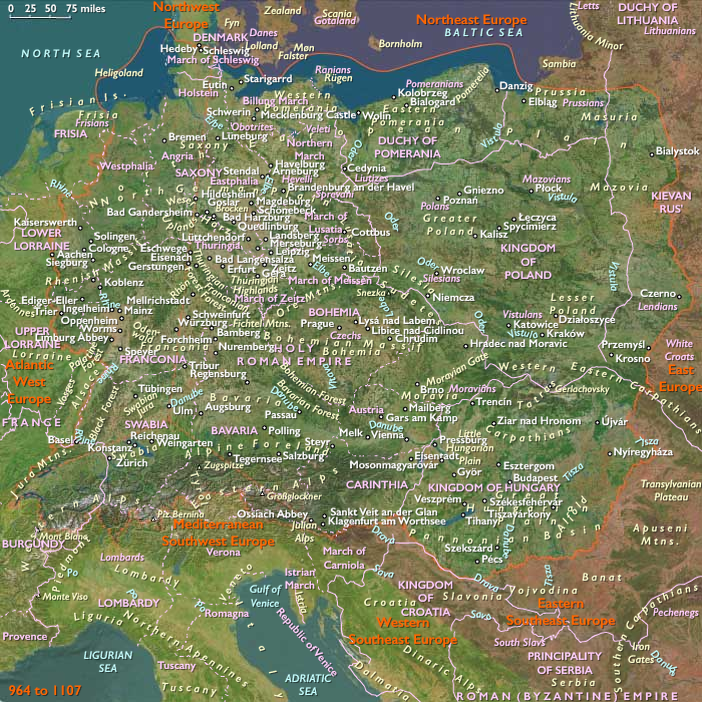
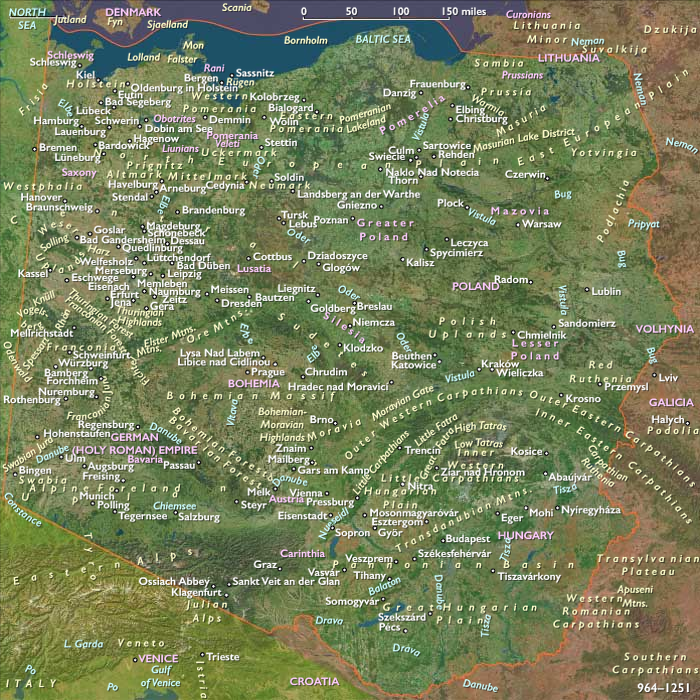
Henry goes north in 1054 to deal with Casimir of Poland, now on the warpath.
He transfers Silesia from Bretislaus to Casimir.
Bretislaus will nevertheless remain loyal to the end.
Locations
People
- Andrew I of Hungary
- Bretislaus I
- Casimir I the Restorer
- Henry III, Holy Roman Emperor
- Henry IV, Holy Roman Emperor
- Pope Leo IX
Groups
- Christianity, Chalcedonian
- Saxony, Duchy of
- Bohemia, Duchy of
- German, or Ottonian (Roman) Empire
- Hungary, Kingdom of
- Poland of the first Piasts, Kingdom of
- Christians, Roman Catholic
Commodoties
Subjects
Regions
Subregions
Related Events
Filter results
Showing 10 events out of 51146 total
Lý Nhat Tôn, third king of the Lý Dynasty, succeeds his father to rule in the region of present Vietnam and changes the country's official name to Dai Viet.
The gifted Japanese Buddhist sculptor Jocho reportedly perfects a technique that permits great refinement in wood sculpting.
He and his studio complete the magnificent gilt-wood statue of Amida Buddha, enshrined in the Phoenix Hall of the Byodo-in temple, in 1053.
Yaroslav, to back up an armistice signed with Constantinople in 1046, had married his fourth and favorite son by Ingigerd Olafsdottir, Vsevolod, to the Greek Anastasia (d. 1067), who tradition holds was a daughter of Emperor Constantine IX Monomachos by his second wife (he gained the Imperial throne through his third marriage), but no reliable source has ever been found to confirm this.
However, the couple's son Vladimir Monomakh bears the family name of that emperor, giving the story credence.
Upon his father's death in 1054, Vsevolod receives in appanage the towns of Pereyaslav, …
…Rostov, …
…Suzdal, and …
…the township of Beloozero, which will remain in possession of his descendants until the end of the Middle Ages.
Together with his elder brothers Iziaslav and Sviatoslav, he forms a sort of princely triumvirate that will jointly wage war on the steppe nomads, the Cumans, who the Rus' call Polovtsy.
Vesevolod will compile the first East Slavic law code.
Yaroslav, during his long reign as Grand Prince, has consolidated the power of Kievan Rus', codified laws, encouraged the spread of Christianity, and beautified Kiev with new edifices, including the Cathedral of Saint Sophia at Kiev.
Yaroslav had In 1019 married Ingegerd Olofsdotter, daughter of the king of Sweden, and had given her Ladoga as a marriage gift.
The Saint Sophia Cathedral houses a fresco representing the whole family: Yaroslav, Irene (as Ingegerd is known in Rus), their five daughters and five sons.
Yaroslav has had three of his daughters married to foreign princes who lived in exile at his court: Elizabeth of Kiev to Harald III of Norway (who attained her hand by his military exploits on behalf of Constantinople; Anastasia of Kiev to the future Andrew I of Hungary; Anne of Kiev to Henry I of France; she was the regent of France during their son's minority; (possibly) Agatha, to Edward the Exile, of the royal family of England; she is the mother of Edgar Ætheling and St. Margaret of Scotland.
Yaroslav has one son from the first marriage (his Christian name was Ilya (?-1020)), and six sons from his second marriage.
The eldest of these, Vladimir of Novgorod, best remembered for building the Saint Sophia Cathedral in Novgorod, has predeceased his father.
Apprehending the danger that could ensue from divisions between brothers, he exhorted them to live in peace with each other.
Following his death in 1054, the three older sons—Iziaslav, Sviatoslav, and Vsevolod—will reign in Kiev one after another.
The youngest children of Yaroslav are Igor (1036–1060) of Volyn and Vyacheslav (1036–1057) of Smolensk.
About the last there is almost no information.
Bretislaus I, Duke of Bohemia, is the author of decrees concerning the rules of Christianization, which include a ban on polygamy and trade on holidays.
It was in 1030 that Bretislaus had married Judith of Schweinfurt.
In 1054, Bretislaus organizes the succession and issues the famous Seniority Law, introducing agnatic seniority for order of succession.
Younger members of the dynasty are supposed to govern fiefs (technically, parts of Moravia), but only at the Duke's discretion.
The result of this institution will be the relative indivisibility of the Czech lands, but also the alternation of rules of stronger (or perhaps more political) dukes with periods of bitter fraction wars of members of the dynasty.
It will be effectively ended by the elevation of Bohemia to kingdom under Ottokar I of Bohemia, when primogeniture will become the ruling principle.
Bretislaus’s eldest son Spytihněv is to succeed him as Duke of Bohemia with control over that territory.
Moravia is incorporated into the Bohemian duchy, but divided between three of his younger sons.
The Olomouc Appanage goes to Vratislaus; the Znojmo Appanage goes to Konrád; and the Brno Appanage went to Otto.
The youngest son, Jaromír, enters the church and becomes Bishop of Prague.
The Norman invasion of Italy is a matter of as much concern to the papacy as it is to Constantinople.
The Norman venture, however, has brought the papacy into conflict with the Eastern Church centered in Constantinople, which, since the eighth century, has exercised jurisdiction over large areas of southern Italy and Sicily.
The forcefully enunciated papal theme of primacy in Leo's pontificate complicates the relations between Rome and Constantinople still further because the patriarch of Constantinople, Michael I Cerularius, considers this sheer provocation.
He closes the Latin (Western) churches in Constantinople and raises serious dogmatic charges against the Roman Church, notably in connection with the Eucharist.
The French cardinal Humbert of Silva Candida has attacked the Patriarch in a vitriolic and passionate manner by arguing the case for Roman primacy and quoting extensively from the forged Donation of Constantine, which allegedly bestowed sovereignty in the West on the papacy.
A legation under Humbert's leadership leaves for Constantinople in April 1054.
On arrival Humbert is cordially welcomed by the Emperor Constantine IX, but spurned by the patriarch.
Despite several meetings between Patriarch, Emperor, and legates, no concrete results emerge.
Cerularius again obstructs Constantine's and Leo's efforts by refusing to meet with the legates.
Eventually, on July 16, 1054, despite the fact that Leo has died and the excommunication is invalid, Humbert takes advantage of the papal vacancy to retaliate against Cerularius and his clergy, putting the papal bull of excommunication -- already prepared before the legation left Rome—on the altar of the church of Hagia Sophia in Constantinople during the celebration of the liturgy and in the full view of the congregation.
The Patriarch, in response, convenes a Holy Synod and excommunicates the legation and its supporters.
This event crystallizes in an official way the gradual estrangement of Eastern and Western Christianity.
Constantine's efforts to effect a reconciliation fail, and the schism between Rome and Constantinople is final.
The Schism of 1054, also called the East-West Schism, symbolizes an irreconcilable difference in ideology.
It is to last, with short interruptions, until the modern age.
The reform movement in the Roman Church has emphasized an ideal of the universal role of the papacy that is wholly incompatible with Greek Christian tradition.
Both sides have also deliberately aggravated their differences by reviving all the disputed points of theology and ritual that had become battle cries during the Photian Schism in the ninth century.
The schism of 1054 passes unnoticed by contemporary imperial historians; only later will its significance as a turning point in East-West relations be fully realized.
(Not long after this break, the word “catholic,” which has come to be used to distinguish true believers from false believers, is used to identify the Western church; the Eastern church is called orthodox.)

Literature, especially Persian literature, has flourished under the patronage of the Buyids during this and the previous caliphs' period.
Luminaries include the Persian (Soghdian) philosopher al-Farabi, who had died in 950; al-Mutanabbi, acknowledged in the East as the greatest of Arabic poets, and himself an Arab, in 965; and the greatest of all, the Iranian Abu Ali Husayn ibn Abdallah ibn Sina (Avicenna) in 1037.
In Iraq, a slackening economy, dissension in the army, and general Buyid disunity has hastened the dynasty's decline since the death of 'Adud ad-Dawlah in 983.
During the first half of the long reign of Caliph al-Qa'im, hardly a day has passed in the capital without turmoil.
Frequently the city has been left without a ruler; the Shi'a Buyid ruler has often been forced to flee the capital.
Upon the death of Abu Kalijar in 1048, his son had taken the throne in Baghdad with the title "al-Malik al-Rahim".
His succession to the entire Buyid Empire had been prevented by his brother Abu Mansur Fulad Sutun, who had taken control of Fars.
The two had then entered into a struggle for supremacy.
Al-Malik al-Rahim took Shiraz, but was then forced back to Iraq due to increased hostility between the Turks and the Daylamite troops there.
At about the same time, the Buyid lands in Oman were permanently lost.
In 1051 or 1052, however, he had defeated Abu Mansur and captured Fars.
Al-Malik al-Rahim then appointed another brother, Abu Sa'd Khusrau Shah, as governor of the province.
Shiraz, however is lost in 1053 or 1054, when Abu Mansur returns as a vassal to the Seljuq ruler Toghril, who, having overrun Syria and Armenia, now casts an eye upon Baghdad at a moment when the city is in the last agony of violence and fanaticism.
Years: 1054 - 1054
Locations
People
- Andrew I of Hungary
- Bretislaus I
- Casimir I the Restorer
- Henry III, Holy Roman Emperor
- Henry IV, Holy Roman Emperor
- Pope Leo IX
Groups
- Christianity, Chalcedonian
- Saxony, Duchy of
- Bohemia, Duchy of
- German, or Ottonian (Roman) Empire
- Hungary, Kingdom of
- Poland of the first Piasts, Kingdom of
- Christians, Roman Catholic