
Filters:
Henry III’s Campaign Against Godfrey II and …
Years: 1045 - 1045
Henry III’s Campaign Against Godfrey II and the Securing of Burgundy (1045)
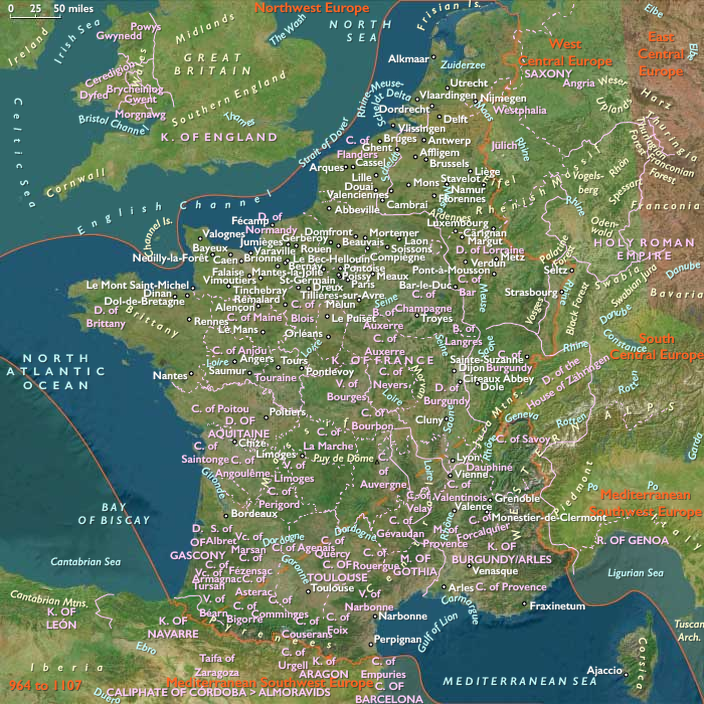
In early 1045, Emperor Henry III launched a military campaign into Lorraine, aiming to crush Godfrey II ("the Bearded") and his rebellion. Though initially successful, his efforts were disrupted by famine, forcing him to shift his focus to Burgundy, where he secured the region under imperial rule.
The Lorraine Campaign and the Siege of Bockelheim
- Henry III entered Lorraine with a local army, intent on subduing Godfrey’s forces.
- He besieged and captured Godfrey’s stronghold at Bockelheim, a strategic castle near Kreuznach.
- Several other fortresses also fell to imperial troops, weakening Godfrey’s ability to resist.
- However, a severe famine forced Henry to withdraw, leaving behind garrisons to protect the region from further raids by Godfrey’s forces.
Godfrey’s Attempts to Stir Rebellion in Burgundy
- As Henry moved out of Lorraine, Godfrey attempted to destabilize imperial authority in Burgundy, a region that had been formally united with the empire in 1033.
- He exploited tensions between:
- The imperialist faction, which supported continued union with the Holy Roman Empire.
- The nationalist faction, which favored an independent Burgundy free from imperial control.
- His efforts sowed discord, but the imperialists, led by Louis, Count of Montbéliard, gained the upper hand.
Henry III’s Victory in Burgundy
- Reginald I, Count of Burgundy (the Free County), was defeated by Louis of Montbéliard, weakening anti-imperial forces in the region.
- By the time Henry III arrived, Reginald and Gerald, Count of Geneva, were ready to submit, acknowledging imperial authority.
- With their homage secured, Burgundy was fully reintegrated under Henry III’s rule, cementing its place within the Holy Roman Empire.
Consequences and Legacy
- While Godfrey continued to resist in Lorraine, his efforts to undermine imperial authority in Burgundy had failed.
- Henry III’s successful assertion of power over Burgundy ensured that the region would remain loyal to the empire, preventing future secessionist movements.
- The campaign exposed the fragility of imperial control in Lorraine, as Henry’s withdrawal due to famine gave Godfrey time to regroup.
- This phase of the Lotharingian Rebellion (1044–1056) illustrated the constant challenges the emperor facedin managing his vast domain, balancing military force, feudal diplomacy, and territorial consolidation.
Despite the temporary setbacks in Lorraine, Henry III’s Burgundian campaign was a clear imperial success, ensuring the duchy’s continued integration into the empire while limiting Godfrey’s ability to expand his influence beyond Lotharingia.
Locations
People
- Godfrey III, Duke of Lower Lorraine
- Gothelo I
- Henry I of France
- Henry III, Holy Roman Emperor
- Peter, King of Hungary
Groups
- Germans
- Hungarian people
- Flanders, County of
- German, or Ottonian (Roman) Empire
- Burgundy, County of
- Lorraine, (second) Duchy of
- Lorraine (Lothier), Lower, (second) Duchy of
Commodoties
Subjects
Regions
Subregions

Years: 1045 - 1045
Locations
People
- Godfrey III, Duke of Lower Lorraine
- Gothelo I
- Henry I of France
- Henry III, Holy Roman Emperor
- Peter, King of Hungary
Groups
- Germans
- Hungarian people
- Flanders, County of
- German, or Ottonian (Roman) Empire
- Burgundy, County of
- Lorraine, (second) Duchy of
- Lorraine (Lothier), Lower, (second) Duchy of
Commodoties
Subjects
Regions
Subregions