
Henry, a pious man, dreams of a …
Years: 1043 - 1043
Henry, a pious man, dreams of a Peace and Truce of God being respected over all his realms.
After his victory in the East, he declares from the pulpit in Konstanz in October 1043 a general indulgence or pardon, whereby he promises to forgive all injuries to himself and to forego vengeance.
He encourages all his vassals to do likewise.
This is known as the "Day of Indulgence" or "Day of Pardon".
Locations
People
Groups
- Lombards (West Germanic tribe)
- Germans
- Hungarian people
- Christianity, Chalcedonian
- Bohemia, Duchy of
- Kievan Rus', or Kiev, Great Principality of
- German, or Ottonian (Roman) Empire
- Italy, Kingdom of (Holy Roman Empire)
- Poles (West Slavs)
- Czechs [formerly Bohemians] (West Slavs)
- Hungary, Kingdom of
- Poland of the first Piasts, Kingdom of
Subjects
Regions
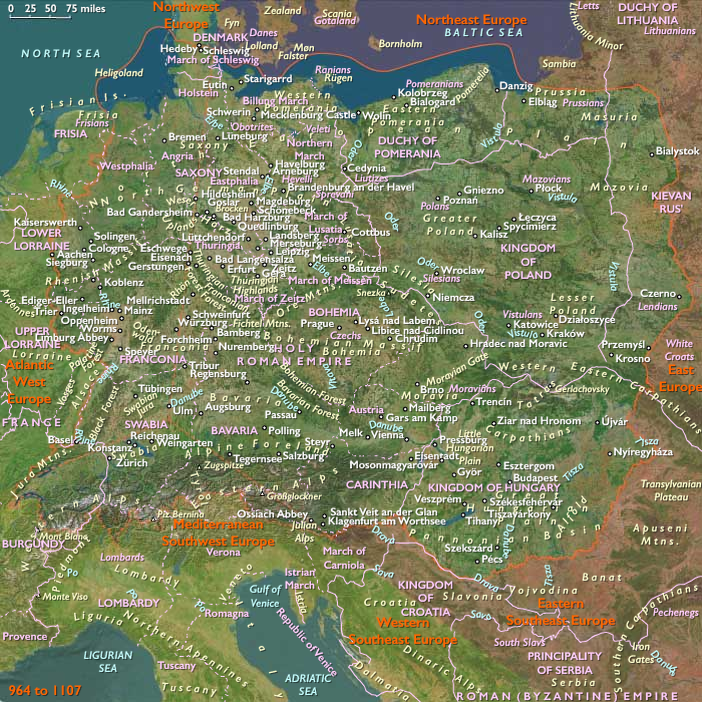
Subregions
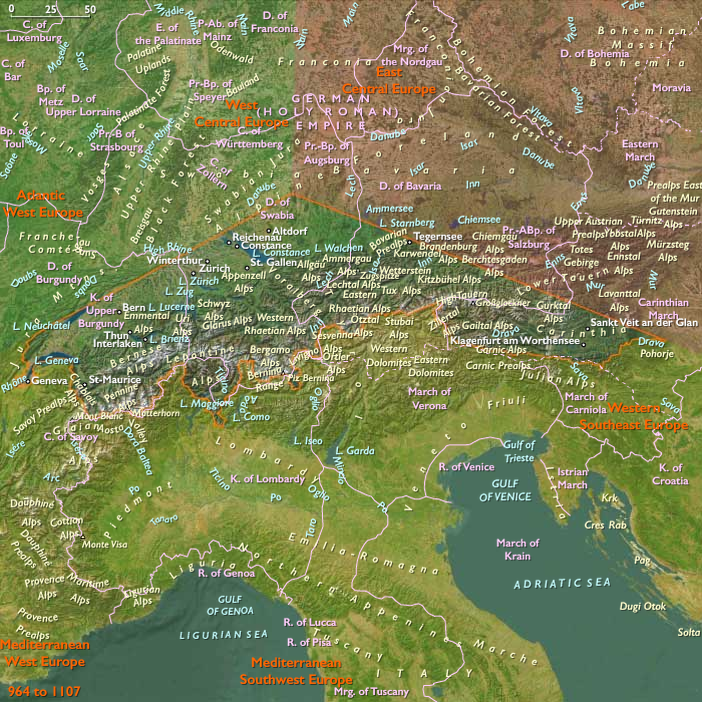
Related Events
Filter results
Showing 10 events out of 51347 total
The Tanguts’ founding father, Li Deming, had not been a very conservative ruler, and thus the Tangut people have begun to absorb more and more of the Chinese culture that surrounds them, but will never lose their actual identity, as is proven by the vast amount of literature that will survive the Tangut state itself.
Li Deming's more conservative son, Li Yuanhao, seeks to restore and strengthen the Tangut people's identity by ordering the creation of an official Tangut script and by instituting laws that reinforce traditional cultural customs.
One of the laws he mandates calls for citizens to wear traditional ethnic apparel, and another requires wearing hair short or shaving the head, as opposed to the Chinese custom at the time of wearing hair long and knotted.
Rejecting the common Chinese surname of "Li" (given to the Xia-xia by the Tang) and "Zhao" (give to the Xia-xia by the Sung) he adopts the Tangut surname "Weiming".
He makes "Xingqing" (present day Yinchuan) his capital city.
At times, the Tangut kingdom operates in the shadow of the Chinese to the East.
Several times, the Chinese are able to mobilize Tibetan tribes against the Tangut state.
However, it is not until 1038 that Li Yuanhao had named himself emperor of Da Xia, and demanded of the Sung emperor recognition as an equal.
The Song court accepts the recognition of Li Yuanhao as 'governor', but not 'emperor', a title considered exclusive to the Sung emperor.
After intense diplomatic contacts, in 1043 the Tangut state accepts the recognition of the Sung emperor in exchange for annual tribute, which implies tacit recognition on the part of the Sung of the military power of the Tangut.
Li nevertheless claims the title of emperor for himself, taking the reign name Jingzong.
Yaroslav stages a naval raid against Constantinople in 1043, led by his son Vladimir of Novgorod and his general Vyshata.
Although the Rus' navy is defeated, Yaroslav manages to conclude the war with a favorable treaty and prestigious marriage of his son Vsevolod to the emperor's daughter.
It has been suggested that the peace with Constantinople was so advantageous to the Kievans because they had succeeded in taking a key imperial possession in Crimea, Chersonesos Taurica.
Nako, having turned to Christianity after his defeat in the Battle of Recknitz in 955, had established his seat at Mecklenburg.
His sons Mstivoj and Mstidrag and grandsons Mstislaw and Udo are mostly associated with the Slavic uprising of 983.
All of them had either abandoned Christianity or were "bad Christians" (at least for a time).
Udo was a bad Christian (male christianus according to Adam of Bremen) whose own father, Mistiwoi, had renounced the new religion for the old Slavic paganism.
Udo had sent his son to be educated at the monastery of St. Michael at Lenzen and later at Lüneburg.
After a Saxon murdered Udo in 1028, Gottschalk had renounced Christianity and assumed the leadership of the Liutici to avenge his father, killing many Saxons before Duke Bernard II of Saxony defeated and captured him; his lands had gone to Ratibor of the Polabians.
Reconverted to Christianity, Gottschalk had been released and sent to Denmark with many of his people to serve King Cnut in his wars with Norway.
Sveyn Estridson, Jarl of Denmark, desired independence from King Magnus I of Norway in 1042.
Because Magnus is supported by his brother-in-law, Bernard II, Sveyn achieves an alliance with the Obotrites through the mediation of Gottschalk.
However, the Obotrite chief Ratibor is killed in a siege by Magnus in 1043.
In an attempt to avenge their father, his sons are killed in the same year in a battle at Lürschau Heath on 28 September.
The death of Ratibor and his sons allows Gottschalk, who marries Sveyn's daughter Sigrid, to seek the inheritance of his father Udo as Prince of the Obodrites.
Samuel is forced by Emperor Henry to renounce all Hungarian territories to the west of the rivers Leitha and Morava as well as agree to the payment of a tribute.
Henry forces Aba to recognize the Danubian territory donated to Germany by Stephen I of Hungary pro causa amicitiae (for friendship's sake); these territories had been ceded to Hungary after the defeat of Conrad II in 1030.
This border will remain the border between Hungary and Austria until 1920.
The funding of the tribute payment is through new taxes on the prelates and seizure of Church estates.
This policy causes discontent even among the members of his own council, resulting in the murder of a number of them during Lent.
In order to punish the king, Bishop Gerard of Csanád refuses to perform his coronation at Easter.
Henry III entertains several embassies at Goslar, his intended capital, after Christmas 1042: Bretislaus comes in person, a Kievan embassy is rejected because Henry is not seeking a Rus' bride, and the ambassadors of Casimir I of Poland are likewise rejected because the duke had not come in person.
George Maniakes transfers his troops into the Balkans and is about to defeat Constantine's army in battle, when he is wounded and dies on the field near Thessaloniki, ending the crisis in 1043.
Constantine's extravagant punishment of the surviving rebels is to parade them in the Hippodrome, seated backwards on donkeys.
With his death, the rebellion ceases.
Harald Hardrada has become extremely rich during his time in the east, and had secured the wealth collected in Constantinople by shipments to Kievan Rus' for safekeeping (with Yaroslav the Wise acting as safekeeper for his fortune).
The sagas note that aside from the significant spoils of battle he had retained, he had participated three times in polutasvarf (loosely translated as "palace-plunder"), a term which implies either the pillaging of the palace exchequer on the death of the emperor, or perhaps the disbursement of funds to the Varangians by the new emperor in order to ensure their loyalty.
It is likely that the money Harald made while serving in Constantinople allowed him to fund his claim for the crown of Norway, which he will pursue in 1046.
If he participated in polutasvarf three times, these occasions must have been the deaths of Romanos III, Michael IV, and Michael V, in which Harald would have had opportunities, beyond his legitimate revenues, to carry off immense wealth.
After Zoe had been restored to the throne in June 1042 together with Constantine IX, Harald had requested to be allowed to return to Norway.
Although Zoe had refused to allow this, Harald had managed to escape into the Bosporus with two ships and some loyal followers.
Although the second ship had been destroyed by Constantinople’s cross-strait iron chains, Harald's ship had sailed safely into the Black Sea after successfully maneuvering over the barrier.
Despite this, Kekaumenos lauds the "loyalty and love" Harald had for the empire, which he reportedly maintained even after he returned to Norway and became king.
Following his escape from Constantinople, Harald had arrived back in Kievan Rus' later in 1042.
During his second stay there, he marries Elisabeth (referred to in Scandinavian sources as Ellisif), daughter of Yaroslav the Wise and granddaughter of the Swedish king Olof Skötkonung.
Shortly after Harald's arrival in Kiev,and immediately after Constantine’s victory over Maniakes, Yaroslav attacks Constantinople, and it is considered likely that Harald provided him with valuable information about the state of the empire.
The Rus' fleet is defeated with the help of Greek fire.
The Chalukyas, under the eastern dynasty’s Somesvara, take the offensive against the Cholas in 1043 with an intensive military campaign aimed at securing control of the Vengi plain.
The late emperor Basil II's project of recovering Sicily from the Arabs is almost realized in 1042 by George Maniakes, the one great general of the post-Macedonian era, who in 1043 is recalled by Constantine.
Refusing, Maniaces is proclaimed emperor by his troops.
Death of Gisela of Swabia and Henry III’s Diplomatic Meeting with Henry I of France (1043)
In 1043, Gisela of Swabia, the mother of Emperor Henry III, passed away, marking the end of one of the most influential imperial matriarchs of the early Salian dynasty. Soon after, Henry III traveled to the French borders, near Ivois, where he met with King Henry I of France, likely to discuss his impending marriage to Agnes of Poitou, the daughter of the Duke of Aquitaine.
Gisela of Swabia’s Death and Her Influence
- Gisela, the wife of Emperor Conrad II, had been a strong political figure throughout her husband’s and son’s reigns.
- She played a crucial role in imperial diplomacy, supporting Conrad in the unification of Upper and Lower Lorraine under Gothelo I and Henry III’s early rule.
- Her death in 1043 left Henry III without his most trusted advisor, increasing the importance of new alliances and marital diplomacy.
Henry III’s Meeting with King Henry I of France (1043)
- Soon after Gisela’s death, Henry III traveled to the French border, likely near Ivois, to meet with Henry I of France.
- The primary purpose of the meeting was likely Henry III’s impending marriage to Agnes of Poitou, daughter of William V of Aquitaine, which would:
- Strengthen ties between the Holy Roman Empire and the Duchy of Aquitaine.
- Secure peace with France, as Aquitaine was a major Capetian vassal.
- Increase imperial influence in western Europe, giving Henry III a valuable political ally in southwestern France.
Significance of the Alliance with Aquitaine
- The marriage to Agnes of Poitou was strategically important, as it tied Henry III to one of the wealthiest and most powerful feudal domains in France.
- It counterbalanced Capetian power while securing imperial prestige in the west.
- Agnes later became Holy Roman Empress, further solidifying the Aquitaine-German alliance.
Legacy
- Gisela’s death marked the end of an era in imperial politics, with Henry III now fully ruling in his own right.
- His marriage to Agnes in 1043/1044 helped reinforce his legitimacy and establish closer Franco-German relations.
- The meeting with Henry I of France highlights the ongoing diplomatic maneuvering between the Capetian and Salian dynasties, as both sought to balance power in medieval Europe.
Thus, 1043 was a pivotal year for Henry III, as he transitioned from ruling under his mother’s influence to fully shaping imperial policy, securing alliances, and asserting his role as the dominant ruler in central Europe.
Years: 1043 - 1043
Locations
People
Groups
- Lombards (West Germanic tribe)
- Germans
- Hungarian people
- Christianity, Chalcedonian
- Bohemia, Duchy of
- Kievan Rus', or Kiev, Great Principality of
- German, or Ottonian (Roman) Empire
- Italy, Kingdom of (Holy Roman Empire)
- Poles (West Slavs)
- Czechs [formerly Bohemians] (West Slavs)
- Hungary, Kingdom of
- Poland of the first Piasts, Kingdom of
