
...Venice. Paolo Caliari, called Il Veronese …
Years: 1553 - 1553
...Venice.
Paolo Caliari, called Il Veronese for his birthplace of Verona, where he trains as a painter, is influenced initially by Giulio Romano, whose mastery of illusionistic devices and allegorical themes the young Veronese tries to emulate in the elaborate frescoes (now largely destroyed) he executes in the early 1550s with Giovanni Battista Zelotti for the interior of the Villa Soranza.
He moves to Venice in 1553, by which time his passion for illusionistic and fanciful effects has merged with an admiration for the sumptuous colors employed by Titian.
The twenty-five-year-old Veronese immediately creates a sensation in Venice with the brilliant color and illusionistic impact of the ceiling panels he paints for the Sala dei Cosiglio dei Dieci (the Hall of the Council of Ten) and other chambers in the Doge's Palace.
Titian has from 1550 worked mainly for Philip II and as a portrait-painter.
For Philip, he paints a series of large mythological paintings known as the "poesie", mostly from Ovid, which are regarded as among his greatest works.
Thanks to the prudishness of Philip's successors, these are later mostly given as gifts and only two remain in the Prado.
Titian is producing religious works for Philip at the same time.
The "poesie" series began with Venus and Adonis, of which the original is in the Prado, but several versions exist, and Danaë with Nursemaid, both sent to Philip in 1553.
The artist's unmatched handling of color is exemplified by his Danaë with Nursemaid.
Although Michelangelo adjudges this piece deficient from the point of view of drawing, Titian and his studio produce several versions for other patrons.
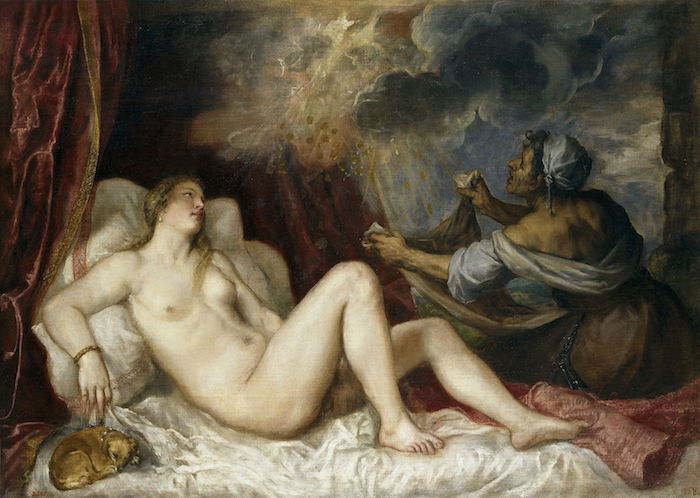
Titian, Danaë with Nursemaid (1553) 129 cm × 180 cm. Museo del Prado, Madrid
Locations
People
Groups
Topics
- Renaissance, Italian
- Counter-Reformation (also Catholic Reformation or Catholic Revival)
- Sephardim, Ashkenazim, and Sabbateanism; 1540 to 1683
- Western Art: 1552 to 1564
Subjects
Regions
Subregions
Years: 1553 - 1553
Titian, Danaë with Nursemaid (1553) 129 cm × 180 cm. Museo del Prado, Madrid
Locations
People
Groups
Topics
- Renaissance, Italian
- Counter-Reformation (also Catholic Reformation or Catholic Revival)
- Sephardim, Ashkenazim, and Sabbateanism; 1540 to 1683
- Western Art: 1552 to 1564
Subjects
Regions
Subregions