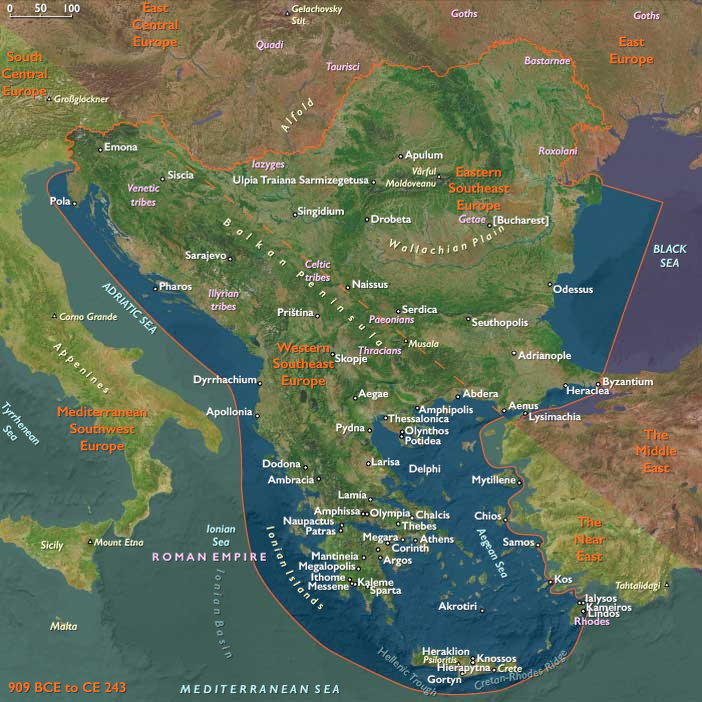
Hellenic culture heavily influences the Getae, especially …
Years: 292BCE - 292BCE
Hellenic culture heavily influences the Getae, especially the ruling class, from about 300 BCE.
One Basileus Dromichaites, having organized the Getae of the Lower Danube into a state by about 300 BCE, repulses an attack by Lysimachus.
Hereafter, native Getian leaders protect the coastal urban centers that have developed from Greek colonies.
Agathocles is sent by his father against the Getae in about 292 BCE but is defeated and taken prisoner.
He is kindly treated by Dromichaetes, and sent back to his father with presents; but Lysimachus, notwithstanding, marches against the Getae, and is taken prisoner himself.
He too is also released by Dromichaetes, who received in consequence the daughter of Lysimachus in marriage.
According to some authors it was only Agathocles and according to others only Lysimachus, who was taken prisoner.
Locations
People
Groups
Topics
Commodoties
Subjects
Regions
Subregions
Related Events
Filter results
Showing 10 events out of 29 total
Christina Gyllenstierna, born to riksråd Nils Eriksson Gyllenstierna and Sigrid Eskilsdotter (Banér) of Venngarn, Heir of Lindholm, was a great-granddaughter of King Charles VIII of Sweden through her father, a younger son of Christina Karlsdotter Bonde, for whom she was named.
She is from a family of Danish origin.
Her grandfather Erik Eriksen of Demstrup ("Gyldenstjerne") was Danish, but became acquainted with Sweden, because the two realms were united in the Kalmar Union.
When Sweden and Denmark began to fight over control of the Union, Erik had allied with the Swedish claimant, Charles VIII.
As a reward, Charles's daughter, the heir of Fogelvik, had been married to him and he ultimately became the High Steward of Charles' court.
Through her mother, Christina is the half-sister of Cecilia Månsdotter of Eka, mother of the future king Gustav I, through her mother's other marriage.
Her father is Niels Eriksen, Lord of Tullgarn (also written Nils Eriksson, and surnamed "Gyllenstjerna" by later historians).
Her family belongs to the highest Swedish nobility of this "Regency" era.
Christina was first engaged to Nils Gädda (d. 1508), governor of Kalmar and Lycka, but the marriage never took place due to his death.
She had married the nephew of her former betrothed, Sten Sture the Younger, son of Svante, the regent of Sweden, in Stockholm on November 16, 1511.
She has had five children during her marriage: Nils in 1512, Iliana in 1514, Magdalena 1516, Svante 1517 and Anna 1518, as well aa son after the death of her spouse, who will live only eighteen months.
She has two sons from her first marriage: Nils and Svante Stensson Sture.
After the death of her father-in-law, regent Svante, in 1512 one year after her marriage, Sten Sture had been elected regent of Sweden.
During this period, Sweden is formally a part of the Kalmar Union of Denmark, Norway and Sweden, with the Danish monarch customarily elected king of all three kingdoms.
This has created an opposition in Sweden to the Danish dominance within the union, and during most of the second half of the fifteenth-century, Sweden had been governed almost continuously by "Regents": the father-in-law of Christina, Svante Nilsson, was regent in 1504–1512.
Sten was eighteen years old at the death of his father.
High Councilor Eric Trolle, who supports union with Denmark, had been chosen as regent by the council.
However, young Sten had utilized the castles and troops enfeoffed to him by his late father and staged a coup.
After Sten promised to continue union negotiations with Denmark, the High Council had accepted him as regent instead of Trolle.
Lord Sten intends to keep Sweden independent of Denmark.
He has taken the Sture name, a legacy from his great-grandmother, because it symbolizes independence of Sweden as reminder of Sten Sture the Elder, his father's third cousin.
Regent Sten had already in 1504 been proposed as a candidate in the election of a new king of Sweden as a replacement for king John, King of Denmark, who had been elected king of Sweden in 1497 but who had been ousted from Sweden in 1502.
Upon the death of John in 1513, the question had again been raised to elect regent Sten as king of Sweden rather than the son of John, Christian II of Denmark, and Sten has been making preparations to arrange an election, among them seeking support from the pope.

Christian II, king of Denmark from 1513, is the son of King John and his wife, Christina of Saxony.
He was born at Nyborg Castle in 1481 and succeeded his father as king of Denmark and Norway.
Christian descends, through Valdemar I of Sweden, from the House of Eric, and from Catherine, daughter of Inge I of Sweden, as well as from Ingrid Ylva, granddaughter of Sverker I of Sweden.
His soon-to-be rival Gustav Vasa descends only from Sverker II of Sweden and the House of Sverker.
Christian, who had taken part in his father's conquest of Sweden in 1497 and in the fighting of 1501 when Sweden revolted, had been appointed viceroy of Norway in 1506, and had succeeded in maintaining control of this country.
Christian's succession to the throne of Denmark and Norway had been confirmed at the Herredag assembly of notables from the three northern kingdoms, which met at Copenhagen in 1513.
The Swedish delegates said, "We have the choice between peace at home and strife here, or peace here and civil war at home, and we prefer the former."
A decision as to the Swedish succession had therefore been postponed.
A peculiarity, more fatal to him in this aristocratic age than any other, is his fondness for the common people, which had been increased by his passion for a pretty Norwegian girl of Dutch heritage, named Dyveke Sigbritsdatter, who had become his mistress in 1507 or 1509.
On August 12, 1515, Christian had married Isabella of Austria, the granddaughter of Holy Roman Emperor Maximilian I, but he had not given up his liaison with Dyveke, and it is only her death in 1517, under suspicious circumstances, that prevents serious complications with Charles of Habsburg.
Christian believes that the magnate Torben Oxe is guilty of Sigbritsdatter's death.
Oxe is brought to trial at Solbjerg outside Copenhagen in what amounts to a justice-of-the-peace court on vague offenses against his liege lord, Christian II.
The verdict as directed by the king is guilty and the death sentence imposed with the comment, 'your deeds not your words have condemned you'.
Over the strenuous opposition of Oxe's fellow peers, he is executed in late 1517.
Hereafter, the king will lose no opportunity to suppress the nobility and raise commoners to power.
Christian’s chief counselor is Dyveke's mother Sigbrit Willoms, who excels in administrative and commercial affairs.
Christian had first appointed her controller of the Sound Dues of Øresund, and has ultimately committed to her the whole charge of the finances.
A bourgeois herself, it is Sigbrit's constant policy to elevate and extend the influence of the middle classes.
She had soon formed a middle-class inner council centering on her, which competes for power with Rigsraadet itself.
The patricians naturally resent their supersession and nearly every unpopular measure is attributed to the influence of the Dutch comptroller.
Christian was meanwhile preparing for the inevitable war with Sweden, where …
It is considered likely that Sten’s wife Christina acted as political adviser to her spouse and participated in state affairs, given her later role.
In practice, Sten and Christina already function as king and queen of Sweden.
In 1519, Peder Månsson, Bishop of Västerås, expresses his surprise in a letter from Rome to the Abbess of Vadstena Abbey that Sten has not yet been crowned, and in the contemporary Stockholm chronicle, Christina is referred to as "Our Gracious Princess".
A third Danish attempt against Sweden, made in 1520 with a large army of French, German and Scottish mercenaries, proves successful.
Sture is mortally wounded at the Battle of Bogesund on January 19, and the Danish army, unopposed, is approaching Uppsala, where the members of the Swedish Privy Council, or Riksråd, had already assembled.
The councilors consent to render homage to Christian on condition that he grant a full indemnity against past actions and a guarantee that Sweden should be ruled according to Swedish laws and custom.
A convention to this effect will be confirmed by the king and the Danish Privy Council on March 31.
Sture's widow, Lady Kristina, continues to resist in Stockholm with support from the peasants of central Sweden, and defeats the Danes at Balundsås on March 19.
Lady Kristina’s forces are eventually defeated at the Battle of Uppsala on Good Friday, April 6.
Trolle is among those who speak in favor of the Danish King, and is rewarded by being reappointed Archbishop of Uppsala Christina has chancellor Peder Jakobsson Sunnanväder bring her son Nils Stensson Sture in safety to Poland, and issue negotiations with Sigismund I the Old and the Hanseatic League for support against Denmark.
The Danish fleet arrives in May and Stockholm is attacked by land and sea.
Lady Kristina has resisted for the past four months, and in the beginning of autumn the tide of war starts to turn in her favor.
The inhabitants of Stockholm have a large supply of food and fare relatively well.
Christian, his own stockpile dwindling, realizes that the Swedish supply will doom his army to maintain the siege throughout the winter.
Through Bishop Mattias, Hemming Gadh and other Swedes of high stature, Christian sends a proposal for retreat that is very advantageous for the Swedes.
After great starvation and suffering in the city, Lady Kristina surrenders on September 7, taking care to exact beforehand an amnesty of the most explicit and absolute character for all acts of resistance to Denmark.
During a meeting on what is thought to be Beckholmen outside of Djurgården, Christian swears that all acts against him will be forgotten, and issues pardons to several named persons (including Gustav Vasa, who had escaped Denmark, where he had been held hostage).
Lady Kristina will be given Hörningsholm and all Mörkön as a fief, and is also promised Tavestehus in Finland.
When this is set to paper, the mayor of the city delivers the keys to the city on Södermalm and Christian holds his grand entry.
Shortly after, he sails back to Denmark, to return in October for his coronation.
Christian, anointed by the restored Archbishop Gustav Trolle in Storkyrkan Cathedral on November 4, takes the usual oath to rule the kingdom through native-born Swedes only.
A banquet is held for the next three days.
On the evening of November 7, Christian summons many Swedish leaders to a private conference at the palace.
At dusk on November 8, Danish soldiers, with lanterns and torches, enter a great hall of the royal palace and take away several noble guests.
Later in the evening, many others of the king's guests are imprisoned.
The following day, November, 9 a council, headed by Archbishop Trolle, sentences the prisoners to death for heresy; the main point of the accusation is their having united in a pact to depose Trolle a few years earlier.
The deposition of a bishop as a crime against the church and, as the king has no authority to issue pardons for this act, he can punish them without violating his pledge.
However, many of the accused are also leading men of the Sture party and thus potential opponents of the Danish kings.
Christian now takes his revenge, known as the Stockholm Bloodbath.
At noon, the anti-unionist bishops of Skara and Strängnäs are led out into the great square and beheaded.
Fourteen noblemen, three burgomasters, fourteen town councilors and about twenty common citizens of Stockholm are then hanged or decapitated.
Kristina's brother Erik Nilsson, Lord of Tullgarn, is executed by beheading, as are many other Swedish magnates.
Gyllenstierna inherits Tullgarn, little benefit as it now does her.
Her husband's remains are exhumed and burned publicly at the stake as a heretic.
Lady Kristina is declared a great traitor and rebel, and as such King Christian calls upon her and publicly asks her to choose: which does she prefer, to be burned at the stake or to be buried alive?
Confronted with this choice, she is unable to reply and faints with horror.
After this, Christian is advised to spare her life.
To save her life, she cedes a large part of her property to Christian.
Gyllenstierna's mother Sigrid is sentenced to be drowned (the only woman condemned to death), but avoids execution by surrendering all her estates.
The executions continue throughout the following day.
According to the chief executioner Jörgen Homuth, eighty-two people are executed.
The details and death toll are uncertain, for Christian himself wanted the public execution to have as strong effect as possible, and later, King Gustav I of Sweden is likely to have boosted the figures to support his Danish War.
Christian justifies the massacre in a proclamation to the Swedish people as a measure necessary to avoid a papal interdict, but, when apologizing to the Pope for the decapitation of the bishops, he blames his troops for performing unauthorized acts of vengeance.
The Stockholm Bloodbath precipitates a lengthy hostility towards Danes in Sweden, and henceforth the two nations will almost continuously be hostile toward each other.
These hostilities, developing into a struggle for hegemony in the Scandinavian and North German area, will last for nearly three hundred years.
Memory of the Bloodbath will serve to let Swedes depict themselves (and often, actually regard themselves) as the wronged and aggrieved party, even when they are the ones who eventually take the political and military lead, such as the conquest and annexation of Scania until the Treaty of Roskilde in 1658.
Gustav appears to have stayed largely inactive during his first months back on Swedish soil.
According to some sources, Gustav had received an invitation to the coronation of Christian in the newly captured Stockholm.
Even though King Christian had promised amnesty to his enemies within the Sture party, including Gustav Eriksson, the latter had chosen to decline the invitation Among the people executed on Stortorget had been Gustav Eriksson's father, Erik Johansson, and nephew, Joakim Brahe.
Gustav himself is at the time staying at Räfsnäs, close to Gripsholm Castle.
If Christian’s intention behind the executions had been to frighten the anti-unionist party into submission, it proves wholly counterproductive.
Gustav, upon hearing of the massacre, has reasons to fear for his life and leaves Räfsnäs for the province of Dalarna in what is at this time northwestern Sweden.