…he restores the king to the Armenian …
Years: 62BCE - 62BCE
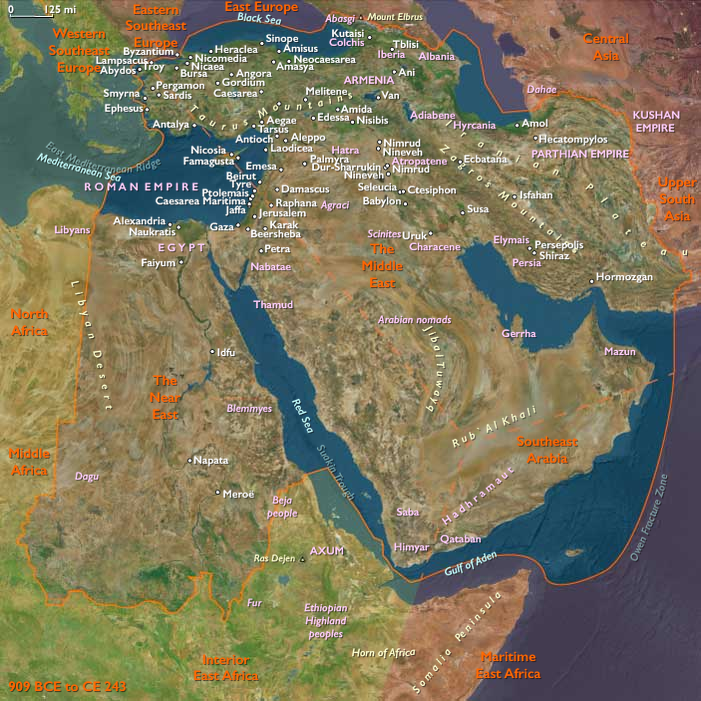
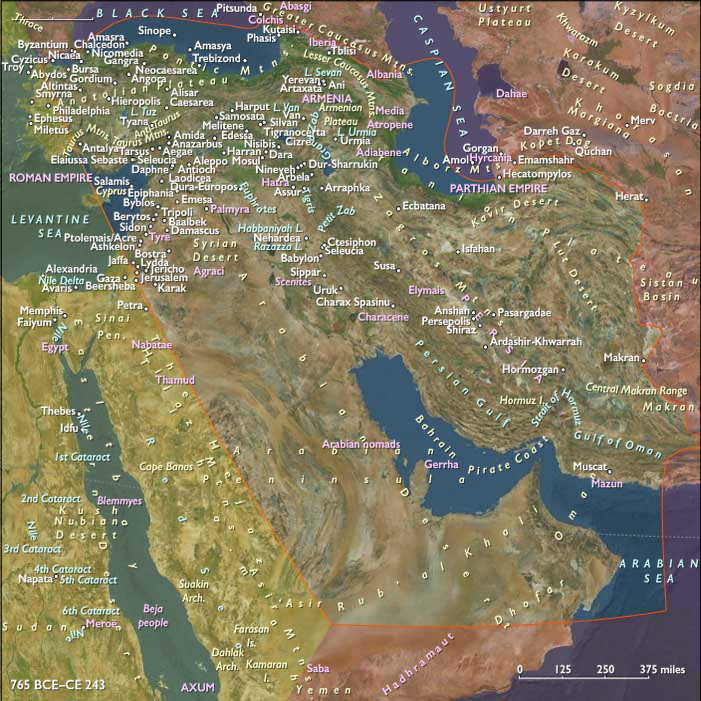
…he restores the king to the Armenian throne in exchange for Syria and other southern conquests, thereby establishing Tigranes as a friend and ally of Rome—and as his own protégé.
Tigranes continues to rule over Armenia as a Roman client-king, though he has lost all his conquests except Sophene and Corduene.
Rejecting a request by Parthian king Phraates III to recognize the Euphrates as the limit of Roman control, …
Locations
People
Groups
- Iranian peoples
- Armenian people
- Roman Republic
- Greeks, Hellenistic
- Parthian Empire
- Armenia, Kingdom of Greater
Topics
Commodoties
Subjects
Regions
Subregions
Related Events
Filter results
Showing 10 events out of 162 total
The yasaq explicitly provides that after the death of the ruler all offspring of the house of Chinggis Khan, wherever they might be, must return to Mongolia to take part in the election of the new khan.
From the outskirts of Vienna and Venice, the tumen countermarch, never to reappear.
They move through Dalmatia and Serbia, then eastward where they virtually destroy the kingdoms of Serbia and Bulgaria before crossing the lower Danube.
They evacuate Hungary for lack of sufficient pasture and move into the southern Russian steppes.
Advances into India also cease.
Because the Song have had the benefit of a lull of nearly ten years in which to recover
and to reorganize, conquering Asia has become more difficult than it would have been earlier.
Möngke himself takes command, but he also places great responsibility on his younger brother, Kublai.
Another brother, Hulagu, is sent to Iran to renew the expansion of Mongol control in Southwest Asia.
Möngke encourages Batu to raid Central Europe, but does not send him additional resources.
Thus, although Batu's armies raid deep into Poland, Lithuania, and Estonia, and again overrun Serbia and Bulgaria, these campaigns are not so important as the ones being undertaken in Southeast Asia and Southwest Asia.
Central Europe (1108 – 1251 CE): Imperial Reform, Urban Expansion, and the Ostsiedlung
Between 1108 and 1251 CE, Central Europe—the heartland of the Holy Roman Empire and its eastern marches—entered an era of extraordinary growth. The Medieval Warm Period brought demographic expansion and agricultural innovation, while political fragmentation fostered new towns, laws, and civic institutions.
From the Rhineland cathedrals and Alpine passes to the plains of Poland and Hungary, Europe’s central belt fused feudal lordship, ecclesiastical reform, and the eastward movement of settlers into one of the most dynamic transformations of the medieval world.
Geographic and Environmental Context
Central Europe stretched from the Rhine to the Vistula and from the Baltic coast to the Alpine valleys and Pannonian plain, encompassing:
-
The Rhineland heartlands of Cologne, Mainz, and Strasbourg;
-
The Alpine crossroads of Tyrol, Zürich, and Geneva;
-
The eastern plains of Silesia, Poland, Bohemia, Moravia, and Hungary.
This was a continent within a continent—a network of fertile valleys, wooded uplands, and trade arteries defined by the Rhine, Elbe, Oder, Vistula, and Danube. Forest clearance and settlement transformed once-marginal lands into the agrarian and urban centers of late medieval Europe.
Climate and Environmental Shifts
The Medieval Warm Period (c. 950–1250) provided long growing seasons, enabling population growth and the spread of viticulture and grain farming north and east.
Favorable weather encouraged three-field rotation, iron ploughs, and horse collars, which revolutionized yields.
Localized floods along the Rhine and Danube enriched soils even as they reshaped towns and dikes.
The forests of Silesia, the Carpathians, and Bavaria yielded timber, salt, and silver—the mineral backbone of Central Europe’s economy.
Political and Institutional Developments
The Imperial Core:
The Holy Roman Empire, though politically fragmented, remained Europe’s constitutional and spiritual axis.
The Hohenstaufen emperors (1138–1254) sought to balance imperial unity with the autonomy of princes and cities.
Archbishops of Mainz, Trier, and Cologne, as imperial electors, embodied this duality of sacred and secular authority.
East Central Kingdoms:
-
Poland (Piast dynasty): The Testament of Bolesław III (1138) divided the realm among dukes, initiating two centuries of fragmentation. Kraków remained the senior duchy, while Silesia and Pomerania invited German settlers under Magdeburg Law, integrating Poland into the Ostsiedlung.
-
Bohemia and Moravia (Přemyslids): Secured hereditary kingship through the Golden Bull of Sicily (1212); Prague emerged as a royal and cultural capital, with silver mining at Kutná Hora enriching the crown.
-
Hungary (Árpád dynasty): The Golden Bull of 1222 codified noble rights; after the Mongol invasion (1241–42), Béla IV rebuilt the kingdom with stone fortifications and foreign settlers, initiating a second wave of colonization and urbanization.
Alpine and South Central Principalities:
Feudal fragmentation defined the Alps: counts of Tyrol, bishops of Geneva, and abbots of Einsiedeln and St. Gallcontrolled passes and tolls.
Urban communes in Zürich and Geneva asserted autonomy; local assemblies in Alpine valleys laid early foundations for Swiss communal governance.
The Rhineland Electorates:
Cologne, Mainz, and Trier dominated the political and spiritual life of the Empire.
Imperial cities such as Strasbourg, Worms, Speyer, and Basel gained privileges, fostering the growth of guilds, markets, and civic culture.
This west–east continuum—imperial in form, feudal in structure, and civic in aspiration—defined Central Europe’s political pluralism.
Economy and Trade
Agrarian Expansion:
Forest clearance and colonization extended cultivation across Silesia, Brandenburg, Bohemia, and Hungary. Heavy ploughs, crop rotation, and watermills drove rural productivity.
Mining and Industry:
Silver at Kutná Hora and Jihlava, salt at Wieliczka, and iron in the Alps and Swabia financed courts and monasteries.
Cistercian abbeys coordinated land reclamation and proto-industrial production.
Trade and Urban Growth:
-
Rhineland: The Rhine served as Europe’s commercial artery, connecting Cologne, Mainz, Strasbourg, and Basel to Flanders and Italy.
-
Alpine routes: Brenner and St. Gotthard passes moved Italian silk and spices north, returning with German metals and wool.
-
Eastern trade: The Oder–Elbe–Danube corridors linked Kraków, Wrocław, Prague, and Buda to Baltic and Adriatic markets.
German urban law (Magdeburg, Lübeck) standardized administration, embedding civic governance across Central Europe.
Urban and Technological Development
Cities expanded rapidly. Cologne, with over 40,000 inhabitants, ranked among Europe’s largest; Cologne Cathedral(begun 1248) inaugurated the Gothic age north of the Alps.
Stone castles, bridges, and Romanesque monasteries transformed the landscape; later Gothic cathedrals rose in Strasbourg, Prague, and Bamberg.
Watermills and guild industries powered textiles, glassmaking, and metalwork.
The Ostsiedlung infused new technology and law across Slavic lands, blending German civic models with local traditions.
Belief and Symbolism
Catholic Christianity unified the region’s culture and law.
-
The archbishoprics of Gniezno, Esztergom, and Prague became national spiritual centers.
-
The Cistercians, Dominicans, and Franciscans spread reform and education, while monasteries became agents of colonization and literacy.
-
Royal sanctity—seen in cults of St. Elizabeth of Hungary and St. Wenceslaus—legitimized dynastic rule.
Pilgrimage and relic cults (notably the Three Kings of Cologne) bound devotion to geography, turning the Rhine and Danube into sacred corridors.
Movement and Interaction Corridors
-
Rhine River: North–south trade spine from Basel to the North Sea.
-
Danube River: Crossed by the Hungarian plain and Bohemian frontier.
-
Elbe–Oder–Vistula basins: Arteries of the Ostsiedlung and grain export.
-
Alpine passes: Brenner and St. Gotthard linking Italy with Germany and Burgundy.
-
Pilgrimage and crusade routes: Swabian knights joined Crusades; Rhineland ports provisioned Mediterranean fleets.
These routes knit the region into Christendom’s spiritual, commercial, and military systems.
Adaptation and Resilience
-
Multipolar politics—Piast duchies, Přemyslid Bohemia, Árpád Hungary—prevented systemic collapse and encouraged local autonomy.
-
Alpine communes and imperial cities institutionalized cooperation and self-defense.
-
Ecclesiastical reform reinforced continuity amid dynastic change.
-
After the Mongol invasion, Hungary’s reconstruction and the eastward settlement drive demonstrated unparalleled resilience.
Fragmentation became an engine of innovation, not decline.
Long-Term Significance
By 1251 CE, Central Europe stood as the pivot of medieval Christendom:
-
The Empire’s Rhineland heartlands led in urbanization, cathedral culture, and commerce.
-
The Alpine passes bound Italy, Germany, and Burgundy into one economic zone.
-
The eastern kingdoms—Poland, Bohemia, and Hungary—had absorbed German colonists and Western institutions, laying the foundations of modern Central Europe.
Fragmented yet interconnected, the region’s plural order and settlement revolution made it Europe’s engine of transformation and resilience.

East Central Europe (1108 – 1251 CE): Piast Fragmentation, Přemyslid Kingship, Árpád Reforms, and the Ostsiedlung
Geographic and Environmental Context
East Central Europe includes the greater part of Germany east of 10°E, Poland, Czechia (Bohemia and Moravia), Slovakia, and Hungary.
-
A vast corridor of plains and uplands—the Elbe, Oder, Vistula, and Danube basins—connected the Baltic to the Carpathians and the Pannonian Plain.
-
Forest clearance and settlement expansion tied the German imperial east to the kingdoms of Poland, Bohemia, and Hungary.
Climate and Environmental Shifts
-
The Medieval Warm Period favored population growth, higher cereal yields, and the spread of viticulture and orchards into sheltered valleys.
-
Floods and periodic droughts punctuated stability, but improved ploughs and crop rotations spread resilience.
Societies and Political Developments
-
Germany east of 10°E: Fragmented imperial principalities encouraged the founding of towns and the granting of civic laws (e.g., Magdeburg Law), attracting settlers and merchants.
-
Poland (Piast dynasty): The Testament of Bolesław III (1138) divided the realm among dukes, initiating a period of long-lasting fragmentation. Kraków served as the notional senior capital, while Silesia and Pomerania drew intense German colonization.
-
Bohemia and Moravia (Přemyslids): Elevated to hereditary kingship with the Golden Bull of Sicily (1212)under Přemysl Otakar I. Prague and Moravian centers like Brno and Olomouc flourished.
-
Hungary (Árpád dynasty): The Golden Bull of 1222 limited royal power and confirmed noble rights. The Mongol invasion (1241–1242) devastated the kingdom, forcing Béla IV into a massive rebuilding effort with stone castles and settlement incentives.
-
Slovakia (Upper Hungary): Integrated into Hungarian mining and defense networks.
Economy and Trade
-
Agrarian expansion: heavy plough, three-field system, and mass clearances extended farmland.
-
Mining: silver at Jihlava and Kutná Hora; salt at Wieliczka.
-
Trade corridors: Oder–Elbe–Danube routes moved grain, timber, and salt to the Baltic and Rhineland; Kraków, Wrocław, Prague, Pressburg, and Buda–Pest acted as hubs.
-
German urban law (Magdeburg, Lübeck) standardized town governance.
Subsistence and Technology
-
Watermills, collar harnesses, and improved ploughs boosted productivity.
-
Romanesque fortresses and Gothic cathedrals reshaped urban skylines.
-
Castles spread across Hungary and Bohemia, especially after Mongol devastation.
Movement and Interaction Corridors
-
The Ostsiedlung carried German-speaking peasants and artisans into Silesia, Pomerania, Brandenburg, and Bohemia.
-
Cistercian monasteries coordinated land clearance and settlement.
-
Mongol invasion briefly severed Carpathian corridors but reforms re-opened them.
Belief and Symbolism
-
Latin Christianity unified political culture: archbishoprics in Gniezno, Esztergom, and Prague guided ecclesiastical governance.
-
Cistercians, Dominicans, Franciscans spread reform, preaching, and literacy.
-
Cults of royal saints (e.g., St. Elizabeth of Hungary) tied dynastic legitimacy to sanctity.
Adaptation and Resilience
-
Multipolar politics (Piast duchies, Přemyslid Bohemia, Árpád Hungary) created redundancy.
-
Hungary’s reconstruction after the Mongols demonstrated adaptive resilience, with stone fortifications and immigrant resettlement.
-
Town networks spread risk through market integration.
Long-Term Significance
By 1251 CE, East Central Europe had become a densely networked agrarian and urban region: fragmented Piast duchies, a hereditary Bohemian kingdom, and a restructured Hungary coexisted within the framework of German colonization and urban law. This laid the institutional and demographic foundations for its later medieval flowering.
Poland had lost ground during the eleventh and twelfth centuries in its complex triangular relationship with the German Empire to the west and the kingdom of Bohemia to the south.
New foreign enemies appear by the thirteenth century.
The Mongol invasion cuts a swath of destruction through the country in 1241; for fifty years after their withdrawal in 1242, Mongol nomads will mount devastating raids into Poland from bases in Ruthenia to the southeast.
Meanwhile, an even more dangerous foe had arrived in 1226 when a Polish duke invited the Teutonic Knights, a Germanic crusading order, to help him subdue Baltic pagan tribes.
Upon completing their mission with characteristic fierceness and efficiency, the knights build a stronghold on the Baltic seacoast, from which they seek to enlarge their holdings at Polish expense.
By this time, the Piasts have been parceling out the realm into ever smaller units for nearly one hundred years.
This policy of division, initiated by Boleslaw II to appease separatist provinces while maintaining national unity, leads to regional governance by various branches of the dynasty and to a near breakdown of cohesiveness in the face of foreign aggression.
The Mongols are ready to move again late in 1241.
In December the army crosses the frozen Danube.
Scouting parties raid into northern Italy toward Venice and Treviso, and up the Danube toward Vienna, but the advance halts suddenly.
Word has come, by way of the incredibly swift Mongol messenger service, that Ogedei had died on December 11.
The horde of Kaidu Khan, three tumen strong, is to the north of the main body, protecting the right flank .
Kaidu sweeps through Lithuania and Poland; on March 18 he destroys the Polish army at Kraków.
He detaches a tumen to raid along the Baltic coast and with the remainder heads westward into Silesia.
On April 9, 1241, at Liegnitz (Legnica, in Poland), the more disciplined Mongol army decisively defeats a numerically superior combined European army in a bitterly contested battle.
A horde of three tumen under Kadan, another son of Ögedei, meanwhile protects the southern flank and advances through Transylvania, into the Danube Valley, and into Hungary.
In mid-April, Kadan and Kaidu join the main body—under Batu—in central Hungary.
Batu leads the central force across the Carpathian Mountains in early April 1241, lures the army of King Bela IV of Hungary into battle at the Sajo River on April 11, and annihilates it.
The Mongols then seize Pest, and they spend the rest of the year consolidating their control of Hungary east of the Danube River.
Polish monarch Boleslaw Wrymouth makes complex arrangements intended to prevent fratricidal warfare and preserve the Polish state's formal unity.
Following his concept of seniority, Boleslaw divides the country into five principalities: Silesia, Greater Poland, Mazovia, Sandomierz and Kraków.
The first four provinces are given to his four sons, who became independent rulers.
The fifth province, the Seniorate Province of Kraków, is to be added to the senior among the Princes who, as the Grand Duke of Kraków, is the representative of the whole of Poland.
The stability of the system is supposedly assured by the institution of the senior or high duke of Poland, based in Kraków and assigned to the special Seniorate Province that is not to be subdivided.
This principle breaks down within the generation of Boleslaw III's sons, when Wladyslaw II the Exile, Boleslaw IV the Curly, Mieszko III the Old and Casimir II the Just fight for power and territory in Poland, and in particular over the Kraków throne.
The external borders left by Boleslaw III at his death closely resemble the borders left by Mieszko I; this original early Piast monarchy configuration does not survive the fragmentation period.
For nearly two centuries, the Piasts will spar with each other, the clergy, and the nobility for the control over the divided kingdom.
Years: 62BCE - 62BCE
Locations
People
Groups
- Iranian peoples
- Armenian people
- Roman Republic
- Greeks, Hellenistic
- Parthian Empire
- Armenia, Kingdom of Greater