His army now bolstered by reinforcements, Allenby …
Years: 1918 - 1918
September
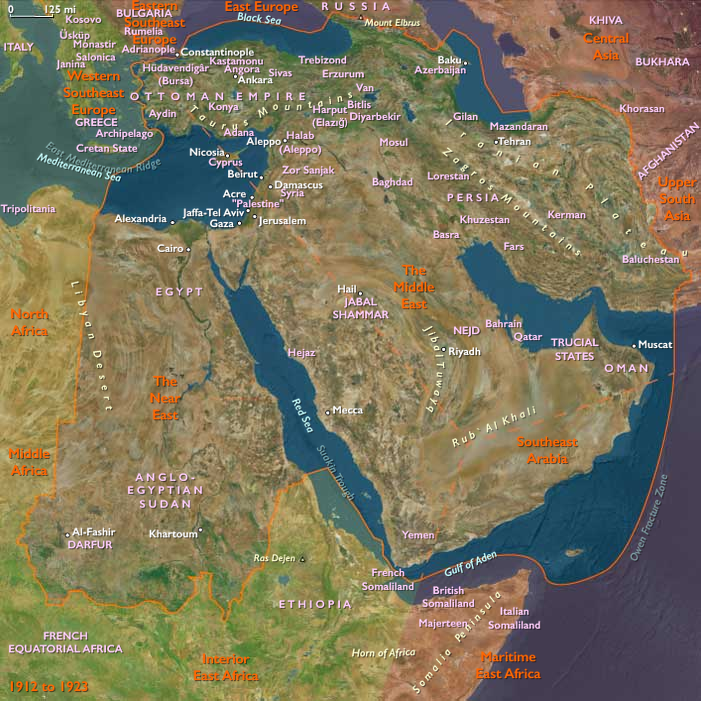
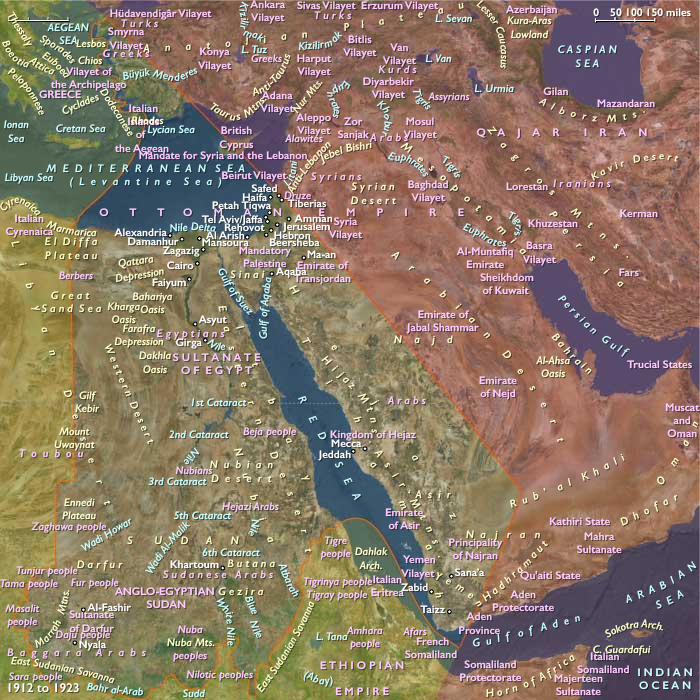
His army now bolstered by reinforcements, Allenby strikes in the west on September 19, 1918, with a numerical superiority of ten to one, having by ruse and diversion induced the Turks to reduce their strength here.
In this Battle of Megiddo, a British infantry attack sweeps the astonished defenders aside and opens the way for the cavalry, which rides thirty miles north up the coastal corridor before swinging inland to cut the Turks' northward lines of retreat.
Locations
People
Groups
- Arab people
- Ottoman Empire
- Palestine, Ottoman
- Britain (United Kingdom of Great Britain and Ireland)
- Arab nationalism
Topics
Commodoties
Subjects
Regions
Subregions
Related Events
Filter results
Showing 10 events out of 7521 total
The great flu epidemic of 1918 kills 20 million people over the world.
The epidemic may have been caused by a type A virus, possibly the swine flu virus.
Some attribute the epidemic to widespread use of vaccines; a minority opinion connects it to wartime use of poison gases.
Others have the raised the possibility of Reyes Syndrome, as aspirin was heavily prescribed for the first time.
Faisal enters Damascus on October 2, and the Ottoman government consents to an armistice on October 31, bringing the war in this theater to a close.
The Bolsheviks assassinate Russian Czar Nicholas II and his family and take Russia out of the war under the 1918 Brest-Litovsk Treaty with Germany.
The Germans had evidently transported revolutionary leader V.I.
Lenin to Russia in a sealed train.
The Central Powers agree to an armistice in 1918.
The belligerents have deployed some 66 million poison gas artillery shells during the Great War.
Czechoslovakia and Poland proclaim themselves republics in 1918.
An attempted assassination of Lenin occurs in 1918.
In 1918, the Arabs are liberated from the remainder of the Turkish Empire.
Britain's Lawrence of Arabia wins the support of the Arabs in spite of the hated Balfour Declaration.
The independent Republic of Armenia is born in 1918 in Russian Armenia, where thousands of refugees from the Turkish slaughter have gathered.
With allied support, loyalists and reactionaries fight the Bolsheviks for control of Russia, unsuccessfully.
Between 1918 to 1922, the US Navy will land troops five times to fight the Bolsheviks in the effort to overthrow the new socialist government of what is to become the USSR.
The great flu epidemic of 1918 kills 20 million people over the world.
The epidemic may have been caused by a type A virus, possibly the swine flu virus.
Some attribute the epidemic to widespread use of vaccines; a minorit opinion connects it to wartime use of poison gases.
Wilson aids Russia’s new Soviet regime with bridge-building projects.
In 1918, Afrikaner Calvinists form the secret oath-bound society called the “Broederbond” (Band of Brothers) to create a separate Afrikaner Christian nation with its own language and culture.
Dutch Reformed Church clergyman Daniel Francois Malan is elected to parliament in 1918 as a member of the National party.
The immediate causes of what will become known to Egyptians as the 1919 Revolution, however, are British actions during the war that caused widespread hardship and resentment.
Specifically, these included Britain's purchase of cotton and requisitioning of fodder at below market prices, Britain's forcible recruitment of about five hundred thousand peasants into the Labor and Camel Transport Corps in the Egyptian Expeditionary Force, and its use of the country as a base and a garrison populated by British, Australian, and other troops.
After the war, Egypt will feel the adverse effects of soaring prices and unemployment.
In Arabia, the Ottoman Turks rule the Yemen until the dismantling of their empire in 1918.
North Yemen obtains nominal independence immediately.
Spain, due to Alfonso XIII’s influence has maintained strict neutrality throughout the conflict.
The great flu epidemic of 1918 kills 20 million people over the world.
The epidemic may have been caused by a type A virus, possibly the swine flu virus.
Some attribute the epidemic to widespread use of vaccines; a minority opinion connects it to wartime use of poison gases.
The V8 engine, a V engine with eight cylinders mounted on the crankcase in two banks of four cylinders, with all eight pistons driving a common crankshaft, had been patented in 1902 by Léon Levavasseur, who had taken out a patent on a light but quite powerful gasoline-injected V8 engine which he called Antoinette after the young daughter of his financial backer, and from 1904 had installed this engine in a number of competition speedboats and early aircraft.
The V8 engine configuration, popular in France from 1904 onward, had been used in a number of aircraft engines introduced by Renault, and Buchet among others.
Some of these engines had found their way into automobiles in small quantities.
Rolls Royce had built a 3,535 cc (216 cu in) V8 car from 1905 to 1906, but only three copies were made and Rolls Royce had reverted to a straight-6 design.
De Dion-Bouton had introduced a 7,773 cc (474 cu in) automobile V8 in 1910 and displayed it in New York in 1912.
Although produced only in small quantities, it had inspired a number of American manufacturers to follow suit.
The first mass-production automobile V8 had been introduced in the United States in 1914 by Cadillac, a division of General Motors which sold 13,000 of the 5,429 cc (331 cu in) L-head engines in its first year of production. (Cadillac has been primarily a V8 company ever since.)
Oldsmobile, another division of General Motors, had introduced its own 4 L (≈244 cu in) V8 engine in 1916.
Chevrolet had introduced a 288 cu in (4.7 L) V8 engine in 1917, but after merging with General Motors in 1918, discontinues the V8 to concentrate on economy cars.
Norman Thomas joins the American Socialist Party in 1918.
Lord Milner directs the British war effort as secretary of war in 1918.
In 1918, British women over thirty win the right to vote.
By 1918, all states in the US have passed compulsory education laws.
Henry Ford is narrowly defeated in his 1918 run for Senator on the Democratic ticket.
The US Congress passes the Sedition Act of 1918.
The United States aids France and Britain in defeating Germany in 1918.
The Central Powers agree to an armistice in 1918.
The belligerents have deployed some 66 million poison gas artillery shells during the Great War.
The Invention Secrecy Act ends in 1918.
Wilson sends Hoover back to Europe to direct the American Relief Administration, an agency created to relieve the suffering in war-ravaged Europe.
Bronislaw Malinowski develops functionalist anthropology in opposition to evolutionist anthropology.
Dada’s anti-art nihilism, exemplified in the works of Alsatian painter and poet Jean Arp, Romanian poet Tristan Tzara and Marcel Duchamp, is a disgusted response to the carnage of war.
An anti-Art Nouveau movement in architecture produces simple rectangular forms.
The de Stijl Group, led by Piet Mondrian and Theo van Doesburg, uses right angles, straight lines and primary hues in their art and architecture.
Paul Robeson, the son of a former slave, graduates with Phi Beta Kappa honors from Rutgers University, where he twice receives All-American football awards.
Moray obtains post-war employment as a fireman on a railroad.
During the war years, the Wobblies have organized blacks, metal miners, lumberjacks, dockworkers, and agricultural laborers in the face of harsh countermeasures by employers, including the deportation of Arizona strikers into the desert; the abduction and lynching of IWW organizer Frank Little in Butte, Montana; the 1915 conviction and execution of folk-song-writer and IWW organizer Joe Hill in Salt Lake City on circumstantial evidence; and the US Department of Justice’s 1917 arrest and prosecution of over 200 IWW leaders for interfering with the war effort and for spreading antiwar propaganda.
Debs, a vociferous opponent of all war except the international battle for socialism, has been outspoken in his opposition to the prosecutionsx made under the Espionage Act of 1917.
In 1918, he is tried and convicted for violating the Espionage Act, for which he receives a ten-year sentence and the loss of his citizenship.
Wilson calls on voters to re-elect a Democratic Congress in 1918 as a vote of confidence.
Republicans capture both houses of Congress.
Berger, who served a Congressional term from 1911 to 1913, is reelected in 1918 but denied a seat because of his conviction for sedition for opposing US participation in the Great War.
Under Wilson’s Selective Service Act, 2.8 million American men have been drafted into the military.
21.3 percent of those reporting fopr induction have been rejected because of handicaps.
Wilson appoints House head of US preparations for the planned Paris Peace Conference.
Baruch is named a US delegate and an economic advisor to the Conference.
The great flu epidemic of 1918 kills 20 million people over the world and an estimated 675,000 in the United States.
The epidemic may have been caused by a type A virus, possibly the swine flu virus.
Some attribute the epidemic to widespread use of vaccines; a minority opinion connects it to wartime use of poison gases.
The Surgeon General of the United States, in 1918, issues a report stating that tuberculosis is the leading cause for discharge of men from the Armed Forces.
Karl T. Compton is assigned in 1918 to the US Embassy in Paris.
(Compton will later serve as a special advisor on Atomic Development and will later advise Truman to drop the two atomic bombs on Japan.
Compton will also become a director of the Ford Foundation, Sloan Kettering Cancer Institute and the Royal Society of London.)

In 1918, a referendum approves the new constitution by a vote of 98,225 to 768.
Generally a liberal document, the constitution allows foreigners to purchase land, a practice viewed as anathema by most Haitians since 1804, when Dessalines had forbidden land ownership by foreigners.
Unrest over the U.S. occupation culminates in a 1918 rebellion by up to 40,000 former cacos and other disgruntled people.
The scale of the uprising overwhelms the Gendarmerie, but Marine reinforcements help quell the revolt at the estimated cost of 2,000 Haitian lives.
Years: 1918 - 1918
September
Locations
People
Groups
- Arab people
- Ottoman Empire
- Palestine, Ottoman
- Britain (United Kingdom of Great Britain and Ireland)
- Arab nationalism