Hatayama Mochikuni, head of Japan’s eminent Hatayama …
Years: 1450 - 1450
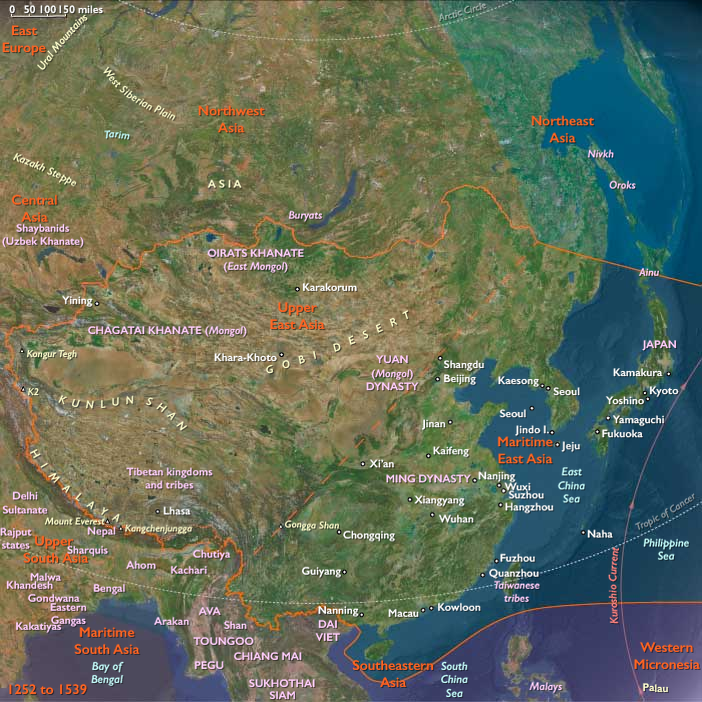
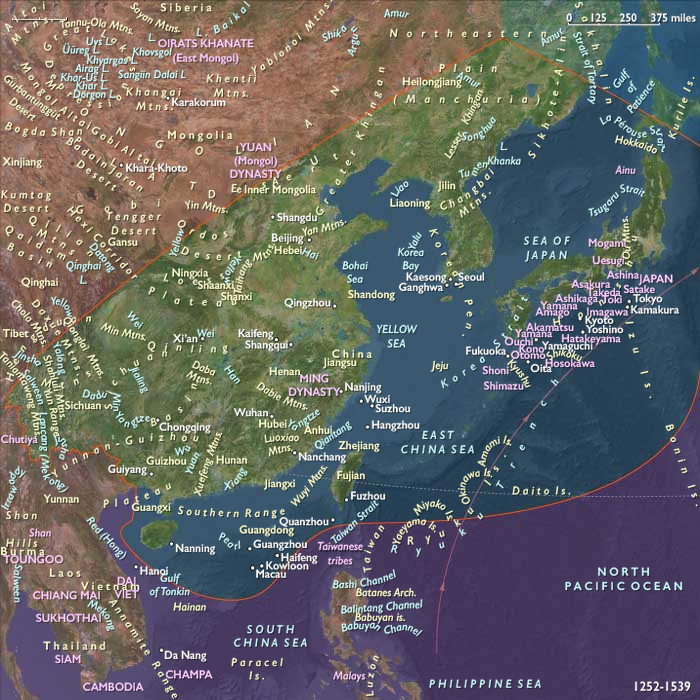
Hatayama Mochikuni, head of Japan’s eminent Hatayama bushi clan, dies in 1450; Hatayama Yoshiyoshi succeeds him to the post of Kanrei (administrative daimyo to the shogunate).
Locations
Groups
Subjects
Regions
Subregions
Related Events
Filter results
Showing 10 events out of 41563 total
Muslim traders from India, cooperating with Arab and Persian sailors, begin encroaching on the Indonesian’s spice trade centers, gaining control of the Malay port of Melaka (also Malacca) around 1450.
The Master of the Tucher Altarpiece (who flourishes between 1430-1450) is a German painter active in Nuremberg.
His name is derived from a painting which has been in that city's Frauenkirche since the early nineteenth century; this has been known as the Tucher Altarpiece at least since 1615, in which year it was moved from its initial location (the Augustinians' church in Nuremberg), to another church in the same city.
This move, and the accompanying restoration of the painting, was done under the auspices of the Tucher family, from whom it received its name.
The Master's style is of a piece with that of his contemporaries such as Konrad Witz and Hans Multscher, all of whose realism is based on sculptural forms.
Unlike Witz, he chose to depict only solid forms, especially those of the human figure, doing away with any suggestion of background.
This can be seen in the central panel of his eponymous altarpiece, in which a painting of the Crucifixion is flanked by scenes from the Annunciation and Resurrection.
The figures stand against a tooled gold ground, purely decorative and with no perspective depth.
Elaborate tracery, a baldacchino, projects over them as if to suggest that they are actually statues.
A still-life appears on the exterior, part of the setting for the Vision of Saint Augustine.
This resembles similar still-lifes painted in the niches above a group of prophets by Barthélemy d'Eyck in a painting of 1445; even so, there is no indication that d'Eyck and the Master were the same artist.
The Hussite Wars, the recurrence of the Black Death in 1437, and the First Margrave War have led to a severe fall in population in Nuremberg, which has twenty thousand residents in 1450.
Dispute between Poland and the Teutonic Order over the control of Gdańsk Pomerania has lasted since the 1308 Teutonic takeover of Danzig (Gdańsk), when that territory had been taken from Poland and annexed by the Teutonic Order.
This result of this event is a series of Polish–Teutonic Wars throughout the fourteenth and fifteenth centuries.
In the fifteenth century, the towns of Prussia experience rapid economic growth, which is not, however, paralleled by an increase in their political influence.
The rule of the Teutonic Knights is seen as increasingly anachronistic—taxes (customs) and the system of grain licenses (every trader has to pay large fees for the privilege of trading grain) are hindering economic development in the province.
At the same time, the nobility wants a greater voice in the running of the country, and regard with envy neighboring Poland, where the nobility enjoys wider privileges.
The Knights are also accused of violating the few existing privileges of the nobility and the cities.
Craftsmen are discontented because of competition from so-called partacze, or artisans settled by the Knights near their castles.
Kashubians, Poles, Germans, and Prussians are slowly melting into one nation, and as national differences disappeared, the common goals of all the ethnic and social groups of Prussia became more prominent, and the Prussian estates leaned increasingly towards Poland.
Prussian knights had in 1397 founded a secret organization called the Eidechsenbund (English translation: Lizard Union), more or less against the Teutonic Knights, but that organization had failed as it was not supported by the urban population.
After the victory by the Polish and Lithuanian forces at Grünfelde near Tannenberg during the Polish-Lithuanian-Teutonic War from 1409 to 1411, the Prussian estates had eagerly pledged allegiance to King Władysław II Jagiełło (Jogaila) of Poland, but they had quickly returned to the order's rule after the Poles were unable to conquer Marienburg (Malbork).
A clause in the peace treaty stated that it was guaranteed by the Prussian states, which would gain the right to defy the Teutonic Order if it broke the treaty.
In the succeeding wars, the Prussian estates had opposes any conflict, and pushed the Grand Masters of the Teutonic Knights to make peace.
A group made up of individuals from the Prussian cities, nobility and clergy, had formed the Prussian Confederation on February 21, 1440 The main contributors were from the nobility of Culmerland (Chełmno Land), Thorn, Culm (Chełmno), and from the Hanseatic cities of Elbing (Elbląg) and Danzig.
Grand Master Paul von Rusdorf was seen to approve the existence of the confederacy, but his successor, Konrad von Erlichhausen, had opposed it.
His non-compromising policy is followed and intensified by Ludwig von Erlichshausen, who takes this office in 1449 or 1450.

Albert is defeated at Pillenreuther Weiher on March 11, 1450.
The Margrave War ends with the signing of a peace treaty in Bamberg on June 22, 1450.
Albert has to return all captured lands to the city of Nuremberg.
Babur had become one of the three important Timurid rulers, together with the late Ulugh Beg and Sultan Muhammad bin Baysonqor (who has gained control of central Persia).
This balance of power is soon upset by Sultan Muhammad, who invades Khurasan.
The campaign starts out badly for Babur: a defeat at Mashad in March 1450 persuades him to cede parts of his territory.
Abdal-Latif Mirza, a somewhat pious person, gains the support of the local religious groups, but this does not save him from a conspiracy hatched against him by the amirs.
His reign lasts for only six months.
He is succeeded by his cousin Abdallah Mirza.
Skanderbeg's Albanian resistance forces rout Sultan Murad II himself in 1449-50, defeating a siege of the fortress of Krujë in 1450.
Now a hero to the West, Skanderbeg receives aid from Venice, Naples, Hungary, and the papacy.
Both sides in the Zürich war had become exhausted by 1446, and a preliminary peace had been concluded.
The parties make a definitive peace in 1450 and Zürich is again admitted into the confederation, but has to dissolve its alliance with the Habsburgs.
The confederation has grown into a political alliance so close that it no longer tolerates separatist tendencies of its members.
Zurich regains some territory, and most of the disputed Tottenburg is awarded to Schwyz.
The crushing defeat experienced by Pisa in 1284 in the Battle of Meloria against Genoa had among its consequences the end of Pisan rule and the beginning of the Genoese influence: this was contested at the beginning by the King of Aragon, who in 1296 had received from the Pope the investiture over Sardinia and Corsica.
A popular revolution against this and the feudal lords, led by Sambucuccio d'Alando, had won the aid of Genoa.
After that, the Cismonte region had been ruled as a league of comuni and churches, after the Italian experience.
The ensuing one hundred and fifty years have been a period of conflict, when Genoese rule is contested by Aragon, the local lords, the comuni and the Pope: finally, in 1450 Genoa cedes the administration of the island to its main bank, the Bank of Saint George, which brings peace to the island.