Harald Gille is killed in 1136 by …
Years: 1136 - 1136
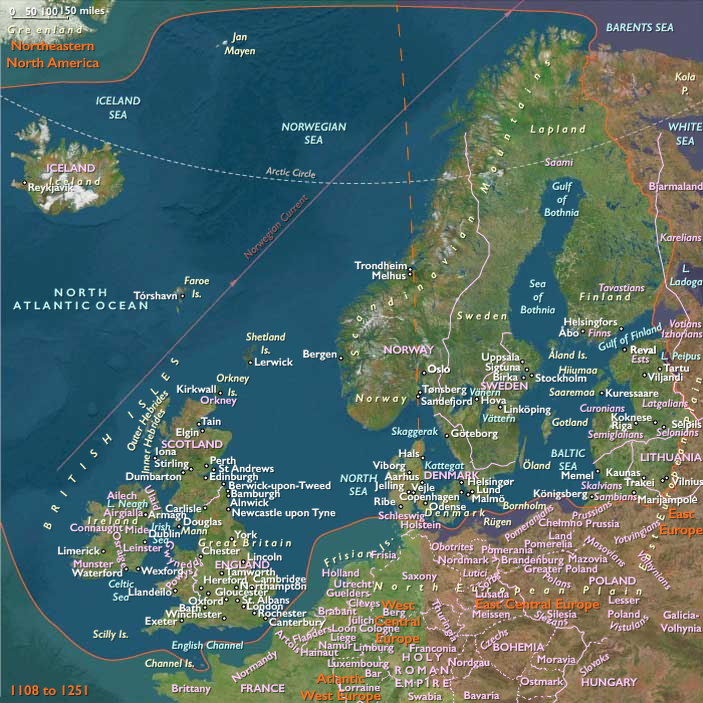
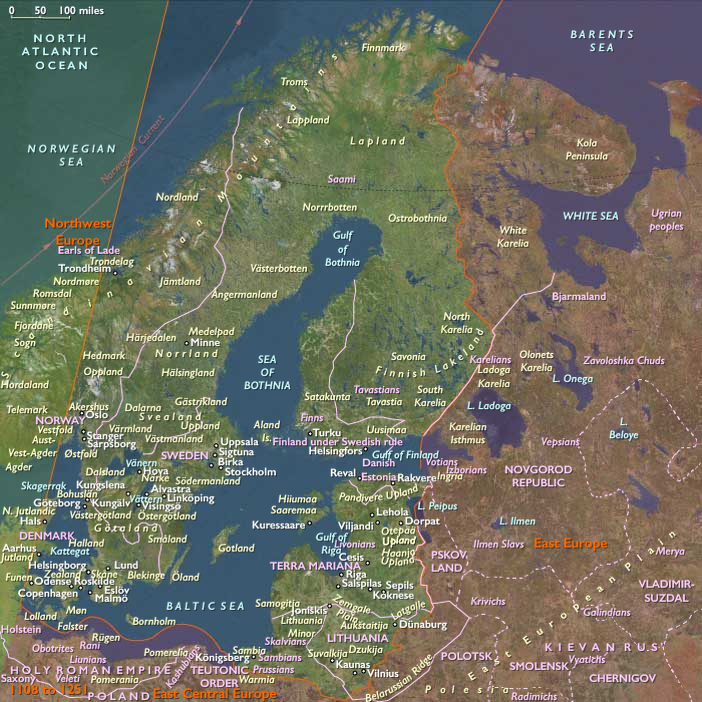
Harald Gille is killed in 1136 by Sigurd Slembe, another royal pretender who in 1135 had had himself proclaimed king.
To back his claim, Sigurd Slembe has brought Magnus IV back from the abbey and made him co-king.
They had decide to split up their forces, and Magnus has headed for eastern Norway, where he has the most popular support.
Here, he is defeated at the Battle of Minne by the forces of King Inge I.
He then flees to Götaland and subsequently to Denmark, where he tries to get support for his cause.
Locations
People
Groups
Topics
Commodoties
Subjects
Regions
Subregions
Related Events
Filter results
Showing 7 events out of 7 total
Thierry, Count of Flanders: His Final Years and the Expansion of Flemish Power (1156–1168 CE)
Thierry, Count of Flanders (r. 1128–1168), spent his final years expanding Flemish influence both militarily and diplomatically while continuing his commitment to the Crusades. His rule was marked by territorial expansion, economic growth, and the strengthening of Flemish governance, laying the foundation for Flanders’ later prominence in northern Europe.
Marriage Alliances and Territorial Gains
- In 1156, Thierry arranged the marriage of his eldest son, Philip of Alsace, to Elizabeth (Isabelle) of Vermandois, the daughter and heiress of Raoul I of Vermandois.
- This strategic union strengthened Flemish ties to central France and set the stage for future territorial gains in Vermandois.
- That same year, Thierry and his wife, Sibylla of Anjou, left for the Holy Land, leaving Philip to govern Flanders in their absence.
Crusading Efforts and Conflicts in the Levant (1156–1159, 1164–1166)
Thierry participated in two major Crusader campaigns:
-
The Siege of Shaizar (1157–1158)
- Thierry joined King Baldwin III of Jerusalem in the siege of Shaizar, an important fortress in Syria.
- A dispute over possession of the stronghold arose between Thierry and Raynald of Châtillon, which ultimately led to the siege failing, and the fortress remained in Muslim hands.
-
The Campaigns of Amalric I (1164–1166)
- Thierry returned to the Holy Land in 1164, accompanying King Amalric I of Jerusalem (his wife's half-brother) on expeditions to Antioch and Tripoli.
- These campaigns were part of Amalric’s broader effort to expand Christian control in the Levant, though Thierry played a secondary role.
- Upon returning to Flanders in 1166, he adopted a date palm as his seal, symbolizing his devotion to the Crusader cause.
Philip of Alsace’s Leadership and Flemish Expansion (1156–1168)
- While Thierry was absent, Philip ruled Flanders as co-count, proving himself an effective leader and military strategist.
- He defeated Floris III, Count of Holland, ending piracy along the Flemish coast.
- Floris was captured in Bruges and remained imprisoned until 1167, when he was forced to recognize Flemish suzerainty over Zeeland as part of his ransom.
- In 1159, Philip married Elizabeth of Vermandois, securing the Vermandois inheritance.
- When Elizabeth’s brother died in 1167, Vermandois passed to Philip, pushing Flemish influence further south than ever before, disrupting the balance of power in northern France.
- Additionally, Philip recovered Waasland and Quatre-Métiers, further expanding Flemish authority.
Thierry’s Final Years and Legacy
- Thierry returned to Flanders in 1166, continuing his moderate and peaceful rule.
- His reign saw the beginning of a highly developed administration, setting the stage for Flanders’ economic and political growth in later centuries.
- Commercial expansion and agricultural development flourished, making Flanders a leading economic hubin medieval Europe.
- He died on January 17, 1168, and was buried in the Abbey of Watten, between Saint-Omer and Gravelines.
- His son, Philip of Alsace, succeeded him as sole ruler, inheriting a strong and expanding Flemish state.
Through marriage diplomacy, military campaigns, and economic reforms, Thierry secured Flanders’ position as a dominant power in northern Europe, with Philip poised to take it to even greater heights
Margaret II of Flanders and the Economic Transformation of Flanders (Mid-13th Century)
Margaret II of Flanders, like her sister and predecessor, pursued a bold economic policy aimed at strengthening international commerce in Flanders, particularly in the rapidly growing port of Bruges. Despite resistance from local merchants, she implemented measures to attract foreign traders, contributing to Flanders’ emergence as a major hub of European trade.
Economic Reforms and Commercial Expansion
- Margaret lifted restrictions on foreign traders, allowing merchants from England, the Holy Roman Empire, and Italy to trade freely in Flemish markets.
- She issued a new coinage, stabilizing the regional economy and facilitating international transactions.
- Her policies helped Bruges grow into an international port, reinforcing its role in the wool and textile trade—the foundation of Flanders’ economy.
The Trade War with England (1270)
- In 1270, Margaret confiscated the property of English merchants in Flanders, provoking a devastating trade war with England.
- England was the primary supplier of raw wool to the Flemish weaving industry, and the disruption of trade crippled textile production in Flanders.
- This conflict strained relations between Flemish weavers and the ruling nobility, as economic hardship fueled social unrest.
Challenges for Her Son, Guy of Dampierre (1278–1281)
- Even after Margaret’s abdication in 1278, her son, Guy of Dampierre, struggled to control the increasingly powerful urban commoners, who resisted noble interference in economic matters.
- To strengthen financial stability in his realm, Guy licensed Lombard merchants to open the first currency exchange in Flanders in 1281, allowing for more efficient financial transactions and reinforcing Bruges’ role as a commercial and banking center.
Legacy
Margaret II’s economic policies laid the groundwork for Flanders' dominance in medieval European trade. Though her trade war with England weakened Flemish industry in the short term, the financial institutions established under her rule—such as currency exchanges and expanded foreign trade networks—contributed to Flanders’ long-term economic success.
Key Urban Centers: Bruges and Antwerp
- Bruges (Brugge) – A major commercial hub in the Hanseatic and Mediterranean trade networks, Bruges became Europe’s leading port during the late medieval period.
- Antwerp – Though initially overshadowed by Bruges, Antwerp would later become one of the most significant economic centers in Europe, especially during the 16th-century rise of global trade.
These cities played a pivotal role in European trade, connecting northern and southern markets, facilitating textile production and banking, and establishing early capitalist financial systems.
Burgundian Consolidation (1348)
- While urban autonomy flourished, the fragmentation of the Low Countries made them vulnerable to external political influence.
- In 1348, the Dukes of Burgundy began consolidating control over the region, setting the stage for:
- The Burgundian Netherlands, a centralized polity that brought greater administrative unity.
- A shift in power from city-led governance to Burgundian ducal authority, though cities continued to retain significant privileges.
Impact and Legacy
- The quasi-independence of Flemish and Brabantine cities created a unique political landscape that persisted for centuries, influencing later Dutch and Belgian history.
- These cities would continue to resist centralized control, leading to future conflicts with the Habsburgs and the Spanish Crown.
- The economic and political structures established in this period helped shape the future success of the Dutch Republic and the rise of Antwerp as a global trading hub in the 16th century.
By 1348, the cities of Flanders and Brabant had evolved into powerful economic and political entities, and though the Dukes of Burgundy began consolidating control, urban autonomy remained a defining characteristic of the Low Countries for centuries.
Hans Memling and Flemish Artistic Refinement (1468–1479)
In the late fifteenth century, Hans Memling (c.1430–1494) emerged as one of the most accomplished and sought-after painters in the Burgundian Netherlands. Memling, originally trained under the master painter Rogier van der Weyden in Brussels, established himself independently in the culturally and economically vibrant city of Bruges around 1465. His work, characterized by its graceful charm, technical virtuosity, and accessible spirituality, won him widespread admiration among both local patrons and international clientele.
Artistic Background and Training
Memling likely trained under Rogier van der Weyden in Brussels, absorbing the older master's subtlety, compositional clarity, and sophisticated treatment of religious subjects. His early works, notably the Donne Altarpiece (also called the Madonna with Saints and Donors) completed in 1468, demonstrate clear evidence of Rogier's influence—seen particularly in their refined figures, balanced composition, and sensitive portrayal of patrons and religious themes.
Style and Artistic Innovations
While indebted to Rogier’s emotional intensity and compositional clarity, Memling developed a distinctive, gentler artistic approach. He softened his mentor's intense emotional expressions into serene, poetic reverence, creating religious images notable for their harmonious beauty and tranquil spirituality. His paintings appealed deeply to both ecclesiastical and lay audiences, blending devotional intimacy with aesthetic refinement in ways that were easily accessible to viewers of all classes.
One of Memling’s notable early works, the Donne Altarpiece (1468), exemplifies this graceful refinement, combining meticulous realism with a pleasing, accessible visual language. Such works established Memling’s reputation as an artist whose style was both deeply religious and profoundly appealing to the prosperous merchant and bourgeois classes of Flanders, as well as to visiting patrons from Italy and elsewhere in Europe.
Patronage and Popularity
Memling’s approachable yet sophisticated style made him a favorite among religious institutions, prosperous Flemish citizens, and wealthy international merchants, especially Italians in Bruges. He enjoyed steady patronage from institutions like the Hospital of Saint John in Bruges, which commissioned significant works such as the Adoration of the Magi triptych in 1479, a masterpiece exemplifying his technical skill, narrative clarity, and elegant portrayal of sacred subjects.
Portraiture and Artistic Legacy
Memling also excelled in portraiture, achieving a refined balance between realism and idealized beauty. His celebrated work Portrait of a Man Holding a Coin (1470s) exemplifies his refined ability to capture nuanced personal characteristics, conveying psychological depth and dignity through a graceful yet naturalistic portrayal of his subjects. His refined portraits significantly influenced Flemish and European portraiture, elevating the genre and establishing a template for subsequent generations of artists.
Economic and Cultural Significance
Through his approachable and refined style, Memling contributed significantly to the enduring popularity of Flemish painting among international patrons, further enriching Bruges as an artistic and cultural center. His popularity among Italian merchants, in particular, strengthened cultural and artistic ties between Northern Europe and Italy, influencing artists on both sides of the Alps.
Long-Term Historical Significance
Hans Memling's artistic legacy marked a critical point in the development of Flemish painting. His harmonious compositions, accessible devotional imagery, and elegant portraiture greatly shaped the subsequent evolution of Netherlandish art, influencing artists such as Gerard David and facilitating the transition from Gothic styles toward a more subtle, humanist artistic sensibility. Memling thus occupies a pivotal position in the artistic history of late medieval Atlantic West Europe, bridging the Gothic tradition and the emerging artistic sensibilities of the Renaissance.

Gerard David's The Judgment of Cambyses (1498)
In 1498, Flemish painter Gerard David completed one of his most influential and politically charged masterpieces, the diptych panels known as The Judgment of Cambyses. Commissioned specifically for the council chamber of the Town Hall of Bruges, these vivid works depict a dramatic historical narrative from ancient Persia, intended as a powerful visual lesson on justice and moral governance for Bruges' civic leaders.
The paintings illustrate the harsh punishment ordered by the Persian king Cambyses against a corrupt judge, graphically portraying the consequences of judicial corruption. David’s vivid and meticulous attention to detail, characteristic of the Flemish tradition, underscores the gravity and moral weight of civic responsibilities entrusted to Bruges' officials. The choice of this historical scene was politically deliberate, reflecting contemporary anxieties about corruption, accountability, and the integrity of local governance.
Artistically, David’s work represents a pivotal moment in the evolution of Flemish painting, blending late medieval realism with an emerging emphasis on humanist moralism, reflecting broader shifts in Renaissance thought and aesthetics. The detailed realism, dramatic narrative, and moral clarity of the composition influenced subsequent artistic treatments of political and ethical themes across Atlantic West Europe.
Culturally and politically, David’s panels reinforced the growing civic consciousness in urban centers of the Low Countries, reflecting broader trends toward greater public accountability and transparency in governance. Moreover, the work's public display within Bruges’ town hall established a tradition of art serving both decorative and didactic functions in civic spaces.
Gerard David’s Judgment of Cambyses thus stands as a significant intersection of artistic achievement, civic morality, and political symbolism in late medieval Atlantic West Europe, emblematic of an era increasingly attentive to issues of justice, governance, and communal ethics.
Juan Luis Vives and the Foundations of Modern Psychology (1538)
In 1538, the renowned Spanish humanist philosopher and scholar Juan Luis Vives publishes his influential treatise, De anima et vita libri tres (Three Books on the Soul and Life). This groundbreaking work explores the nature of human consciousness, the mechanisms of memory, the association of ideas, and extends even into the realm of animal psychology.
Vives offers innovative insights into how ideas form associative networks within the human mind, foreshadowing concepts central to modern psychology. His meticulous examination of memory processes, from encoding and storage to retrieval, positions him among the early pioneers who anticipate cognitive psychology centuries before its formal establishment.
Remarkably, Vives does not confine his observations solely to humans, but ventures into comparative psychology, acknowledging mental processes in animals—an exceptionally progressive stance for his era.
Long-term Significance
Vives’s comprehensive treatment of psychological phenomena establishes him as a key transitional figure bridging medieval scholastic thought and modern empirical psychology. His emphasis on experience, observation, and critical inquiry lays crucial groundwork for later scholars, influencing notable figures such as René Descartes, Francis Bacon, and ultimately shaping the development of psychology as a distinct scientific discipline.