Hans Burgkmair the Elder, a leading German …
Years: 1518 - 1518
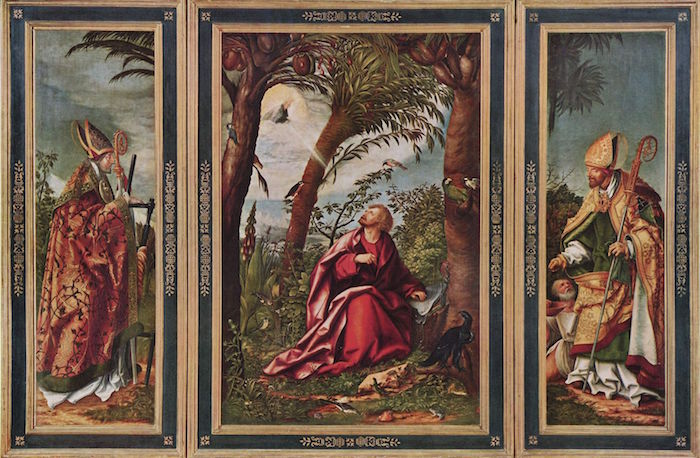
Hans Burgkmair the Elder, a leading German painter and graphic artist, has probably visited Venice and northern Italy several times, where he has developed an Italianate sense of color and modeling: he combines this with northern expressiveness and love of detail, exemplified by his magnificent “St. John Altarpiece,” painted in 1518.
Related Events
Filter results
Showing 10 events out of 38891 total
A second Danish attempt to subdue Sweden in 1518 is also frustrated by Sture's victory at Brännkyrka.
It is decided after the battle of Brännkyrka that Sten Sture and King Christian will meet in Österhaninge for negotiations.
To guarantee the safety of the king, the Swedish side sends six men as hostages to be kept by the Danes for as long as the negotiations last.
However, Christian does not show up for the negotiations, violates the deal with the Swedish side and takes the hostages aboard ships carrying them to Copenhagen.
The six members of the kidnapped hostage are Hemming Gadh, Lars Siggesson (Sparre), Jöran Siggesson (Sparre), Olof Ryning, Bengt Nilsson (Färla)—and Gustav Eriksson.
Gustav is held in Kalø slot, a castle located in eastern Jutland, where he is treated very well after promising he will make no attempt to escape.
A reason for this gentle treatment is King Christian's hope to persuade the six men to switch sides, and turn against their leader Sten Sture.
This strategy will prove successful regarding all men but Gustav, who remains loyal to the Sture party.
Maximilian is a keen supporter of the arts and sciences, and he has surrounded himself with scholars such as Joachim Vadian and Andreas Stoberl (Stiborius), promoting them to important court posts.
Many of them have been commissioned to assist him complete a series of projects, in different art forms, intended to glorify for posterity his life and deeds and those of his Habsburg ancestors.
He refers to these projects as Gedechtnus ("memorial"), and includes a series of stylized autobiographical works: the epic poems Theuerdank and Freydal, and the chivalric novel Weisskunig, both published in editions lavishly illustrated with woodcuts.
In this vein, he has commissioned a series of three monumental woodblock prints—The Triumphal Arch (1512–18, one hundred and ninety-two woodcut panels, two hundred and ninety-two centimeters wide and three hundred and fifty-seven centimeters high—approximately 9'8" by 11'8½"), and a Triumphal Procession (1516–18, one hundred and thirty-seven woodcut panels, fifty-four meters long) which is led by a Large Triumphal Carriage (1522, eight woodcut panels, one and a half inches high and eight feet long), created by artists including Albrecht Dürer, Albrecht Altdorfer and Hans Burgkmair.
Burgkmaier has spent much of his time from about 1508 working on the woodcut projects of Maximilian I until the Emperor's death in 1519.
He is responsible for sixty-one of the one hundred and thirty-five prints in the “Triumphal Procession,” a great scroll depicting a magnificent parade in honor of the emperor, which are large and full of character, illustrating the emperor's genealogy and the major events of his reign.
He also did most of the illustrations for the Weiss König (White King), one of three books commissioned by Maximilian, and much of Theurdank, a poetic work composed by Maximilian in German which tells the fictionalized and romanticized story of his journey to marry Mary of Burgundy in 1477.
He works closely with the leading blockcutter Jost de Negker, who becomes in effect his publisher.
Burgkmair also creates many of the woodcuts in Maximilian's great “Triumphal Arch” (a multi-artist project supervised by Albrecht Dürer).
For the prominent merchant banker Jakob Fugger, he decorates the facade of his house in Augsburg, renowned as the first Italian Renaissance palace in Germany (the paintings have since disappeared).
Philipp Melanchthon, whose real family name is Schwarzerd (meaning "black earth"), of which Melanchthon is the Greek translation, had been educated at Heidelberg and Tubingen, where he had read widely in the Greek classics and Hebrew scriptures.
In 1518, Melanchthon goes to the University of Wittenberg as a professor of Greek and delivers an inaugural address on behalf of humanistic studies.
Under Martin Luther's influence, Melanchthon is won over to the evangelical cause.
Luther himself defends his theology before his fellow Augustinians.
Copies of his ninety-five theses, which are quickly spread throughout Europe, unleash a storm of controversy.
Thirty-one-year-old German Roman Catholic theologian Johann Eck writes his Obelisci in reply to Luther's theses, condemning his ideas.
Lucas Cranach the Elder’s Reclining Nymph, painted in 1518, displays influences of Quentin Massys and Jan Gossaert, as well as of Flemish and Italian Renaissance artists.
Cranach's religious subjects reflect the development of the Protestant Reformation, and its attitudes to religious images.
In his early career, he had painted several Madonnas; his first woodcut (1505) represents the Virgin and three saints in prayer before a crucifix.
Later on he painted the marriage of St. Catherine, a series of martyrdoms, and scenes from the Passion.
After 1517 he will occasionally illustrate the old subjects, but will also give expression to some of the thoughts of the Reformers, although his portraits of reformers are more common than paintings of religious scenes.
In a picture of 1518, where a dying man offers "his soul to God, his body to earth, and his worldly goods to his relations", the soul rises to meet the Trinity in heaven, and salvation is clearly shown to depend on faith and not on good works.
Albrecht Dürer, in the etchings that he produces between about 1515 and 1518, employs classical subject matter to depict the ideal human proportions in the Renaissance manner.
Hans Baldung, like Dürer and Cranach, supports the Protestant Reformation.
He is present at the diet of Augsburg in 1518, and one of his woodcuts represents Luther in quasi-saintly guise, under the protection of (or being inspired by) the Holy Spirit, which hovers over him in the shape of a dove.
Janbirdi al-Ghazali had joined the Mamluk governor of Aleppo in defecting to the Ottomans and severed allegiance with Mamluk sultan Qansuh al-Ghawri.
Selim I is reportedly impressed by al-Ghazali's loyalty to his superiors and in a bid to have him serve under the Ottomans, appoints him as governor of Damascus in February 1518.
At this time, Damascus Province encompasses much of the Levant, including much of central and southern Syria, the Syrian coastline, Palestine, Transjordan and Lebanon.
He pays an annual tribute of two hundred and thirty-three thousand dinars to the Ottoman sultan.
The Bahmani dynasty believes that they descend from Bahman, a legendary king of Iran.
The Bahamani Sultans are patrons of the Persian language, culture and literature, and some members of the dynasty had become well-versed in that language and composed its literature in that language.
The most important personality of the Bidar period of the Bahmani sultanate was Mahmud Gawan, who served several sultans as prime minister and general from 1461 to 1481.
He had reconquered Goa, which had been captured by the rulers of Vijayanagar, thereby extending the sultanate from coast to coast.
Gawan also introduced remarkable administrative reforms and controlled many districts directly, thus very much improving the state’s finances, but his competent organization ended with his execution, ordered by the sultan as the result of a court intrigue.
After realizing his mistake, the sultan drank himself to death within the year, thus marking the beginning of the end of the Bahmani sultanate.
After Gawan’s death the various factions at the sultan’s court had begun a struggle for power that ends only with the dynasty itself: indigenous Muslim courtiers and generals are ranged against the ‘aliens’—Arabs, Turks and Persians.
The last sultan, Mahmud Shah, no longer has any authority and has presides over the dissolution of his realm as Sri Krishnadevaraya of Vijayanagar defeats the last remnant of Bahmani power.
The governors of the four most important provinces had declared their independence from the Bahmani ruler one after another: Bijapur (1489), Ahmadnagar (1490), Berar (1490), Bidar (1492) and Golconda (1512).
Although the Bahmani sultans will live on in Bidar until 1527, they are mere puppets in the hands of the real rulers of Bidar, the Barid Shahis, who use them so as to put pressure on the other usurpers of Bahmani rule.
The Bidar Sultanate was founded in 1492 by Qasim Barid, a Turkmen from Georgia who had joined the service of the Bahmani sultan Muhammad Shah III.
Beginning his career as a sar-naubat, he later became the mir-jumla (prime minister) of the Bahmani sultanate and during the reign of Mahmud Shah became the de facto ruler.
After his death in 1504, his son Amir Barid became the prime minister and controlled the administration of the Bahmani sultanate.

The city of Vijayapura owes much of its greatness to Yusuf Adil Shah, the founder of the independent state of Bijapur.
Ruled by the kings of the Adil Shahi dynasty, Bijapur has proved to be the most expansive of the successor states to Bahmani.
Embroiled in incessant fighting on the Deccan, …