Han imperial forces have by 204 succeeded …
Years: 204 - 204
Han imperial forces have by 204 succeeded in crushing the Yellow Turban rebellion in Shandong and …
Locations
People
Groups
- Taoism
- Chinese (Han) people
- Chinese Empire, Tung (Eastern) Han Dynasty
- Way of the Five Pecks of Rice
Topics
Commodoties
Subjects
Regions
Subregions
Related Events
Filter results
Showing 10 events out of 60761 total
…Shanxi provinces, although they have been severely weakened by the effort.
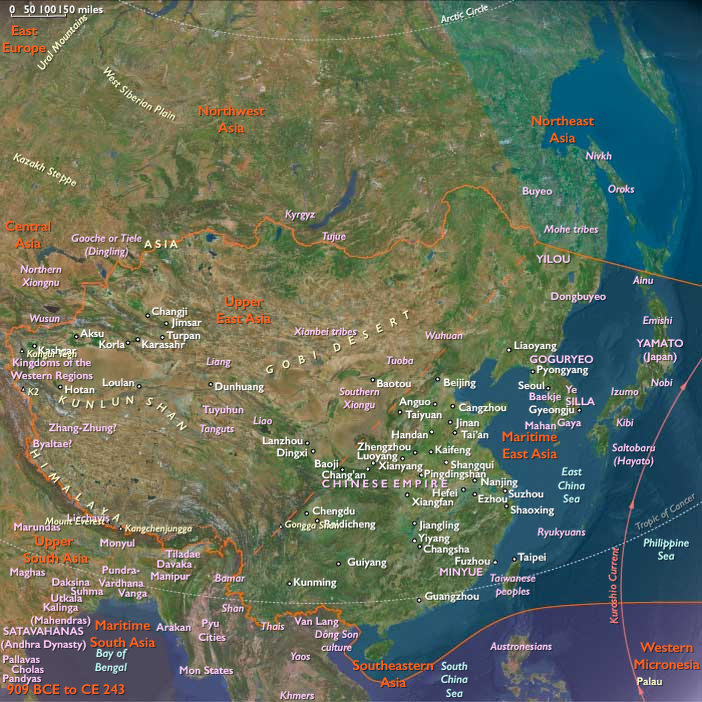
Yuan Shao had maintained good relations with the Wuhuan beyond the imperial borders during his campaign against rival warlord Gongsun Zan, their common enemy, in the 190s.
Yuan Shao had given the chieftains of his Wuhuan allies seals and insignia as chanyu after the final destruction of Gongsun Zan in the Battle of Yijing in 199, and has reinforced the alliance by marrying the daughters of his subordinates to the Wuhuan leaders, pretending as though the daughters were his own.
The Wuhuan war leader Tadun was especially powerful and was thus very well-treated by Yuan Shao.
The Wuhuan have continued to support the Yuan clan after Yuan Shao's defeat at the Battle of Guandu against Cao Cao.
Subsequently, Yuan Shao's oldest and youngest son, Yuan Tan and Yuan Shang respectively, fought among themselves in a succession feud, which Cao Cao had exploited for himself.
Soon Yuan Tan was killed in a battle against Cao Cao and Yuan Shang had to flee to his second brother, Yuan Xi, in You Province.
The Yuan brothers in You Province had then been the targets of a mutiny against them, and had fled further north to seek protection from the Wuhuan, who have been united under the military leadership of Tadun, whose apparent strength prompts rumurs that he is seeking to emulate Modu Chanyu of the Xiongnu and Tanshihuai of the Xianbei in creating a hegemony over the northern nomadic tribes.
With the arrival of the Yuan brothers, accompanied by a considerable number of their followers, Tadun has gained command of a combined Wuhuan and Chinese force that is said to have numbered up to three hundred thousand.
In the name of helping Yuan Shang regain his territories, the Wuhuan make several raids across the imperial border, and are said to have kidnapped over one hundred thousand Chinese families.
Posed with such danger in the north, Cao Cao contemplates the elimination of the Wuhuan threat.
Severus had fallen heavily under the influence of his Praetorian Prefect, Gaius Fulvius Plautianus, who after 197, according to Cassius Dio, comes to have almost total control of most branches of the imperial administration.
Plautianus's daughter, Publia Fulvia Plautilla, had been married in 202 to Severus's son, Caracalla.
Plautianus has become so powerful that Roman Empress Julia Domna and Caracalla have begun to be concerned.
The marriage between Caracalla and Fulvia Plautilla is not a happy one.
In fact, Caracalla loathes both her and her father, threatening to kill them after becoming sole emperor.
When Plautianus discovers this, he begins to plot to overthrow Severus' family.
His excessive power comes to an end on January 22, 205, after the emperor’s dying elder brother, Publius Septimius Geta, states to Severus that he hates Plautianus and warns him of Plautianus' treachery.
The imperial family summons him to the palace and orders his death.
After his death, Plautianus’ property is confiscated, his son of the same name, daughter and granddaughter are exiled to Sicily and then later to Lipari and his name is erased from public monuments.
Seven years later, his son, daughter and granddaughter will be strangled on Caracalla's orders.
However, the two following praefecti, including the jurist Aemilius Papinianus, will receive even larger powers.

Cao Cao, in preparation for a campaign far to the north of the imperial heartland, has put Dong Zhao in charge of digging two canals, the Pinglu Trench ("Pacify-the-Caitiffs Trench") and the Quanzhou Trench, from the autumn of 206 to spring of 207 so he can use these waterways to ship supplies to the north.
While these works are under way, some generals try to dissuade Cao Cao from campaigning so far to the north in case of an attack from the south, fearing that Liu Bei would certainly persuade Liu Biao, the Governor of Jing Province, to raid Xu City, Cao’s capital.
However, Cao Cao's strategist Guo Jia urges a swift attack, opining that the Wuhuan, being so far away from the Chinese heartland, are deluded by a false sense of security and can be defeated and destroyed in a quick attack.
Otherwise, the Yuan brothers and the Wuhuan would cause trouble, and the newly settled northern provinces would be lost.
Further, Liu Biao would then not be persuaded by Liu Bei, who he does not trust in any case, to launch an attack on Xu City.
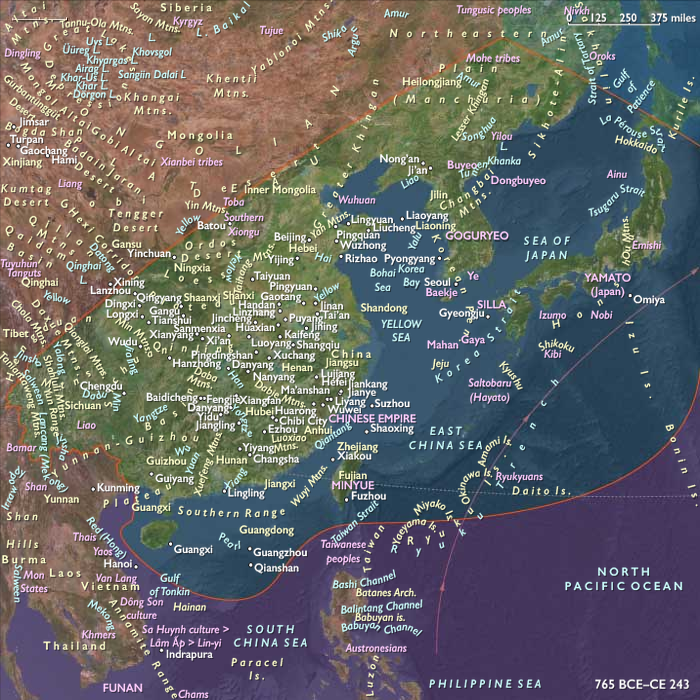
Cao Cao agrees with Guo Jia's analysis, and in the summer of 207, Cao personally marches his army to Yijing (present-day Yi County, Hebei) and makes the city his base camp for the campaign.
From here, …
…Cao advances to Wuzhong (present-day Ji County, Tianjin), where the local leader Tian Chou submits to him.
The base of Wuhuan power is located at Liucheng ( in present-day Xingcheng, Liaoning), and the obvious line of attack from Wuzhong is through the plains along the coastline of the Bohai Sea.
The monsoon season sets in, however, in the seventh lunar month, and the heavy rains flood the low-lying areas and drench the roads in mud, making the terrain impassible.
The Wuhuan also anticipate such an attack route and hold the river crossings, and for some time Cao Cao's army cannot advance.
Cao Cao turns for advice to Tian Chou, who is familiar with the area and has had run-ins with the Wuhuan before.
Tian Chou advises Cao Cao of a disused road that leads to the abandoned Former Han frontier lands, whence the army could march through undefended territory and attack the Wuhuan where they least expected it.
Cao Cao, most pleased, accepts the plan and leads his army back (presumably to Wuzhong).
He has his men erect signs on the roads by the water, stating "It is the middle of summer, and the road is impassable. We are waiting for autumn or winter to resume the advance."
Enemy scouts see the sign and apparently believe that Cao Cao had really retreated.
As Tian Chou had predicted, the Wuhuan are convinced that any force that cannot advance through the plains has to turn back.
Cao Cao takes Guo Jia’s suggestion that "swiftness is the key in war" and that he should leave the baggage behind and make a forced march with light troops to take the enemy by surprise, since carrying too much baggage bogs the army down and alerts the enemy of the army's presence.
With Tian Chou leading the way, Cao Cao leads a light force to embark on what has been called one of his most remarkable military adventures of his career.
They climb the hills of Xuwu (west of present-day Zunhua, Hebei), …
…exit the Chinese frontiers through Lulong Pass (present-day Xifeng Pass) into the upper valley of the Luan River, and march through difficult terrain for over five hundred li.
Turning east at Pinggang (near present-day Pingquan County, Hebei), the expedition force crosses the grazing fields of the Xianbei and reenters the mountain ranges that serve as the Later Han Dynasty's borders.
Cao Cao's men have by now flanked Tadun's defensive positions and are advancing on a line to the sea that will divide the enemy territory in two.
Tadun and his allies, as Cao Cao's army reaches the valley of Daling River by autumn in the eighth lunar month, realize what is happening, hastily withdraw from their prepared positions, and gather to face Cao Cao to the north.
With tens of thousands of men gathered, Tadun, along with Yuan Shang, Yuan Xi, and the two Wuhuan chanyu Louban and Wuyan, meet Cao Cao's army at White Wolf Mountain (near present-day Lingyuan, Liaoning).
The encounter is sudden for both parties.
Faced with superior numbers and the baggage left in the rear, Cao Cao's lightly armored men become afraid.
The Wuhuan, on the other hand, are evidently unprepared for battle as they are not in proper formations, nor do they attempt to take the initiative by harassing Cao Cao's march.
Undaunted, Cao Cao climbs a slope to observe the enemy's formations.
He sees that the Wuhuan are in disorder, and immediately unleashes his soldiers to exploit this weakness.
With general Zhang Liao leading the offensive, the light force swiftly defeats the Wuhuan cavalry, and Cao Chun's brigade captures Tadun.
Within a short time, Tadun and many of his men are killed and the battle is over.
Over two hundred thousand Chinese settlers and Wuhuan tribesmen surrender to Cao Cao.
In a single engagement, Cao Cao has broken the back of Wuhuan resistance.
…
The Yuan brothers and the surviving Wuhuan leaders, Supuyan, Louban, Wuyan and others, flee east with a few thousand horses to Liaodong (eastern Liaoning), where the warlord Gongsun Kang enjoys some degree of independence from the Han Dynasty imperial court due to Liaodong's distance from the capital and the chaotic state in China.
In the ninth lunar month, Cao Cao continues his march into Liucheng, and here he halts, making no intention to attack Liaodong despite the urgings of his subordinates.
He later explains that applying pressure to Liaodong may have bound Yuan Shang and Gongsun Kang against him, but if he left them to their own devices, they would quarrel among themselves.
A few days after Yuan Shang and Yuan Xi arrive in Liaodong, Gongsun Kang arranges to see them.
Yuan Shang plots to kill Gongsun Kang and take his territory for the Yuans, but Gongsun Kang strikes first, killing the brothers and sending their heads to Cao Cao.
The Wuhuan leaders who follow the Yuans are not spared either and all are decapitated.
Years: 204 - 204
Locations
People
Groups
- Taoism
- Chinese (Han) people
- Chinese Empire, Tung (Eastern) Han Dynasty
- Way of the Five Pecks of Rice