Hakim has displayed a growing inclination toward …
Years: 1021 - 1021
Hakim has displayed a growing inclination toward asceticism in the final years of his reign, and withdraws for meditation regularly.
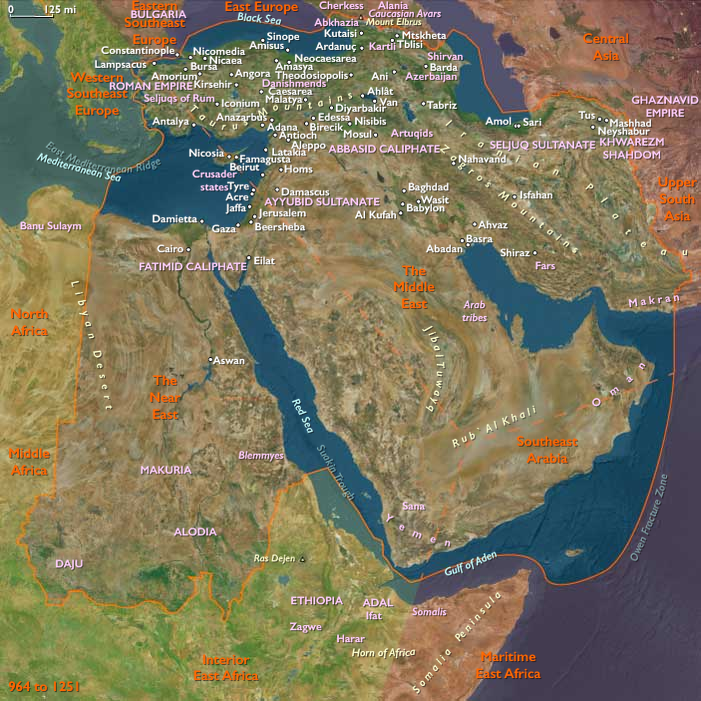
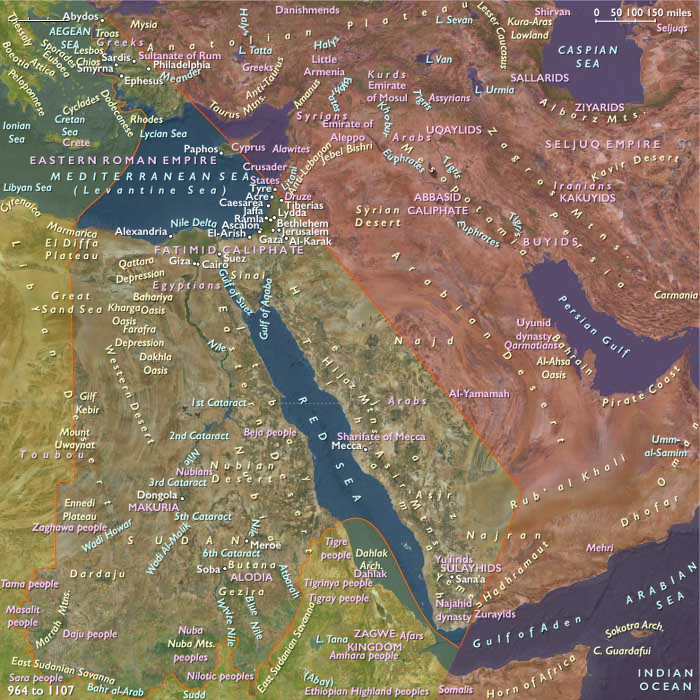
At the age of thirty-six on the night of 12/13 February 1021, Hakim leaves for one of his night journeys to the al-Muqattam hills outside of Cairo and never returns.
A search finds only his donkey and bloodstained garments.
His disappearance has remained a mystery.
Locations
People
Groups
Subjects
Regions
Subregions
Related Events
Filter results
Showing 10 events out of 613 total
The houses of Tusculum and Spoleto are together the dominant secular powers in the central Italian peninsula, the one representative of the papal power and the other of the imperial.
Pope John XIX, born Romanus in Rome, succeeds his brother Pope Benedict VIII, both members of the house of Tusculum, on April 19.
Prior to being elected Pope, he had been an unordained layman and was therefore ordained a bishop in order to enable him to ascend the papal chair, having previously been a consul and senator.
John XIX plays a role in the process leading to the Schism of 1054 by rejecting a proposal by Patriarch Eustathius of Constantinople to recognize this Patriarchate's sphere of interest in the east.
Against the grain of ecclesiastical history, John XIX agrees, upon being paid a large bribe, to grant the title of ecumenical bishop to the Patriarch of Constantinople.
However, this proposal excites general indignation throughout the Church, compelling him almost immediately to withdraw from the agreement.
On the death of the Emperor Henry II on July 13, 1024, the new pope gives his support to Emperor Conrad II.
Aribert journeys to Rome for the imperial coronation of Conrad by Pope John XIX on March 26, 1027 in an impressive ceremony, attended by, among other dignitaries, Cnut, King of England, Denmark and Norway, and overlord of Sweden.
Guido of Arezzo, possibly born in France around 990, becomes a Benedictine monk and goes to Arezzo in Italy, where he lives for many years and where, in about 1025, he perfects the staff system of musical notation.
A renowned musical theorist and an innovative teacher, he formulates the concept of a scale pattern comprising six notes represented by the syllables ut (do), re, mi, fa, sol, la, and teaches that the interval between each syllable is a whole tone except for the one between mi and fa, which is a half step.
Because singers can now associate syllables with the fixed pitches of the notes, they are able to learn melodies much more quickly and accurately than previously.
Guido’s revolutionary inventions capture the attention of the papal court in Rome, where he successfully demonstrates his techniques.
He discusses contemporary polyphony in his writings, notable the “Micrologus.”
Alberic III, Count of Tusculum, obtains the Papal chair for his son Theophylact III (or IV), who is a nephew of Pope Benedict VIII and Pope John XIX, at the death of the latter in October 1032.
He reportedly leads an extremely dissolute life and allegedly had few qualifications for the papacy other than connections with a socially powerful family.
Alberic uses the title of consul, dux et patricius Romanorum: "consul, duke, and patrician of the Romans."
This signifies his secular authority in Rome.
He also bears the titular comes sacri palatii Lateranensis ("Count of the Sacred Lateran Palace"), which signifies his ecclesiastical function in the papal curia.
During the pontificate of his brother John XIX, he had been made a senator, but he had had to abandon this title for the aforementioned consular dignity in order to avoid tensions with the Emperor Henry II.
Alberic does not appear in sources after 1033, when he leaves the comital powers to his son, the newly elected pope.
Pope Benedict IX had been briefly forced out of Rome in 1036, but had returned with the help of Emperor Conrad II.
In September 1044, the opposition forces him out of the city again and elects John, Bishop of Sabina, as Pope Sylvester III.
Benedict IX's forces return in April 1045 and expel his rival, who returns to his previous bishopric.
Later in 1045, in order to rid the Church of the scandalous Benedict, his godfather, the pious priest John Gratian, persuades Benedict to resign the papacy for a sum of money, thus allowing Gratian to become Pope Gregory VI.
Some also say that Benedict wanted to marry.
Benedict IX soon regrets his resignation and returns to Rome, taking the city; he will remain on the throne until July 1046, although Gregory VI continues to be recognized as the true pope.
At this time, Sylvester III also reasserts his claim.
…Rome and holds a synod wherein he declares no Roman priest fit.
Adalbert of Bremen refuses the honor and Henry appoints Suidger of Bamberg, who is acclaimed duly by the people and clergy, we are told.
He takes the name Clement II.
On Christmas Day 1046, Clement is consecrated, and Henry and Agnes are crowned Holy Roman Emperor and Empress.
The populace gives Henry the golden chain of the patriciate and makes him patricius, giving the powers, seemingly, of the Crescentii family during the tenth century to nominate popes.
The previously deposed Pope Benedict IX had seized the Lateran Palace in November 1047, a month after the death of Pope Clement II German troops drive him away in July 1048.
To fill the power vacuum, Bishop Poppo of Brixen is elected as Pope Damasus II and universally recognized as such.
Bruno of Egisheim-Dagsburg, a native of Eguisheim, Upper Alsace, was born into family was of noble rank, and his father, Count Hugh, was a cousin of Emperor Conrad II (1024–1039).
He had been educated at Toul, where he had successively become canon and, in 1026, bishop.
In the latter capacity, he had rendered important political services to his relative Conrad II, and afterwards to Emperor Henry III.
He has become widely known as an earnest and reforming ecclesiastic by the zeal he showed in spreading the rule of the order of Cluny.
On the death of Pope Damasus II in 1048, Bruno had been selected as his successor by an assembly at Worms in December.
Both the Emperor and the Roman delegates had concurred.
However, Bruno apparently favored a canonical election and stipulated as a condition of his acceptance that he should first proceed to Rome and be freely elected by the voice of the clergy and people of Rome.
Setting out shortly after Christmas, he meets with abbot Hugh of Cluny at Besançon, where he is joined by the young tuscan Benedictine monk Ildebrando, or Hildebrand, the future Pope Gregory VII.
Arriving in pilgrim garb at Rome in the following February, he is received with much cordiality, and at his consecration assumed the name Leo IX.
With Leo IX’s appointment to the papacy, the movement of church reform, which had been gathering momentum in Burgundy and Lorraine, finally comes to Rome.
Leo has brought several reform-minded churchman to Rome, including Ildebrando, who, together with the diplomat and reformer Humbert of Silva Candida, and the Benedictine reformer Peter Damian, assist the new pope in his extensive reform program.
Leo IX favored traditional morality in his reformation of the Catholic Church.
One of his first public acts is to hold the well-known Easter synod of 1049, at which celibacy of the clergy (down to the rank of subdeacon) is required anew.
Also, the Easter synod is where the Pope at least succeeds in making clear his own convictions against every kind of simony.
Benedict IX refuses to appear on charges of simony in 1049 and is excommunicated.

Pope Leo IX had occupied the greater part of 1049 in one of those progresses through Italy, Germany and France that form a marked feature in his pontificate.
After presiding over a synod at Pavia, he had joined Henry III in Saxony and accompanied him to Cologne and Aachen.
He had also summoned a meeting of the higher clergy in Reims in which several important reforming decrees were passed.
At Mainz, he had held a council at which the Italian and French as well as the German clergy were represented, and ambassadors of the Greek emperor were present.
Here too, simony and the marriage of the clergy had been the principal matters dealt with.
After Leo’s return to Rome, he holds another Easter synod on April 29, 1050.
It is occupied largely with the controversy about the teachings of Berengar of Tours.
In the same year, he presides over provincial synods at Salerno, Siponto and Vercelli, and in September revisits his native Germany.