
Hamilcar, delayed by three years, leads a …
Years: 480BCE - 480BCE
Hamilcar, delayed by three years, leads a Carthaginian expedition to Sicily, which coincides with the expedition of Xerxes against mainland Greece in 480 BCE.
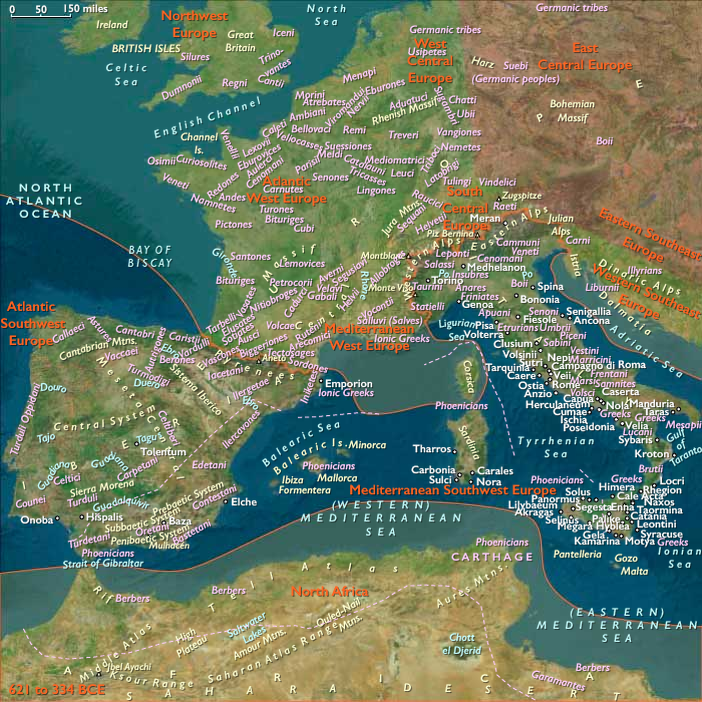
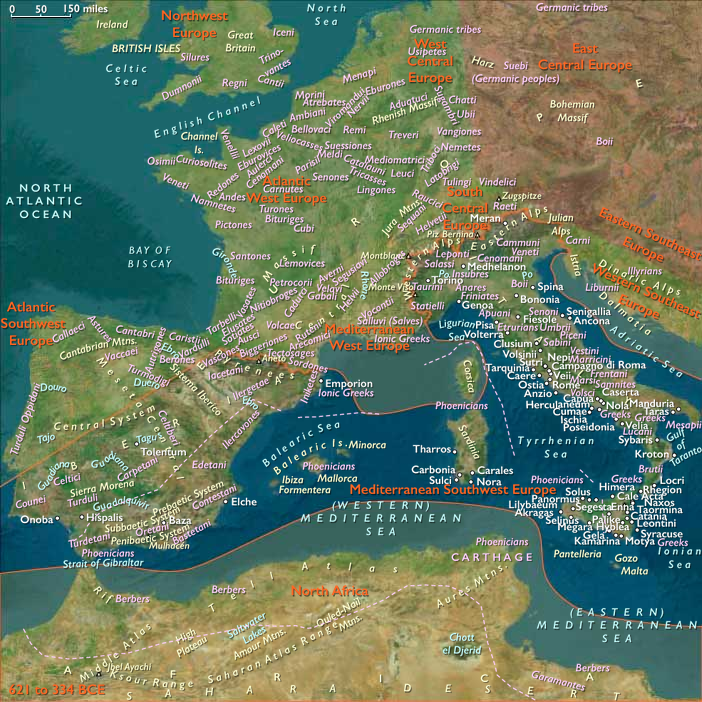
He is said to have assembled an army numbering three hundred thousand soldiers from Iberia, Sardinia, Corsica, Italy, Gaul and Africa under the command of a body of Carthaginian officers, along with war chariots, two hundred warships and three thousand transports for the venture.
Hamilcar had chosen not to sail to Selinus and then attack Akragas, although it lies on the coast closest to Carthage.
The Carthaginian fleet, escorted by sixty triremes, sails to Panormus instead.
Hamilcar has chosen this course probably because restoring Terrilus was his primary objective.
The conquest of Sicily, if this indeed is a consideration, takes second place to his duty as a guest friend of Terrilus.
The fleet is battered by storms at sea, losing the ships carrying the chariots and horses—which is to be a significant factor in the coming battle.
The Greek fleet, able to muster two hundred ships, does not contest the crossing; in fact, it will play no part in the coming battle.
Hamilcar spends three days reorganizing his forces at Panormus, and repairing his battered fleet.
Locations
People
Groups
- Greece, classical
- Sicily, classical
- Italy, classical
- Carthage, Kingdom of
- Syracuse, Corinthian city-state of
- Himera, (Dorian-Ionian Greek) city-state of
Topics
- Younger Subboreal Period
- Phoenician colonization
- Iron Age Europe
- Iron Age Cold Epoch
- Classical antiquity
- Greco-Persian Wars, Early
- Sicilian War, First, or First Carthaginian-Syracusan War
- Sicilian Wars, or Carthaginian-Syracusan Wars
- Persian Invasion of Greece, Second
Commodoties
Subjects
Regions
Subregions
Years: 480BCE - 480BCE
Locations
People
Groups
- Greece, classical
- Sicily, classical
- Italy, classical
- Carthage, Kingdom of
- Syracuse, Corinthian city-state of
- Himera, (Dorian-Ionian Greek) city-state of
Topics
- Younger Subboreal Period
- Phoenician colonization
- Iron Age Europe
- Iron Age Cold Epoch
- Classical antiquity
- Greco-Persian Wars, Early
- Sicilian War, First, or First Carthaginian-Syracusan War
- Sicilian Wars, or Carthaginian-Syracusan Wars
- Persian Invasion of Greece, Second
Commodoties
Subjects
Regions
Subregions