...Hamadan in 1724-25), and ...
Years: 1725 - 1725
...Hamadan in 1724-25), and ...
Locations
People
Groups
- Ottoman Empire
- Persia, Safavid Kingdom of
- Russian Empire
- Persia, Hotaki Ghilzaid Kingdom of
- Britain (United Kingdom of Great Britain and Northern Ireland)
Topics
Commodoties
Subjects
Regions
Subregions
Related Events
Filter results
Showing 10 events out of 27816 total
Hendrick Zwaardecroon was responsible for the ruthless repression in 1721 of the so-called conspiracy of Pieter Erberfelt, who, it had been claimed (probably falsely), had been plotting to expel the Dutch from the Indies.
Zwaardecroon had gone to the Indies in 1684 as secretary to the commissioner-general of the Dutch East India Company and advanced steadily until he was appointed governor-general in 1718, when the company was in serious financial difficulties.
He has taken harsh steps to halt smuggling and, more constructively, introduced new products into Java and expanded trade with China.
He has stimulated the production of indigo, improved cotton cultivation, and encouraged the production of sappanwood (from the tree Caesalpina sappan), used for dye.
Most important, he has imported the coffee tree, a future staple of the economy.
It is meanwhile discovered that Nian had engaged in secret correspondence with Yintang, the Emperor's brother and political rival.
His plea for leave being denied, Nian is, at the end of May, transferred to the post of Tartar General at Hangzhou.
The armies he once commanded come under the control of Yue Zhongqi.
As accusations accumulate from his former friends and officials, Nian is in a few months progressively degraded in rank until he becomes merely a bannerman-at-large.
In November, he is arrested and taken under escort to Beijing.
The Gǔjīn Túshū Jíchéng ("Complete Collection of Illustrations and Writings from the Earliest to Current Times"), a vast encyclopedic work written in China during the reigns of Qing emperors Kangxi and Yongzheng, completed in 1725, had been headed initially by scholar Chen Menglei, and later by Jiang Tingxi.
One of the Yongzheng Emperor's brothers had patronized the project for a while, although Yongzheng contrives to give exclusive credit to his father Kangxi instead.
It contains eight hundred thousand pages and over one hundred million Chinese characters.
Topics covered include natural phenomena, geography, history, literature and government.
The sea floor just north of the Peterhof site and to the east toward St. Petersburg is too shallow for either commercial ships or warships.
However, to the west of Peterhof, the sea floor drops off to be deep enough for sea vessels.
Accordingly, when Peter the Great had decided to build St. Petersburg at the eastern end of the Gulf of Finland, he had first captured the Kotlin Island, clearly visible from the Peterhof site just to the northeast in the middle of the Gulf.
At Kotlin Island, he has built the commercial harbor for St. Petersburg as well as the Kronstadt fortifications across the twenty kilometers of shallow sea to provision and defend the Navy that he has built.
Peter first mentions the Peterhof site in his journal in 1705, during the Great Northern War, as a good place to construct a landing for use in traveling to and from the island fortress of Kronstadt.
Peter had in 1714 begun construction of the Monplaisir ("my pleasure") Palace based on his own sketches of the palace that he wanted close to the shoreline.
This has become Peter's Summer Palace, which he uses on his way coming and going from Europe through the harbor at Kronstadt.
On the walls of this seacoast palace hang hundreds of paintings that Peter has brought from Europe and allowed to weather Russian winters without heat, together with the dampness of being so close to the sea.
In the seaward corner of his Monplaisir Palace, Peter had made his Maritime Study, from which he can see Kronstadt Island to the left and St. Petersburg to the right.
He had later expanded his plans to include a vaster royal château of palaces and gardens further inland, on the model of Versailles.
Each of the tsars after Peter will expand on the inland palaces and gardens of Peterhof, but the major contributions by Peter the Great are completed by 1725.
A grand residence, it has become known as the "Russian Versailles.” A French architect, Nicolas Pineau, had gone to Russia in 1716 and introduced the Rococo style to the newly founded city of St. Petersburg (e.g., Peter's study in Peterhof, before 1721).
The Rococo in Russia has flourished in St. Petersburg under the protection of Peter I and Elizabeth.
Peter's principal architect, Gaetano Chiaveri, who draws heavily on northern Italian models, is most noted for the library of the Academy of Sciences (1725) and the royal churches of Warsaw and Dresden.
Peter had also entertained plans of a similar palace at Strelna, a short way to the east, but these plans are abandoned when, in early January 1725, Peter is struck once again with uremia.
Legend has it that before lapsing into unconsciousness Peter asked for a paper and pen and scrawled an unfinished note that read: "Leave all to...." and then, exhausted by the effort, asked for his daughter Anna to be summoned.
Without having named a successor, Peter dies between four and five in the morning January 28, 1725, leaving an empire that stretches from Arkhangelsk (Archangel) on the White Sea to Mazanderan on the Caspian and from the Baltic Sea to the Pacific Ocean.
He is fifty-two years, seven months old at his death, having reigned forty-two years.
An autopsy reveals his bladder to be infected with gangrene.
Catherine represents the interests of the "new men", commoners who had been brought to positions of great power by Peter based on competence.
A change in government is likely to favor the entrenched aristocrats.
For this reason, during a meeting of a council to decide on a successor a coup is arranged by the late tsar’s best friend, Prince Aleksandr Menshikov, and others in which the guards regiments with whom Catherine is very popular proclaim her the ruler of Russia, giving her the title of Empress.
Menshikov, who is committed to the Petrine system, recognizes that, if this system is to continue, Catherine is the only possible candidate, as her name is a watchword for the progressive faction.
Her placement on the throne means a final victory over ancient prejudices, a vindication of the new ideas of progress, and not least security for Menshikov's person and his ill-gotten fortune.
Supporting evidence is "produced" from Peter's secretary Makarov and the Bishop of Pskov, both "new men" with motivation to see Catherine take over.
The real power, however, lies with Menshikov and with Count Peter Andreyevich Tolstoy, who has materially assisted Menshikov to raise the empress consort to the throne.
The new sovereign makes him a count and one of the six members of the newly instituted Supreme Privy Council.

The Great Northern War, in which the overambitious Augustus II, King of Poland and Elector of Saxony, had embroiled Poland, has ruined the country economically.
A crushing defeat of Sweden by Peter I (the Great) of Russia at the Battle of Poltava (Ukraine, Russian Empire) in 1709 had eventually restored Augustus II to the throne but made him dependent on the tsar.
Augustus, having failed to strengthen his position through war and territorial acquisitions, contemplates domestic reforms while his entourage plays with the idea of a coup backed by Saxon troops.
Russia in 1716 and 1717 had intervened in an internal dispute between Augustus and dissident Polish nobles (Confederation of Tarnogród).
A settlement at the “silent Sejm” surrounded by Russian troops had removed Saxon contingents from Poland, but it had brought about certain reforms.
After Peter annexed Livonia in 1720, the king had seen the danger of Russia's growing influence in Polish affairs.
Subsequent attempts by Augustus to mount a coalition against the rising might of Russia founder on the distrust of the king's motives.
He had even been suspected of plotting partitions of the Commonwealth.
During the remaining years of his reign, Augustus's main preoccupation is to ensure the succession of his one legitimate son, Frederick Augustus II (eventually king of Poland as Augustus III), and to secure other lands for his many illegitimate children, but his hopes of establishing a strong hereditary monarchy will come to naught.
The “Saxon Era,” which lasts for more than sixty years, marks the lowest point in Polish history.
The neighboring states had signed agreements among themselves to promote weakness within the Commonwealth, as for instance the Austro-Russian accord of 1675 and the Swedish-Brandenburg pacts of 1686 and 1696, which have been followed by others in the 1720s.
Foreign interlopers corrupt politicians and foment disorder.
Attempts at reform are stymied by the determination of the szlachta to preserve their "golden freedoms" as well as the liberum veto, the use of which has paralyzed ten out of eighteen Sejms during the reign of Augustus II.
A Protestant-Catholic riot in Torun in 1724 had resulted in Protestant officials' being sentenced to death.
Prussian and Russian propagandists speak of a “bloodbath” and use the situation as an opportunity to denounce Polish intolerance.
Posing as a protector of non-Catholics, St. Petersburg is in fact using them as a political instrument.
Polish politics, ways, and manners, as well as declining education and rampant religious bigotry, are increasingly pictured as exotically anachronistic.
The Polish nobles have become the laughingstock of Europe.
Because the promises John Casimir had made during the darkest days of Swedish invasion to improve the lot of the peasantry have remained empty, the oppressed peasants are largely alienated from the nation.
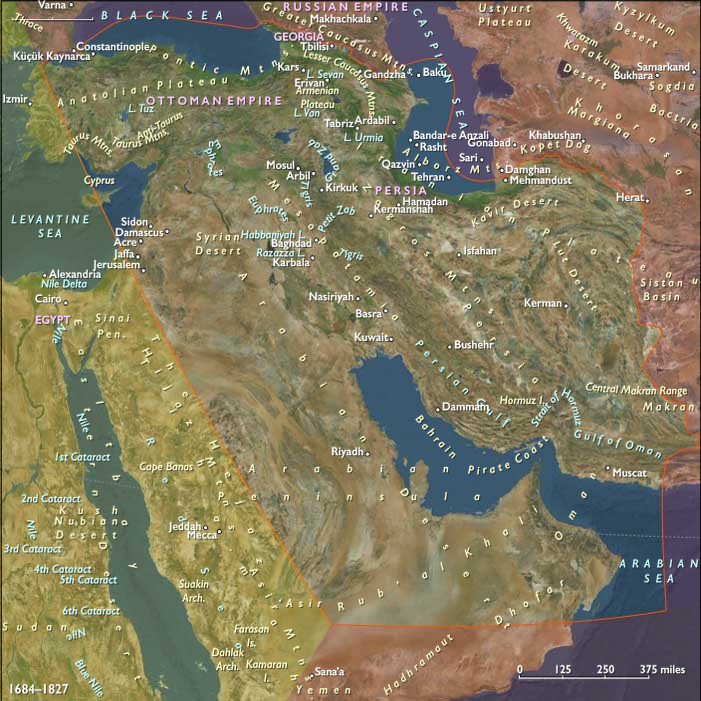
The city of Tabriz is in 1724–1725 again occupied by the Ottomans, who massacre two hundred thousand of its inhabitants.
The city will be later retaken by Persian forces.
The Ottoman Empire, backed by Britain, disputes Russia’s Caspian Sea acquisitions.
The confrontation threatens to blow up into a direct Russo-Turkish war, but this is avoided by the Treaty of Constantinople of 1724, by which the Ottomans receive western Persia (occupying Tabriz, ...
...Kermanshah, and ...
...the Russians, northern Persia (holding three Caspian regions and captured territories.)
This is perhaps the first such imposition of precise boundaries by European powers on an Islamic state.
Tahmasp II, as the representative of the ousted Safavid dynasty, controls the provinces of Mazandaran and ...
Years: 1725 - 1725
Locations
People
Groups
- Ottoman Empire
- Persia, Safavid Kingdom of
- Russian Empire
- Persia, Hotaki Ghilzaid Kingdom of
- Britain (United Kingdom of Great Britain and Northern Ireland)