
Hadrian romanizes the city of Jerusalem, renaming …
Years: 135 - 135
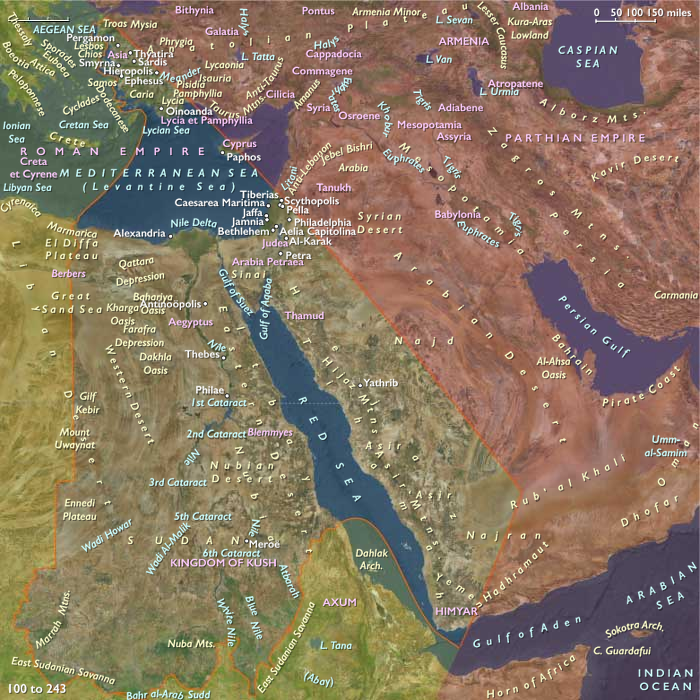
Hadrian romanizes the city of Jerusalem, renaming it Aelia Capitolina (after his first name, Aelius), and bans the Jews from entering it on pain of death, except for one day each year.
These anti-Jewish measures, which affect also Jewish Christians, is taken to ensure 'the complete and permanent secularization of Jerusalem.' (E. Mary Smallwood, The Jews under Roman rule: from Pompey to Diocletian: a study in political relations; BRILL, 1981 p.460.)
According to Eusebius, the Jerusalem church was scattered twice, in CE 70 and CE 135, with the difference that from 70-130 the bishops of Jerusalem have evidently Jewish names, whereas after 135 the bishops of Aelia Capitolina appear to be Greeks.
Hadrian places the city's main Forum, as is standard for new Roman cities, at the junction of the main cardo and decumanus, now the location for the (smaller) Muristan.
Adjacent to the Forum, at the junction of the same cardo, and the other decumanus, Hadrian builds a large temple to the goddess Venus, which will later become the Church of the Holy Sepulcher.
Several boundary walls of Hadrian's temple, despite eleventh-century destruction, which will result in the modern Church having a much smaller footprint, have been found among the archaeological remains beneath the Church.
The city is without walls, protected by a light garrison of the Tenth Legion.
The detachment at Jerusalem, which apparently encamps all over the city’s western hill, is responsible for preventing Jews from returning to the city.
The enforcement of the ban on Jews entering Aelia Capitolina will continue until the fourth century CE.
Locations
People
Groups
- Polytheism (“paganism”)
- Jews
- Greeks, Hellenistic
- Syria (Roman Province)
- Judea (Roman province)
- Christians, Jewish
- Christians, Early
- Roman Empire (Rome): Nerva-Antonine dynasty
- Syria Palæstina, Roman province of (Judea, Samaria, and Idumea)
Topics
Commodoties
Subjects
Regions
Subregions
Related Events
Showing 10 events out of 61136 total
Years: 135 - 135
Locations
People
Groups
- Polytheism (“paganism”)
- Jews
- Greeks, Hellenistic
- Syria (Roman Province)
- Judea (Roman province)
- Christians, Jewish
- Christians, Early
- Roman Empire (Rome): Nerva-Antonine dynasty
- Syria Palæstina, Roman province of (Judea, Samaria, and Idumea)
Topics
Commodoties
Subjects
Regions
Subregions