
Hadrian, a conservative emperor more interested in …
Years: 122 - 122
Hadrian, a conservative emperor more interested in consolidating Rome’s imperial acquisitions then gaining new territory, abandons the Roman attempt to subjugate Scotland.
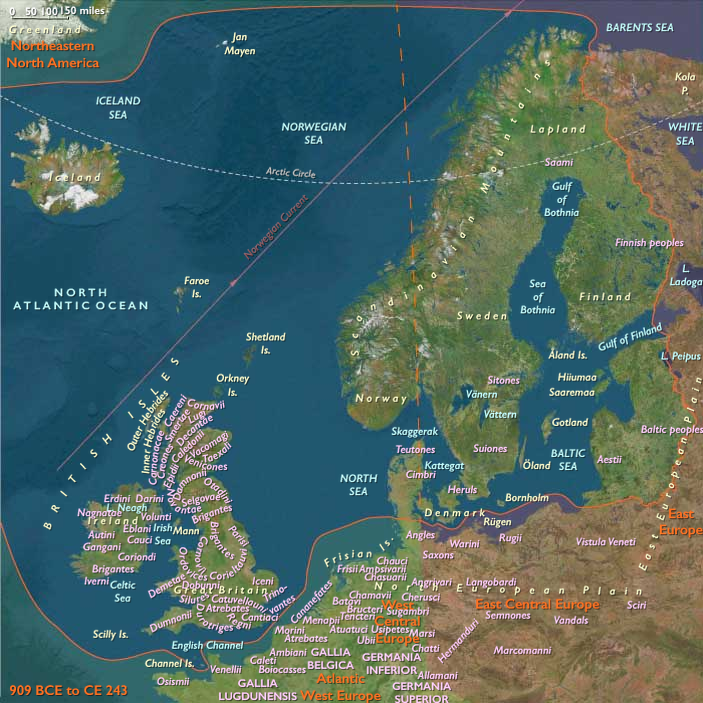
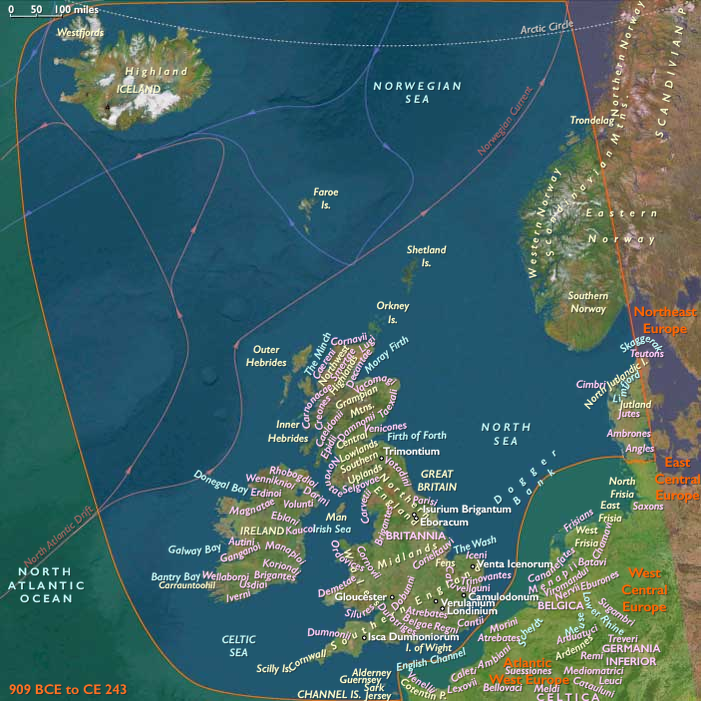
A permanent fortified wall built across northern England, to extend west from Segedunum at Wallsend on the River Tyne to the shore of the Solway Firth, was likely planned before Hadrian's visit to Britain in CE 122.
According to restored sandstone fragments found in Jarrow that date from 118 or 119, it was Hadrian's wish to keep "intact the empire," which had been imposed upon him by "divine instruction."
(Anthony Everitt [2009] Hadrian and the Triumph of Rome, Random House, Inc.); the fragments then announce the building of the wall.
It is entirely possible that, on his arrival in Britain in 122, one of the stops on his itinerary was the northern frontier and an inspection of the progress of the wall as it was being built.
Later called Hadrian’s Wall and still partially intact, it runs across northern England at its narrowest point, between the Solway Firth and the River Tyne, situating the barrier to take advantage of available high ground.
The wall, seventy-three and a half miles (one hundred and eighteen kilometers) long, 1.6 to 11.5 feet (two to three and a half meters) thick and twenty-three feet (seven meters) high, is less a defensive line than a barrier to large-scale, swift movements by hostile forces, and a defensive screen behind which the Romans can maneuver.
A ditch on either side protects both faces of the wall, some stretches of which are originally constructed of turf, but later rebuilt in stone.
Towers containing gates are built into the wall at intervals of 1 Roman mile (about 1,665 yards/1,522 meters), with two smaller turrets placed at equal distances between each pair of "mile castles."
Large forts, constructed across or adjacent to the wall, house its garrisons.
Reasons for the wall’s construction vary, as no recording of any exact explanation survives.
However, a number of theories have been presented by historians, primarily centering around an expression of Roman power and Hadrian's policy of defense before expansion.
For example, on his accession to the throne in 117, Hadrian had been experiencing rebellion in Roman Britain and from the peoples of various conquered lands across the Empire, including Egypt, Palestine, Libya, Mauretania.
These troubles may have been a factor in Hadrian's plan to construct the wall, and his construction of limes in other areas of the Empire, but to what extent is unknown.
Scholars also disagree over how much of an actual threat the sparsely populated land of northern Britannia (Scotland) actually presented, and whether there was any more economic advantage in defending and garrisoning a fixed line of defenses like the Wall over simply conquering and annexing the Scottish Lowlands and manning the territory with a loose arrangement of forts.
The limes of Rome were never expected to stop whole tribes from migrating or entire armies from invading, and while a frontier protected by a palisade or stone wall would surely help curb cattle-raiders and the incursions of other small groups, the economic viability of constructing and constantly manning a seventy-two-mile (one hundred and sixteen kilometer long boundary along a sparsely populated border to stop small-scale raiding is dubious.
Another possible explanation for the erection of the great wall is the degree of control it would have provided over immigration, smuggling, and customs.
Limes do not strictly mark the boundaries of Rome, with Roman power and influence often extending beyond its walls.
People inside and beyond the limes travel through it each day when conducting business, and organizes checkpoints like those offered by Hadrian's Wall provide good opportunities for taxation.
With watch towers only a short distance from gateways in the limes, patrolling legionaries would be able to keep track of entering and exiting natives and Roman citizens alike, charging customs dues, and checking for smuggling activity.
Locations
People
Groups
Topics
Commodoties
Subjects
- Commerce
- Engineering
- Environment
- Labor and Service
- Conflict
- Faith
- Government
- Custom and Law
- Technology
- Economics
Regions
Subregions
Related Events
Showing 10 events out of 61199 total
Years: 122 - 122
Locations
People
Groups
Topics
Commodoties
Subjects
- Commerce
- Engineering
- Environment
- Labor and Service
- Conflict
- Faith
- Government
- Custom and Law
- Technology
- Economics
Regions
Subregions