
Northern North America (1828–1971 CE): Industrial Nations, …
Years: 1828 - 1971
Northern North America (1828–1971 CE): Industrial Nations, Expanding Frontiers, and Cold War Geographies
Geography & Environmental Context
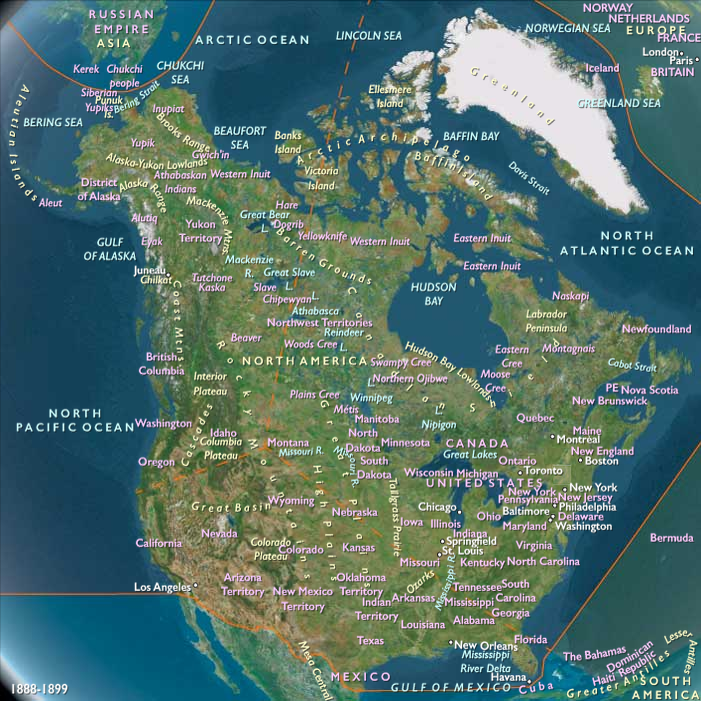
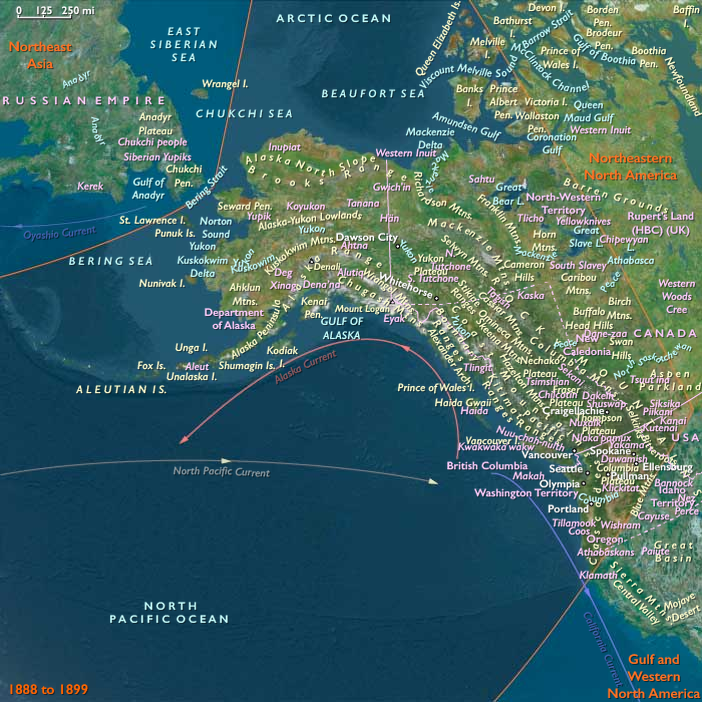
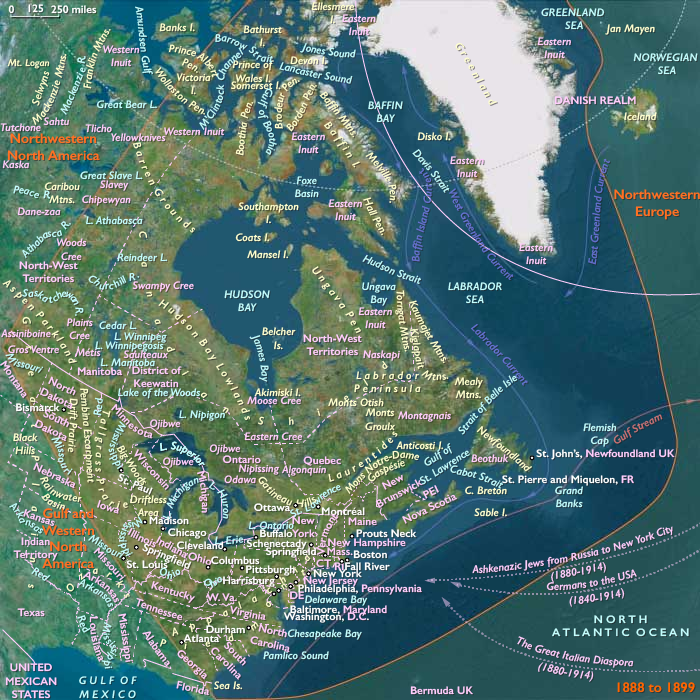
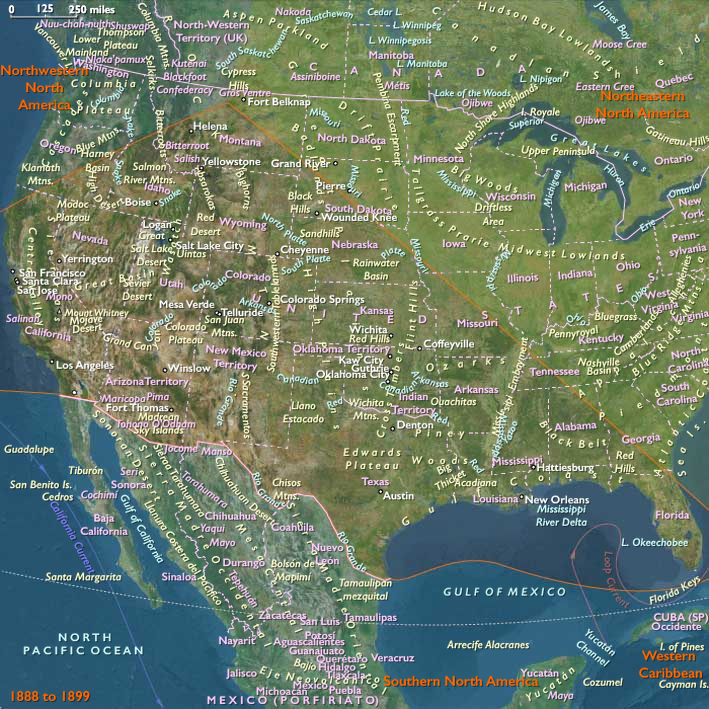
Northern North America encompasses the United States and Canada, excluding the West Indies, and divides into three subregions with fixed boundaries:
-
Northeastern North America: east of 110°W, including the Great Lakes–St. Lawrence basin, Hudson Bay, Labrador, Newfoundland, Greenland, the Atlantic seaboard from New England through Virginia, the Carolinas, and most of Georgia, as well as the Mississippi Valley north of Illinois’ Little Egypt, the Upper Missouri above the Iowa–Nebraska crossing, northeast Alabama, central and eastern Tennessee, and nearly all of Kentucky.
-
Northwestern North America: west of 110°W, including Alaska, the Yukon, British Columbia, Alberta west of 110°W, Washington, Oregon north of the Gulf line, northern Idaho, the northwestern portions of Montana, and northern California above the Gulf line.
-
Gulf and Western North America: the wedge south of the Montana diagonal, including nearly all of Florida, the lower Mississippi Valley, the southern Plains, the arid Southwest, and California south of the Oregon line.
This continental span contained Arctic tundra and boreal forest, Great Plains and Mississippi bottomlands, Appalachian and Pacific cordilleras, subtropical deltas, and Mediterranean California.
Climate & Environmental Shifts
The Little Ice Age ebbed by the mid-19th century, followed by gradual warming. Droughts and hurricanes repeatedly struck the Plains and Gulf coasts, while the Dust Bowl (1930s) devastated farms in the southern Plains. Industrial expansion brought deforestation, coal smoke, and polluted rivers, especially in the Great Lakes. Massive dams and irrigation systems — from the Hoover Dam to the St. Lawrence Seaway — transformed landscapes. Greenland’s ice and Arctic permafrost remained defining constraints, even as Cold War bases pushed into icy terrain.
Subsistence & Settlement
-
Indigenous nations: Confined to reserves and reservations, often by force, yet maintained ceremonies, farming, and mixed economies.
-
United States: Expanded westward through annexations and conquest, fought a Civil War (1861–65), and by the 20th century became a global power. Its economy diversified: cotton and tobacco in the South, corn and wheat in the Midwest, ranching on the Plains, citrus and irrigated crops in California, oil in Texas and Oklahoma, and industry in the Great Lakes and Northeast.
-
Canada: Achieved Confederation in 1867, expanded westward, and industrialized through Montreal, Toronto, and Halifax, while prairie farming drew settlers. By the mid-20th century, Canada asserted sovereignty as a bilingual, bicultural nation.
-
Greenland: Remained Danish until 1953, when it became a province; Inuit lifeways of hunting and fishing endured alongside missions, trade posts, and military installations.
Technology & Material Culture
Railways, canals, and steamships in the 19th century gave way to highways, aviation, and electronics in the 20th. Industrial mass production reshaped daily life: automobiles, telegraphs, radios, and televisions transformed communication and culture. In Alaska, British Columbia, and the Pacific Northwest, salmon canneries, sawmills, and oil pipelines redefined economies. Skyscrapers rose in New York, Chicago, and Los Angeles; Hollywood studios and aerospace plants symbolized Gulf & Western modernity. Inuit and Native traditions — from totem carving to powwows and drum dances — persisted, often underground, before revival by the mid-20th century.
Movement & Interaction Corridors
-
Rivers & canals: The Mississippi remained a backbone; the St. Lawrence Seaway (1959) linked Great Lakes industry to the Atlantic.
-
Overland trails & railways: Oregon and Santa Fe Trails gave way to transcontinental railroads, highways, and pipelines.
-
Maritime & global trade: Gulf ports tied into the Caribbean and Atlantic; California ports linked to Asia. The Panama Canal (1914) fused Gulf and Pacific economies.
-
Air & Cold War routes: Alaska became an airbridge to Asia in WWII; DEW Line radar stations made the Arctic a Cold War front line.
Cultural & Symbolic Expressions
-
Indigenous resilience: Ceremonies, art, and oral traditions preserved identity under dispossession; 20th-century activism began cultural resurgence.
-
African American culture: From the Gulf South arose blues, jazz, and gospel — later shaping global music.
-
Mexican American communities: In Texas, New Mexico, Arizona, and California, bilingual and Catholic traditions defined regional life.
-
National mythologies: The “Wild West,” the frontier, and the wilderness became symbolic narratives in both nations. Hollywood, national parks, and skyscrapers embodied progress and identity.
-
Greenland Inuit: Hunting songs, carvings, and drum dances blended with Lutheranism and Cold War geopolitics.
Environmental Adaptation & Resilience
-
Farming: Mechanization and fertilizers boosted yields but stressed soils; Dust Bowl crises spurred conservation.
-
Water control: Dams, aqueducts, and irrigation turned deserts into farmland but altered ecosystems.
-
Conservation: National parks and wildlife laws reflected emerging ecological awareness.
-
Urban resilience: Cities rebuilt after fires, earthquakes, and storms; suburbs spread after WWII.
Political & Military Shocks
-
United States: Expanded via wars with Mexico (1846–48) and Native nations; fought a Civil War; emerged from two World Wars as a superpower; became a Cold War leader.
-
Canada: Consolidated federation, expanded to the Pacific, and by the 20th century gained full sovereignty from Britain.
-
Greenland: Shifted from colony to province of Denmark, with U.S. military bases central to Cold War defense.
-
Indigenous dispossession: Trail of Tears, Plains wars, reservations, and residential schools inflicted deep trauma, yet mid-20th-century activism laid groundwork for revival.
Transition
Between 1828 and 1971, Northern North America transformed into a continent of industrial democracies, resource frontiers, and Cold War battlegrounds. The United States emerged as a global superpower; Canada matured into a sovereign federation; Greenland became strategically vital. Indigenous, African American, and Mexican American communities endured dispossession and marginalization but defined much of the continent’s cultural vitality. By 1971, the subregion was at once an engine of global industry, a crucible of diverse identities, and a geopolitical frontier, carrying into the late 20th century the legacies of expansion, exploitation, resilience, and renewal.
People
Groups
- Georgia, State of (U.S.A.)
- United States of America (US, USA) (Washington DC)
- Louisiana, State of (U.S.A.)
- Mississippi, State of (U.S.A.)
- Texas, Mexican
- Alabama, State of (U.S.A.)
- Texas, Republic of
- Texas, State of (U.S.A.)
- Alabama, State of (U.S.A.)
- California, State of (U.S.A.)
- Nevada, State of (U.S.A.)
- Arizona, State of (U.S.A.)
- United Farm Workers of America
- American Indian Movement (AIM)
Topics
- Indian Wars in Upper North America
- Texas Revolution or Texas War of Independence
- Trail of Tears, Cherokee
- “Manifest Destiny” and American Expansion; 1840-1851
- Mexican-American War
- American Civil War (War between the States, War of the Rebellion, War of Secession, War for Southern Independence)
- American Civil War & Reconstruction; 1864 through 1875
- Red River War
- Great Sioux War of 1876
- Great Migration
- World War, First (World War I)
- Dust Bowl
- World War, Second (World War II)
- American Civil Rights Movement
- Vietnam War, or Second Indo-China War
Commodoties
Subjects
- Performing Arts
- Environment
- Labor and Service
- Government
- Custom and Law
- Aeronautics
- political movement
- social movements
Regions
Subregions
Years: 1828 - 1971
People
Groups
- Georgia, State of (U.S.A.)
- United States of America (US, USA) (Washington DC)
- Louisiana, State of (U.S.A.)
- Mississippi, State of (U.S.A.)
- Texas, Mexican
- Alabama, State of (U.S.A.)
- Texas, Republic of
- Texas, State of (U.S.A.)
- Alabama, State of (U.S.A.)
- California, State of (U.S.A.)
- Nevada, State of (U.S.A.)
- Arizona, State of (U.S.A.)
- United Farm Workers of America
- American Indian Movement (AIM)
Topics
- Indian Wars in Upper North America
- Texas Revolution or Texas War of Independence
- Trail of Tears, Cherokee
- “Manifest Destiny” and American Expansion; 1840-1851
- Mexican-American War
- American Civil War (War between the States, War of the Rebellion, War of Secession, War for Southern Independence)
- American Civil War & Reconstruction; 1864 through 1875
- Red River War
- Great Sioux War of 1876
- Great Migration
- World War, First (World War I)
- Dust Bowl
- World War, Second (World War II)
- American Civil Rights Movement
- Vietnam War, or Second Indo-China War
Commodoties
Subjects
- Performing Arts
- Environment
- Labor and Service
- Government
- Custom and Law
- Aeronautics
- political movement
- social movements
Regions
Subregions