
Gulf and Western North America (1684–1827 …
Years: 1684 - 1827
Gulf and Western North America (1684–1827 CE): Missions, Revolts, and Expanding Frontiers
Geographic & Environmental Context
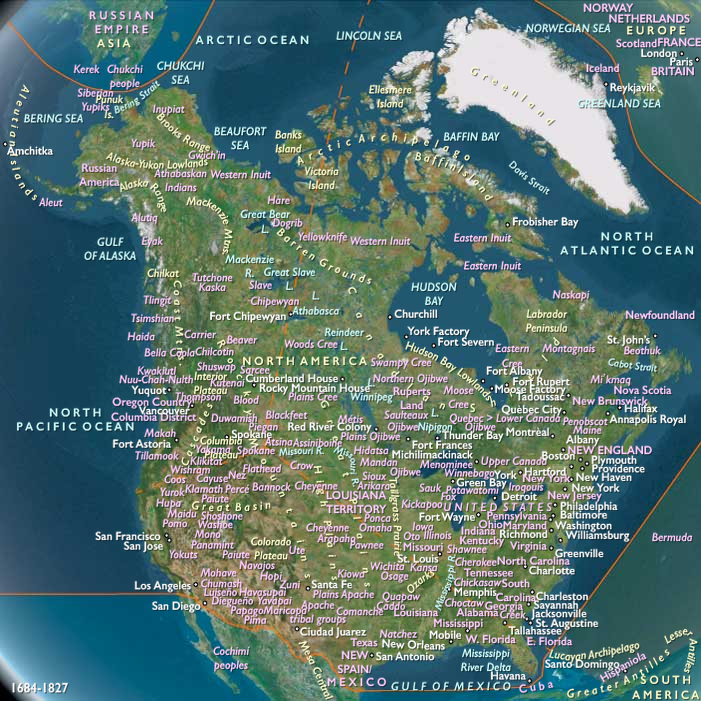
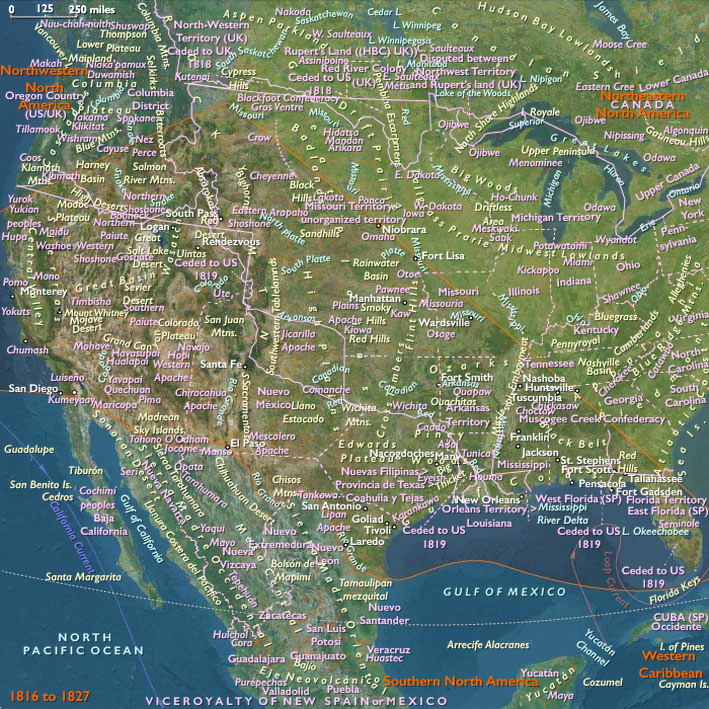
The subregion of Gulf and Western North America includes Mississippi, Louisiana, Arkansas, Texas, Oklahoma, Kansas, New Mexico, Colorado, Wyoming, Arizona, Utah, Nevada, nearly all of California (except the far northwest), nearly all of Florida (except the extreme northeast), southwestern Georgia, most of Alabama, southwestern Tennessee, southern Illinois, southwestern Missouri, most of Nebraska, southeastern South Dakota, southern Montana, southern Idaho, and southeastern Oregon. Anchors included the lower Mississippi delta, the Rio Grande valley, the Sonoran and Chihuahuan deserts, and the California coast.
Climate & Environmental Shifts
The Little Ice Age persisted into the 18th century, bringing cooler winters and drought cycles to the Southwest. Hurricanes periodically devastated Gulf settlements. California’s Mediterranean climate sustained oak groves, salmon runs, and estuaries, but aridity in deserts stressed irrigation systems.
Subsistence & Settlement
-
Puebloans continued irrigated farming of maize, beans, and squash, though Spanish tribute demands strained resources.
-
Navajo and Apache adopted horses and expanded raiding economies.
-
Plains peoples increasingly relied on mounted bison hunting, reshaping lifeways.
-
California tribes harvested acorns, fish, and game; in the late 1700s, Spanish missions sought to convert and settle them under forced labor.
-
Spanish colonists established missions, presidios, and ranches in Florida, Texas, New Mexico, Arizona, and California; French Louisiana (founded 1699) grew around New Orleans and the Mississippi delta. After 1763, Louisiana passed to Spain, then back to France, and was sold to the United States in 1803.
Technology & Material Culture
Adobe pueblos, irrigation canals, and kivas persisted. Indigenous horse culture flourished on the Plains. Spanish introduced stone churches, presidios, iron tools, firearms, and livestock. California’s missions of Junípero Serra embodied a distinctive architectural and cultural imprint.
Movement & Interaction Corridors
-
Spanish missions and presidios extended along the Rio Grande, into Texas, and along California’s coast.
-
French traders in Louisiana used the Mississippi as a highway of exchange.
-
Indigenous horse trade moved animals across the Plains.
-
The Gulf Coast and Caribbean funneled silver, hides, and grain into global markets.
Cultural & Symbolic Expressions
-
Pueblo rituals of kachina dances endured underground after the Pueblo Revolt of 1680, the largest Indigenous uprising of colonial North America.
-
Southeastern Green Corn ceremonies persisted despite missionization.
-
California tribes blended Indigenous ritual with Catholic festivals in mission contexts.
-
Spanish Catholicism dominated mission landscapes; French Catholic culture shaped Louisiana.
Environmental Adaptation & Resilience
Indigenous communities resisted or adapted to mission labor, relocated settlements, and integrated horses for mobility and hunting. Colonists diversified economies through ranching, farming, and coastal trade. Hurricanes, droughts, and epidemics tested resilience, but hybrid lifeways sustained survival.
Transition
By 1827 CE, Gulf and Western North America was a patchwork: Spanish missions, French legacies, Indigenous nations, and expanding U.S. frontiers. Horses, guns, and new crops had remade societies, while epidemics and conquest inflicted loss. Yet resilience persisted in Pueblo villages, Plains bison hunts, and California’s tribal memory.
People
Groups
- Osage Nation (Amerind tribe)
- Caddo (Amerind tribe)
- Dakota, aka Santee Sioux (Amerind tribe)
- Lakota, aka Teton Sioux (Amerind tribe)
- Kiowa people (Amerind tribe)
- Cheyenne people (Amerind tribe)
- Crow people, aka Absaroka or Apsáalooke (Amerind tribe)
- Spanish Florida
- France, (Bourbon) Kingdom of
- Comanche (Amerind tribe)
- England, (Stewart, Restored) Kingdom of
- Louisiana (New France)
- England, (Orange and Stewart) Kingdom of
- Texas, Spanish
- Spain, Bourbon Kingdom of
- Seminole (Amerind tribe)
- Louisiana (New France)
- England, (Stuart) Kingdom of
- Britain, Kingdom of Great
- Louisiana (New France)
- Louisiana (New France)
- Louisiana (British colony)
- West Florida
- Louisiana (Spanish colony)
- Spanish Florida
- United States of America (US, USA) (Washington DC)
- Britain (United Kingdom of Great Britain and Ireland)
- Louisiana (French colony)
- Louisiana, District of (U.S.A.)
- Louisiana, Territory of (U.S.A.)
- Louisiana, State of (U.S.A.)
- Texas, Mexican
- Florida, Territory of (U.S.A.)
- Coahuila y Tejas (Coahuila and Texas)
Topics
- Age of Discovery
- Colonization of the Americas, Spanish
- North American Fur Trade
- Seminole War, First
- Seminole Wars
Commodoties
Subjects
- Commerce
- Watercraft
- Public health
- Labor and Service
- Fashion
- Conflict
- Exploration
- Government
- Human Migration
Regions
Subregions
Related Events
Showing 10 events out of 30218 total
Years: 1684 - 1827
People
Groups
- Osage Nation (Amerind tribe)
- Caddo (Amerind tribe)
- Dakota, aka Santee Sioux (Amerind tribe)
- Lakota, aka Teton Sioux (Amerind tribe)
- Kiowa people (Amerind tribe)
- Cheyenne people (Amerind tribe)
- Crow people, aka Absaroka or Apsáalooke (Amerind tribe)
- Spanish Florida
- France, (Bourbon) Kingdom of
- Comanche (Amerind tribe)
- England, (Stewart, Restored) Kingdom of
- Louisiana (New France)
- England, (Orange and Stewart) Kingdom of
- Texas, Spanish
- Spain, Bourbon Kingdom of
- Seminole (Amerind tribe)
- Louisiana (New France)
- England, (Stuart) Kingdom of
- Britain, Kingdom of Great
- Louisiana (New France)
- Louisiana (New France)
- Louisiana (British colony)
- West Florida
- Louisiana (Spanish colony)
- Spanish Florida
- United States of America (US, USA) (Washington DC)
- Britain (United Kingdom of Great Britain and Ireland)
- Louisiana (French colony)
- Louisiana, District of (U.S.A.)
- Louisiana, Territory of (U.S.A.)
- Louisiana, State of (U.S.A.)
- Texas, Mexican
- Florida, Territory of (U.S.A.)
- Coahuila y Tejas (Coahuila and Texas)
Topics
- Age of Discovery
- Colonization of the Americas, Spanish
- North American Fur Trade
- Seminole War, First
- Seminole Wars
Commodoties
Subjects
- Commerce
- Watercraft
- Public health
- Labor and Service
- Fashion
- Conflict
- Exploration
- Government
- Human Migration
Regions
Subregions