
Gulf and Western North America (1696–1707 CE): …
Years: 1696 - 1707
Gulf and Western North America (1696–1707 CE): Indigenous Migrations, Colonial Expansion, and Cultural Exchange
Indigenous Peoples and Horse Culture on the Plains
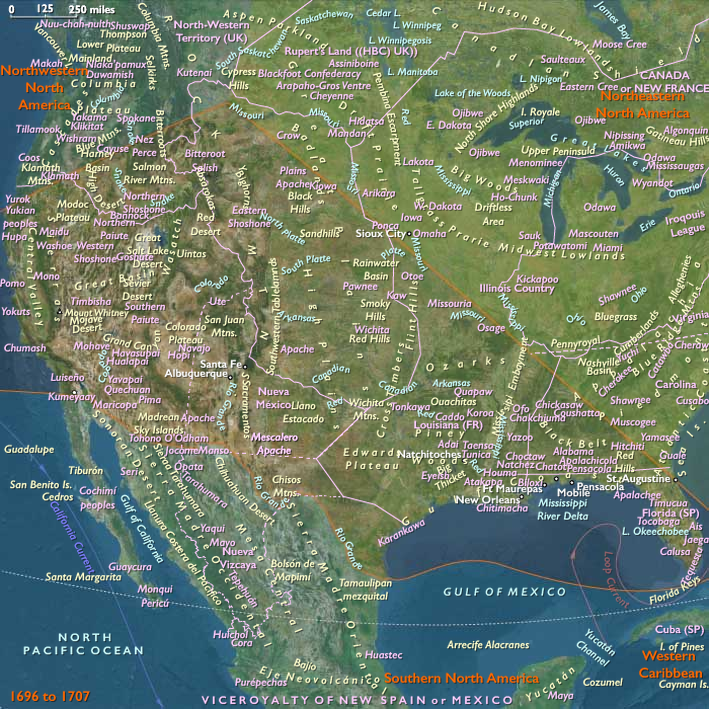
By the late seventeenth century, diverse indigenous groups occupied distinct ecological niches across the Great Plains. The Algonquian-speaking Blackfeet, having migrated from the forests north of Lake Winnipeg, and the Uto-Aztecan-speaking southern Shoshone—who would become known as the Comanches after migrating from around Utah’s Great Salt Lake—were the only non-agricultural groups in this expansive region.
Agricultural tribes including the Mandan and Hidatsa had established semi-permanent villages along the Missouri River. Other Plains agriculturists, notably ancestors of the Caddo, Wichita, Pawnee, and the Arikara (the latter having recently diverged from the Pawnee), maintained village-based agriculture while gradually adopting the emerging equestrian culture.
Kiowas, primarily residing in northern Texas, Oklahoma, and eastern New Mexico, facilitated the spread of equestrian culture by trading horses to the Wichita, and later to the Cheyenne and Arapaho peoples. Similarly, the Utes traded horses to the Wyoming-based Shoshoni, who then passed these horses on to the recently separated Absaroke (Crow) and tribes of the southern Columbia Plateau, including the Nez Perce, Cayuse, and Palouse.
French and Spanish Colonial Rivalries
European claims in North America intensified, with France, Spain, and England consolidating their territories and competing fiercely. French explorers, notably Jean Baptiste Le Moyne, Sieur de Bienville, joined his brother Pierre Le Moyne d'Iberville to establish the colony of Louisiana. In 1699, they explored the Gulf of Mexico coast, discovering the Chandeleur Islands, Cat Island, and Ship Island, eventually ascending the Mississippi River to present-day Baton Rouge and False River.
Iberville founded the colony's first settlement, Fort Maurepas (present-day Ocean Springs, Mississippi), appointing Sauvolle de la Villantry as governor and Bienville as his lieutenant. Following Iberville’s return to France, Bienville established Fort de la Boulaye in 1700 on the Mississippi River and assumed governance after Sauvolle's death in 1701, initiating the first of his four terms as governor of Louisiana.
In response, Spain reinforced its Gulf Coast presence by establishing a garrison at Pensacola in 1696, setting the foundation for Florida's future capital. Meanwhile, in present-day New Orleans, natives had already established a critical portage between the Mississippi River and Bayou St. John (Bayouk Choupique), leading into Lake Pontchartrain. The integration of native and French settlements around this strategic portage laid the groundwork for what would eventually become the city of New Orleans, a pivotal economic and cultural hub.
Cultural and Religious Encounters in the Lower Mississippi Valley
French Catholic missionaries arrived among the lower Mississippi tribes, including the Taensa, Tunica, and Natchez, around 1699. These tribes, maintaining advanced agricultural societies and sophisticated ceremonial traditions, lived in significant villages featuring large structures often described by Europeans as earth-walled buildings, likely constructed of wattle-and-daub and cane mats.
The Taensa, noted for hierarchical social structures and complex religious practices involving ceremonial sacrifice, experienced devastating losses from European-introduced smallpox around 1700. Continuous raids by the Yazoo and Chickasaw, seeking captives for the English slave trade, further pressured the Taensa, who eventually relocated southwards and became embroiled in conflicts with other indigenous groups, including the Bayogoula and Houma.
Similarly, the French established missions among the Tunica and neighboring tribes (Koroa, Yazoo, Mosopelea) near the mouth of the Yazoo River around 1700. These tribes were distinctive for their complex religious practices and economic roles as middlemen in salt trade between Caddoan groups and the French settlers. During this era, the Chickasaw intensified slave raids, significantly impacting the Tunica, Taensa, and Quapaw populations along the lower Mississippi.
English-Spanish Conflicts in Florida
The early years of Queen Anne’s War saw intense English-Spanish rivalries, notably the English capture and burning of the Spanish town of St. Augustine, Florida in 1702. Although the main fortress withstood English assault, the surrounding settlement suffered extensive damage, marking the campaign as an English military failure. However, these hostilities devastated the Spanish mission system in Florida, culminating tragically in the Apalachee Massacre of 1704, effectively decimating the Apalachee tribe and destabilizing Spanish influence in the region.
Formation and Migration of the Crow Tribe
A distinct group from the Hidatsa villages along the Knife and Heart Rivers (present-day North Dakota) migrated westward between 1675 and 1700. Settling along the lower Yellowstone River in present-day Montana, these "proto-Crow" established initial residences primarily in tipis, indicating early stages of their transformation into a buffalo-hunting society. The Crow maintained connections and cultural exchanges with neighboring tribes such as the Kiowa and Arapaho, with whom they shared significant ceremonial practices and sacred objects, including the powerful Tai-may figure central to the Kiowa Sun Dance.
Key Historical Developments
-
French establishment of the Louisiana colony and early settlements (Fort Maurepas, Fort de la Boulaye).
-
Spanish response through fortified settlements at Pensacola.
-
Cultural and religious exchanges and conflicts among indigenous tribes in the Lower Mississippi Valley.
-
Intensification of slave raids and intertribal conflicts triggered by European demand.
-
English-Spanish military confrontations severely impacting Florida's indigenous communities and Spanish colonial infrastructure.
-
Formation and migration of the Crow tribe and cultural exchanges among Plains tribes.
Long-Term Consequences and Historical Significance
The era 1696–1707 marked intensified European rivalries, indigenous cultural adaptations, and significant demographic shifts due to disease, warfare, and slave raiding. These developments critically reshaped the sociopolitical landscape, laying the foundations for subsequent European territorial claims and indigenous responses across Gulf and Western North America.
People
- Jean-Baptiste Le Moyne de Bienville
- Pierre Le Moyne d’ Iberville
- René Robert Cavalier, Sieur de La Salle
Groups
- Chumash people
- Wichita, or Kitikitish (Amerind tribe)
- Christians, Roman Catholic
- Natchez (Amerind tribe)
- Tocobaga
- Karankawa (Amerind tribe)
- Apalachee (Amerind tribe)
- Houma people (Amerind tribe)
- Koroa (Amerind tribe)
- Taensa (Amerind tribe)
- Yavapai (Amerind tribe)
- Yokuts
- Mohave people
- Jicarilla Apache
- Mescalero
- Chiricahua
- Western Apache
- Luiseño
- Leon-Jefferson culture
- Acoma Pueblo
- Chickasaw (Amerind tribe)
- Mosopelea, or Ofo (Amerind tribe)
- Eight Northern Pueblos (Amerind tribal confederation)
- Apache (Na-Dené tribe)
- Navajo people (Na-Dené tribe)
- Quapaw, or Arkansas (Amerind tribe)
- Omaha (Amerind tribe)
- Pawnee (Amerind tribe)
- Caddo (Amerind tribe)
- Timucua (Amerind tribe)
- Tunica people
- Arikara people (Amerind tribe)
- Mandan (Amerind tribe)
- Hidatsa people (Amerind tribe)
- Shoshone, Shoshoni, or Snakes (Amerind tribe)
- Ute (Amerind tribe)
- Blackfoot Confederacy
- Crow people, aka Absaroka or Apsáalooke (Amerind tribe)
- Cheyenne people (Amerind tribe)
- Arapaho people (Amerind tribe)
- Nez Perce (Amerind tribe)
- Iowa (Amerind tribe)
- Ponca (Amerind tribe)
- Cayuse people (Amerind tribe)
- Palus, or Palouse (Amerind tribe)
- Lipan Apache people (Amerind tribe)
- Plains Apache, or Kiowa Apache; also Kiowa-Apache, Naʼisha, Naisha (Amerind tribe)
- Yazoo (Amerind tribe)
- Santo Domingo, Real Audiencia de
- Spanish Florida
- New France (French Colony)
- New Spain, Viceroyalty of
- Spain, Habsburg Kingdom of
- Apalachee Province
- France, (Bourbon) Kingdom of
- Santa Fe de Nuevo México (Spanish Colony)
- England, (Stewart, Restored) Kingdom of
- Illinois Country
- England, (Orange and Stewart) Kingdom of
Topics
- Age of Discovery
- Colonization of the Americas, Spanish
- Colonization of the Americas, French
- Colonization of the Americas, English
- Queen Anne's War
- Apalachee massacre
Commodoties
Subjects
Regions
Subregions
Related Events
Showing 10 events out of 693 total
Years: 1696 - 1707
People
- Jean-Baptiste Le Moyne de Bienville
- Pierre Le Moyne d’ Iberville
- René Robert Cavalier, Sieur de La Salle
Groups
- Chumash people
- Wichita, or Kitikitish (Amerind tribe)
- Christians, Roman Catholic
- Natchez (Amerind tribe)
- Tocobaga
- Karankawa (Amerind tribe)
- Apalachee (Amerind tribe)
- Houma people (Amerind tribe)
- Koroa (Amerind tribe)
- Taensa (Amerind tribe)
- Yavapai (Amerind tribe)
- Yokuts
- Mohave people
- Jicarilla Apache
- Mescalero
- Chiricahua
- Western Apache
- Luiseño
- Leon-Jefferson culture
- Acoma Pueblo
- Chickasaw (Amerind tribe)
- Mosopelea, or Ofo (Amerind tribe)
- Eight Northern Pueblos (Amerind tribal confederation)
- Apache (Na-Dené tribe)
- Navajo people (Na-Dené tribe)
- Quapaw, or Arkansas (Amerind tribe)
- Omaha (Amerind tribe)
- Pawnee (Amerind tribe)
- Caddo (Amerind tribe)
- Timucua (Amerind tribe)
- Tunica people
- Arikara people (Amerind tribe)
- Mandan (Amerind tribe)
- Hidatsa people (Amerind tribe)
- Shoshone, Shoshoni, or Snakes (Amerind tribe)
- Ute (Amerind tribe)
- Blackfoot Confederacy
- Crow people, aka Absaroka or Apsáalooke (Amerind tribe)
- Cheyenne people (Amerind tribe)
- Arapaho people (Amerind tribe)
- Nez Perce (Amerind tribe)
- Iowa (Amerind tribe)
- Ponca (Amerind tribe)
- Cayuse people (Amerind tribe)
- Palus, or Palouse (Amerind tribe)
- Lipan Apache people (Amerind tribe)
- Plains Apache, or Kiowa Apache; also Kiowa-Apache, Naʼisha, Naisha (Amerind tribe)
- Yazoo (Amerind tribe)
- Santo Domingo, Real Audiencia de
- Spanish Florida
- New France (French Colony)
- New Spain, Viceroyalty of
- Spain, Habsburg Kingdom of
- Apalachee Province
- France, (Bourbon) Kingdom of
- Santa Fe de Nuevo México (Spanish Colony)
- England, (Stewart, Restored) Kingdom of
- Illinois Country
- England, (Orange and Stewart) Kingdom of
Topics
- Age of Discovery
- Colonization of the Americas, Spanish
- Colonization of the Americas, French
- Colonization of the Americas, English
- Queen Anne's War
- Apalachee massacre
Commodoties
Subjects
Regions
Subregions